Virtual Banking for Global and High Risk Payment Processing
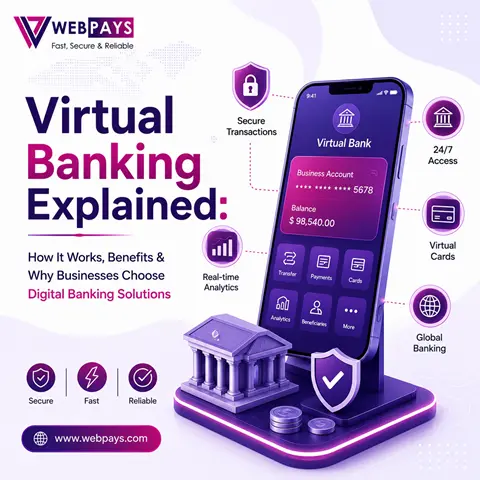
Managing business finances no longer depends on visiting a bank branch or handling every payment manually. Businesses can now manage accounts, collect payments, send funds, monitor transactions and connect financial operations to other systems through digital banking infrastructure
Virtual banking is an important part of this shift. It can give businesses access to virtual accounts, digital payment tools, multi-currency capabilities and automated transaction management through online platforms and APIs.
For companies working across borders, handling large payment volumes, or operating in industries that face additional banking restrictions, the right virtual banking infrastructure can make financial operations easier to manage. However, virtual banking is not a replacement for a merchant account, payment gateway or acquiring relationship. Each serves a different purpose within the payment ecosystem.
What Is Virtual Banking?
Virtual banking refers to banking and financial services delivered primarily through digital platforms rather than physical branches. Depending on the provider, businesses may access account management, payment collection, transfers, currency conversion, reporting and API-based financial services through a web dashboard or integrated system.
A virtual account is commonly used as a unique account identifier connected to an underlying banking or payment structure. It can help identify where a payment came from, separate transaction flows and automate reconciliation without requiring a separate traditional bank account for every customer or business unit.
For businesses, this can be particularly useful when multiple customers, invoices, markets or payment channels need to be tracked within one financial operation.
How Virtual Banking Works - Step by Step
The exact setup varies between providers, but a typical virtual banking arrangement works through several stages:
- Account onboarding - The business applies with a virtual banking or financial services provider and completes the required business verification and due-diligence checks.
- Virtual account creation - The provider may issue one or more virtual account numbers or other payment identifiers. These can be assigned to customers, invoices, departments, currencies or specific payment flows.
- Payment collection - A customer or business partner sends funds using the account details supplied by the merchant. The payment is associated with the relevant virtual account or reference.
- Transaction identification - The virtual account structure helps identify the payer, amount, reference and other available transaction information.
- Reconciliation - Businesses can use this information to match incoming funds with invoices, orders, customers or internal records. API and webhook integrations can reduce the need for manual reconciliation.
- Transfers and payouts - Depending on the provider and supported payment rails, businesses can initiate transfers, supplier payments, refunds or other disbursements through a digital platform.
- Currency management - Some providers support multiple currencies, allowing businesses to receive, hold or convert funds according to the services and jurisdictions supported by the provider.
The available features, settlement times and currencies depend on the banking partners, payment rails, regulatory framework and country involved.
Why Virtual Banking Can Help High Risk Businesses
Businesses classified as high risk can face additional challenges when establishing banking and payment relationships. Factors such as industry type, chargeback exposure, regulatory requirements, transaction patterns and geographic markets can affect how banks and payment providers assess an account.
Virtual banking can provide useful infrastructure for these businesses, particularly when financial operations involve multiple payment flows.
Transaction Segregation
Virtual accounts can help separate payments by customer, market, product or business unit. This gives finance teams a clearer view of where money is coming from and makes transaction reconciliation easier.
Better Transaction Visibility
Digital dashboards and automated reporting can provide a centralized view of incoming and outgoing payments. This can be useful when finance teams need to investigate a transaction or prepare records for an internal or compliance review.
Automated Reconciliation
High-volume businesses can quickly accumulate thousands of payment records. Matching each payment manually can consume significant administrative time. Virtual account structures and API integrations can help automate this process.
Multi-Currency Operations
Businesses serving international customers may need to manage several currencies. Where supported, virtual banking can provide access to local or international account details and currency conversion services through one platform.
Fraud and Transaction Monitoring
Some providers offer additional monitoring capabilities, such as transaction alerts, velocity checks or other fraud-control tools. These features can help businesses identify unusual payment activity, although no banking structure eliminates fraud risk completely.
Operational Scalability
A business may need different payment identifiers as its customer base or transaction volume grows. API-enabled virtual account systems can support the creation and management of multiple accounts without requiring a conventional bank relationship for every individual payment flow.
Virtual banking therefore works best as part of a broader financial infrastructure rather than as a standalone solution to every high-risk payment challenge.
What Makes a Business High Risk?
High risk is generally a financial and operational classification rather than a judgment about whether a business is legitimate. Banks and payment providers may consider factors such as:
- Higher-than-average chargeback exposure
- Regulatory complexity
- Subscription or recurring billing models
- The countries in which customers are located
- The nature of the products or services
- Higher fraud exposure
- Licensing requirements
- Previous processing history
- Transaction volume and ticket size
Industries sometimes classified as high risk can include gambling, adult services, forex, cryptocurrency, nutraceuticals and other businesses subject to additional processing or regulatory considerations.
Classification varies between financial institutions and payment providers. A business should therefore confirm the eligibility criteria of a provider rather than assuming that every provider applies the same risk policy.
What Should You Look for in a Virtual Account Provider?
Choosing a virtual banking provider requires more than comparing account-opening speed or transaction fees.
Regulatory and Compliance Framework
Understand which entity provides the service, where it operates and which regulatory framework applies. Businesses should also understand the provider's KYC, KYB, AML and transaction-monitoring requirements.
Supported Currencies and Countries
If your customers are international, check whether the provider supports the currencies and payment corridors your business actually needs.
Reconciliation Features
Look for transaction references, reporting tools, API access and other features that can reduce manual accounting work.
Payment and Transfer Limits
Review daily, monthly and per-transaction limits before onboarding. A solution suitable for a small business may not be appropriate for a high-volume merchant.
Fees and Reserves
Look beyond the headline transaction fee. Consider currency conversion charges, transfer fees, account fees and any reserve or settlement conditions that may apply.
Support
Businesses operating in complex payment environments may need access to knowledgeable account support rather than a basic ticketing system.
Security Controls
Review available authentication, user permissions, transaction alerts and other security controls. Businesses should also understand how sensitive financial information is protected.
Virtual Banking vs Online Banking
Virtual banking and online banking are often used interchangeably, but they are not necessarily the same thing.
Online banking usually refers to the digital interface provided by a traditional bank. Customers can use a website or mobile application to check balances, make transfers, view statements and manage an existing bank account.
Virtual banking generally refers to financial services built around digital infrastructure. Depending on the provider, this may include virtual accounts, APIs, automated reconciliation, multi-currency services and digital payment management.
The distinction becomes more relevant for businesses with international operations.
| Feature | Online Banking | Virtual Banking |
|---|---|---|
| Account management | Yes | Yes |
| API integration | Depends on bank | Common in business-focused solutions |
| Automated reconciliation | Usually limited | Often a core feature |
| Multiple virtual accounts | Limited or unavailable | Often supported |
| International payments | Available depending on bank | Often designed for cross-border use |
| Physical branch | May be part of banking model | Usually not required for access |
| Business automation | Varies | Highly scalable |
| Fraud protection | Standard bank-level security | Account masking + advanced controls |
Neither option is automatically better for every business. Online banking may be perfectly adequate for straightforward banking requirements, while companies with complex payment flows may benefit from virtual account infrastructure and API-based automation.
How to Transfer Money to a Virtual Account
Transferring money to a virtual account generally follows the same basic process as a bank transfer.
Step 1: Obtain the Account Details
The recipient provides the required information. Depending on the country and payment rail, this may include an account number, bank name, routing information, IBAN or SWIFT/BIC details.
Step 2: Select the Appropriate Payment Rail
The available option depends on the sender's location and the destination. Examples include:
- ACH in the United States
- SEPA or SEPA Instant in participating European markets
- SWIFT for international transfers
- NEFT, RTGS
- UPI where applicable
- Domestic bank transfer systems
Step 3: Enter the Details Carefully
Enter the account information and payment reference exactly as provided. An incorrect account number or missing reference can delay reconciliation.
Step 4: Confirm the Payment
Review the recipient, currency and amount before authorizing the transaction.
Step 5: Track the Transfer
The recipient can monitor the payment through its banking or payment platform. Notification and settlement times vary according to the payment rail, financial institutions and jurisdictions involved.
How Virtual Accounts Support International Payments
Cross-border payments can create additional administrative work for growing businesses. Different currencies, banking systems, local payment methods and settlement processes can make financial management complicated. Virtual account infrastructure can help by bringing several payment flows into a centralized system.
For example, a business serving customers in the United States, Europe and the United Kingdom may use supported local-format account details where available, while managing the resulting transactions through one platform.
Potential advantages include:
- Easier identification of incoming payments
- Centralized transaction reporting
- Support for multiple currencies
- Automated reconciliation
- API connectivity
- Reduced dependence on manual payment tracking
However, businesses should always check the actual countries, currencies, payment rails and settlement arrangements supported by a provider. "Global" does not mean every market or currency is automatically available.
Virtual Bank Account Without KYC: What Businesses Should Know
Searches for "virtual bank account without KYC" are common, particularly among businesses looking for faster onboarding. However, businesses should understand the difference between simplified digital onboarding and completely bypassing customer verification.
KYC, or Know Your Customer, is part of the customer due-diligence process used by regulated financial institutions and payment providers. Depending on the service and jurisdiction, verification may involve:
- Identity information
- Business registration documents
- Beneficial ownership information
- Address verification
- Source-of-funds information
- Other compliance documentation
A legitimate provider may use digital onboarding to make verification faster, but faster verification does not necessarily mean no KYC.
Why Businesses Should Be Careful With No-KYC Claims
A provider offering regulated financial services will generally have compliance obligations. Businesses should therefore be cautious about services promising anonymous or completely verification-free banking. Before opening an account, check:
- Who provides the account
- The provider regulatory status
- Applicable KYC and KYB requirements
- Transaction limits
- Supported activities
- Withdrawal and settlement conditions
- The legal entity holding or safeguarding funds
For businesses processing meaningful transaction volumes, regulatory clarity is generally more important than avoiding a legitimate verification process.
Virtual Payment Address vs Virtual Bank Account
The terms VPA and VBA can sound similar, but they serve different purposes.
- What Is a Virtual Payment Address? A Virtual Payment Address, or VPA, is commonly associated with India's UPI ecosystem. It acts as an identifier that can be used to initiate a UPI payment without requiring the payer to enter traditional bank account details.
- What Is a Virtual Bank Account? A Virtual Bank Account is generally an account identifier used within a banking or payment infrastructure. Businesses can use virtual accounts to identify incoming payments, separate transaction flows and support reconciliation.
| Feature | Virtual Payment Address (VPA) | Virtual Bank Account (VBA) |
|---|---|---|
| Main ecosystem | Net Banking | Banking/payment infrastructure |
| Primary use | Simplified payment identification | Payment collection and reconciliation |
| International use | Primarily linked to supported UPI use cases | Can support international operations depending on provider |
| Business reconciliation | Basic to moderate | Often designed for detailed reconciliation |
| API use | Depends on provider | Common in business solutions |
A business serving primarily domestic UPI customers may find a VPA useful. A company managing international collections, multiple currencies or high transaction volumes may require a broader virtual account structure.
Some payment architectures can use both, with a customer-facing payment identifier connected to a wider banking or payment infrastructure.
Virtual Banking and High Risk Merchant Accounts
It is important to distinguish between virtual banking and merchant acquiring. A virtual bank account can help a business manage and reconcile funds. A merchant account and payment gateway, on the other hand, are part of the infrastructure used to accept card and other online payments.
For a high-risk merchant, the wider payment setup may involve:
Customer → Payment Gateway → Processor/Acquirer → Merchant Account → Settlement Account
Virtual banking can support the settlement and financial-management side of this ecosystem by helping businesses organize incoming funds, manage currencies, track transactions and handle payouts. It does not automatically make an otherwise unsupported business eligible for card processing.
Virtual Banking for Casino and Adult Businesses
Casino and adult businesses can face additional requirements from banks, payment providers and regulators. Licensing, customer location, transaction monitoring, chargebacks and payment-method restrictions may all need to be considered. For these businesses, virtual banking can be useful as a supporting financial layer.
Online Casino Operations
A casino operating across several approved markets may need to manage transactions in different currencies and maintain clear records for deposits, withdrawals and operational expenses.
Virtual accounts can help organize these flows where the provider and relevant financial partners support the activity. Useful capabilities may include:
- Separate payment flows by market
- Multi-currency account structures
- Detailed transaction records
- Automated reconciliation
- Payout management
- Integration with payment systems
However, payment processing must still comply with the licensing and regulatory requirements applicable to the casino and its target markets.
Adult Businesses
Adult-content businesses may also face restrictions from mainstream banking and payment providers. Recurring payments, customer disputes, age-related compliance requirements and card-network policies can make payment infrastructure more complex. A specialist financial and payment setup may help businesses manage:
- Subscription-related transactions
- Refunds and payouts
- Transaction reporting
- Multiple payment methods
- Customer payment records
- Compliance documentation
Billing descriptors, payment methods and transaction practices must always comply with the applicable provider and card-network rules.
Can Virtual Banking Reduce Chargeback Problems?
Virtual banking does not prevent chargebacks. What it can do is improve the quality and organization of transaction information available to a business.
Detailed records can help a merchant identify disputed transactions, review payment history and gather relevant documentation for a response. This may support a stronger chargeback-management process.
The outcome of a dispute still depends on factors such as the payment method, card-network rules, issuer decision, transaction evidence and the merchant's processing practices.
For high-risk businesses, chargeback management should therefore be treated as part of the broader payment strategy rather than something solved by a virtual account alone.
Key Benefits for International Businesses
For businesses managing international payment flows, virtual banking can provide several operational advantages:
- Centralized financial management: Multiple payment flows can be monitored through one digital environment.
- Improved reconciliation: Virtual identifiers and transaction references can make it easier to match payments with invoices or customers.
- Multi-currency support: Where available, businesses can manage supported currencies without establishing a separate conventional banking relationship for every market.
- API integration: Businesses can connect payment information with accounting, ERP and other internal systems.
- Better visibility: Digital reporting can give finance teams a clearer view of incoming and outgoing transactions.
- Flexible payment operations: Virtual account structures can be useful when a business needs to separate funds by customer, market or transaction type.
The actual benefits depend on the provider, banking partners, payment rails and jurisdictions involved.
How to Choose the Right Virtual Banking Solution
Before choosing a provider, businesses should look beyond the account-opening process. Ask these questions:
- Which legal entity provides the service?
- What regulatory framework applies?
- Which countries and currencies are supported?
- What are the transaction and account limits?
- How quickly are funds settled?
- Which payment rails are available?
- Are APIs and webhooks supported?
- How does transaction reconciliation work?
- What KYC/KYB documentation is required?
- What fees, conversion costs or reserves apply?
- Which industries and business activities are accepted?
- What support is available if a payment or account issue occurs?
These questions can help businesses compare providers based on their actual operational requirements instead of choosing purely on price.
Conclusion
Virtual banking represents a fundamental shift in how financial services are delivered and consumed — particularly for businesses operating in complex, high-volume, or high risk environments. Across all ten dimensions explored in this guide, the consistent theme is the same: virtual banking replaces friction, delay, and manual process with automation, speed, and control. Whether your business needs to simplify global payment collection, manage high risk merchant transactions, understand the difference between a virtual payment address and a virtual banking account, or find compliant payment solutions for a casino or adult platform, virtual banking provides the infrastructure to do it effectively.
→ Book a 15-Minute Infrastructure Consultation — discuss your industry, processing volume, and target markets with our specialist team.
Speak with the WebPays team to discuss your payment infrastructure and identify the options that fit your business model. Our specialists cover every regulated vertical — including high risk, gaming, CBD, forex, adult services, and crypto — with direct relationships across acquiring banks and open banking infrastructure providers across the UK, EU, Asia, Middle East and the United States.
Phone: +3197010280631
Email: info@webpays.com