Online Gambling Payment Processing

Online gambling is a high-risk industry, so most standard banks and processors will not approve it. Webpays provides payment processing for licensed gambling and gaming businesses, covering card acceptance, alternative payment methods, refunds and player payouts. Each setup is assessed around the merchant's licence, target markets and transaction profile. This guide explains how gambling payment processing works, what you need to apply, and how to choose a secure gateway.
Through reliable gambling-acquiring associates, we deliver you everything you require to receive and process credit card payments and pay out winning rewards smoothly and safely. Our full-featured reliable gambling payment gateway integration services are also completely customizable. And they have been ideal to provide significance and boost to your gambling business. Moreover, you can take credit and debit card payments securely and efficiently, process recurring and extended payments, handle refunds, and pay out winning amounts in easily accessible and tailored platforms.
Our payment gateway for online gambling businesses is the most suitable option for merchants who have a gambling license and can be able to run a gambling business online with all the terms and conditions and gambling laws.
What is a Gambling Merchant Account?
A gambling merchant account is a merchant account approved to accept card and other payments for gambling activity. It is different from a payment gateway. The gateway is the technology that sends payment data securely, while the merchant account is the arrangement with an acquiring bank that settles the funds. Because gambling is high-risk, these accounts are underwritten more closely and are often set up around the operator's business model. They may also be called casino merchant accounts or betting merchant accounts.
Licensed operators in these sectors typically need a gambling-approved processing solution:
There are different sorts of online gambling and casino businesses that run within the online gambling sector. So, let’s discuss some primary types of them:
- Online casinos
- Online poker
- Small lottery syndicates
- Sportsbooks & sports betting
- Online bingo and raffles
- Lottery and lottery syndicates
- Horse racing betting
- Prize draws
- Mobile gaming
- Social gaming
- iGaming platforms
and many more…
Why Is Online Gambling Considered High-Risk?
Banks and card networks treat online gambling as high-risk for five main reasons:
- Regulatory and reputational concerns: - Gambling is legal in many places, but it is also targeted for money laundering and fraud. Many operators serve players across borders, which adds compliance complexity.
- No processing history: - New operators often have no payment history, so underwriters cannot judge their risk.
- High transaction volumes: - Frequent deposits and withdrawals produce large, fast-moving volumes.
- Chargeback and dispute exposure: - Many small card payments and disputed transactions can raise chargeback ratios.
- Strict chargeback monitoring: - Card networks and acquirers set limits on chargeback ratios. Exceeding them can lead to fees, remediation programmes or account termination
How to Get a Payment Processor Gambling
Getting a payment processor for a gambling business generally starts with determining whether the business and its activities are acceptable to the acquiring and payment partners involved.
A gambling merchants should be prepared to provide information such as:
- Company registration details
- Ownership and management information
- Gambling or gaming licence information, where applicable
- Website or application details
- Description of the gambling products offered
- Target markets
- Expected monthly transaction volume
- Average deposit and withdrawal values
- Expected currencies
- Existing payment history, if available
- Chargeback and refund information
- Customer verification procedures
- Compliance and responsible-gambling processes
Payment providers and acquiring partners may conduct detailed merchant due diligence before approving an account. This is particularly important in higher-risk industries because processors need to understand the merchant, its customers, its transaction activity, and the potential risks associated with processing.
Webpays reviews each application against the operator's licence, markets and transaction profile, so the processing structure fits the actual business model instead of a generic ecommerce setup.Typical onboarding takes 2-5 working days
With Webpays, an eligible gambling business can discuss its processing requirements and provide the relevant business and compliance information for assessment. The objective is to establish a payment structure that matches the merchants actual business model instead of using a generic ecommerce setup.
What Payment Solutions Are Best for Online Casinos?
Most online casinos need a mix of card payments, local payment methods and digital wallets, matched to the countries they serve.
There is no single payment solution that is appropriate for every online casino. The right combination depends on the casino customer base, geographical coverage, licensing position, currencies, transaction values, and preferred deposit and withdrawal methods.
An online casino may need a combination of:
| Method | Best for | Consider |
| Cards (credit/debit) | Wide global reach | Chargeback risk, 3-D Secure |
| Digital wallets | Fast deposits and withdrawals | Market availability |
| Bank transfers / open banking | Higher-value payments | Settlement speed |
| Local payment methods | Specific countries | Coverage varies by market |
For casino merchants, having several payment methods can be useful because customers in different markets may have different payment preferences.
Webpays can help eligible online gambling businesses assess their payment requirements and determine which processing structure is appropriate for their operation. This approach can be particularly relevant when a casino serves customers across multiple countries and needs payment options that correspond with its target markets.
The key consideration is not simply the number of payment methods available. merchants should also consider transaction approval rates, settlement arrangements, fraud controls, chargeback management, reporting, customer experience, and regulatory requirements.
How to Implement Secure Payment Gateways in Gambling Apps
Use a hosted payment page or the processor's official API so your app never handles raw card data, and follow PCI DSS requirements.
Security should be considered from the beginning when integrating a payment gateway into a gambling application.
A typical implementation can involve a secure payment page or gateway interface where the customer selects a payment method, enters the required information, completes any necessary authentication, and receives confirmation of the transaction.
The exact integration depends on the payment provider and technical environment. Developers should follow the processor API documentation and security requirements rather than creating an independent payment flow that unnecessarily handles sensitive card information.
PCI DSS provides a baseline of technical and operational requirements for protecting payment account data and applies across entities involved in payment card processing.
Where payment functions are outsourced to a compliant third-party provider, the merchant PCI DSS responsibilities depend on how the payment environment is implemented. PCI Security Standards Council guidance notes that merchants should work with their payment service provider when implementing payment solutions securely.
For a gambling application, a secure payment implementation should consider:
- Encryption and secure communication
- Secure authentication
- Tokenization where supported
- Appropriate access controls
- Fraud monitoring
- Transaction monitoring
- Secure API integration
- Protection against malicious scripts
- Appropriate logging and monitoring
- PCI DSS responsibilities
- Customer verification requirements
Webpays can work with eligible gambling businesses to assess their payment processing requirements and determine an appropriate gateway structure for their website or application. No gateway is "most secure" on its own. Judge it on PCI DSS compliance, tokenization, 3-D Secure support, fraud and transaction monitoring, and how securely it integrates with your platform.
What Is the Most Secure Payment Gateway for an Online Gambling Site?
Security should not be judged by a single feature or marketing statement. A secure gambling payment gateway should be evaluated according to the complete payment environment, including data protection, authentication, fraud controls, transaction monitoring, integration security, compliance responsibilities, and the security practices of the businesses involved.
PCI DSS is designed to protect payment account data and covers merchants, processors, acquirers, issuers, and service providers that store, process, transmit, or can affect the security of cardholder data.
For an online gambling site, merchants should therefore examine questions such as:
- How is payment information protected?
- What authentication options are available?
- How are suspicious transactions monitored?
- How are chargebacks handled?
- How does the gateway communicate with the gambling platform?
- What security requirements apply to the merchant?
- How is access to payment information controlled?
- What happens when a transaction is declined?
- How are refunds and withdrawals managed?
This is important because payment security is not only a property of the gateway itself. The merchant's website, application, integrations, internal controls, customer authentication, and operational processes also affect the overall security of the payment environment.
How to Use Credit Card for Online Gambling
Players can use a credit card at checkout only where the operator's processor approves gambling transactions and the player's jurisdiction allows it.
Credit card acceptance for online gambling depends on the jurisdiction, gambling activity, payment network rules, acquiring arrangements, and the merchant approval status.
A gambling merchant should not assume that a standard ecommerce merchant account can automatically be used for gambling transactions. The business activity needs to be disclosed accurately during onboarding, and the processor or acquiring partner must approve the relevant business model.
For customers, the general payment flow can involve selecting credit card payment at checkout, entering the requested card information through the payment interface, completing authentication where required, and receiving a transaction confirmation.
For merchants, the process is more involved. The merchant needs an appropriate merchant account or processing arrangement that permits the relevant gambling transactions.
In the United States, the legality of internet gambling and the payment methods that can be used can depend on the applicable federal and state framework. The federal UIGEA specifically addresses payment transactions associated with unlawful internet gambling
Gambling transactions must always be disclosed and approved, never routed through a standard ecommerce account.
What Are the Best Payment Solutions for Online Gambling Platforms
Choose a mix of methods that covers your markets, supports both deposits and withdrawals, and includes fraud controls and clear reporting. Online gambling platforms often need more than one payment method because their customers may come from different countries and have different preferences.
A payment strategy can include card processing alongside alternative payment methods, local payment options, digital wallets, or other methods supported by the merchants's target markets. When evaluating payment solutions, gambling platforms should consider:
- Geographic coverage - A payment method that works well in one country may have limited usefulness in another. merchants should examine whether the payment solution supports their actual customer markets.
- Transaction acceptance - A payment gateway should provide reliable transaction processing and clear decline information so that merchants can identify payment issues and improve their payment flow.
- Deposits and withdrawals - Gambling platforms need to consider both incoming deposits and outgoing withdrawals. The payment structure should account for the merchants's complete transaction cycle.
- Fraud and risk controls - Gambling transactions can require additional monitoring because of account abuse, payment fraud, chargebacks, and unusual transaction activity.
- Reporting - Clear transaction reporting can help merchants reconcile payments, investigate disputes, monitor activity, and manage their finance operations.
- Scalability - A payment structure should be able to accommodate changes in transaction volume, customer markets, currencies, and payment methods as the gambling business develops.
Webpays provides payment processing support for eligible gambling and gaming businesses, with the payment structure assessed around the merchants requirements rather than a one-size-fits-all model.
How iGaming Payment Solutions Handle Large Jackpot Payouts
Large payouts need identity and ownership checks, transaction monitoring and clear records before funds are released. Large jackpot payouts require a payment process that is different from handling ordinary customer deposits. Before a large withdrawal is completed, merchants may need to verify the customer identity, account information, transaction history, eligibility, and other relevant requirements. The exact checks depend on the merchant licence, jurisdiction, payment method, and internal compliance procedures.
The payment infrastructure should also provide sufficient visibility over large transactions. Merchants may need reporting and transaction records that allow their finance and compliance teams to review significant payouts.
A well structured iGaming payment environment can separate the customer deposit journey from the withdrawal process while maintaining appropriate controls across both sides of the transaction. For large payouts, merchant should consider:
- Customer identity verification
- Account ownership verification
- Withdrawal limits and policies
- Transaction monitoring
- Fraud screening
- Payment method availability
- Settlement timing
- Currency conversion
- Transaction records
- Compliance requirements
Webpays can assess the payment requirements of eligible iGaming businesses and help determine an appropriate processing structure for their deposit and payout flows.
Large jackpot payments should never be treated simply as a larger version of a normal card transaction. The merchant needs a payment process that accounts for the additional financial, operational, and compliance considerations associated with significant withdrawals.
What Payment Gateway Should I Use for My Online Gambling Business?
The appropriate payment gateway depends on the specific gambling business rather than a universal provider ranking. Before choosing a gateway, a merchant should define:
- Where the business is licensed
- Which countries it intends to serve
- What gambling products it offers
- Expected transaction volume
- Average deposit amount
- Expected withdrawal volume
- Required currencies
- Preferred payment methods
- Existing chargeback levels
- Customer verification procedures
- Website or application technology
- Settlement requirements
A gambling merchant should also be transparent about its business activity during the application process. Attempting to process gambling transactions through an account that was approved for a different business model can create serious processing and compliance problems.
Webpays offers an online gambling payment gateway approach focused on eligible gambling businesses and their individual processing requirements. The onboarding discussion can cover the merchant business model, licensing position, target markets, transaction expectations, and required payment methods.
This gives the merchant an opportunity to understand the proposed payment structure before implementing it across its customer journey.
Webpays gambling payment processing platform offers various significant benefits
With many promising features and flexible infrastructure, you can depend on our best payment gateway for online gambling websites. And concentrate on what’s essential for your gambling business. You can also provide your customers with the best possible casino payment processing experience.
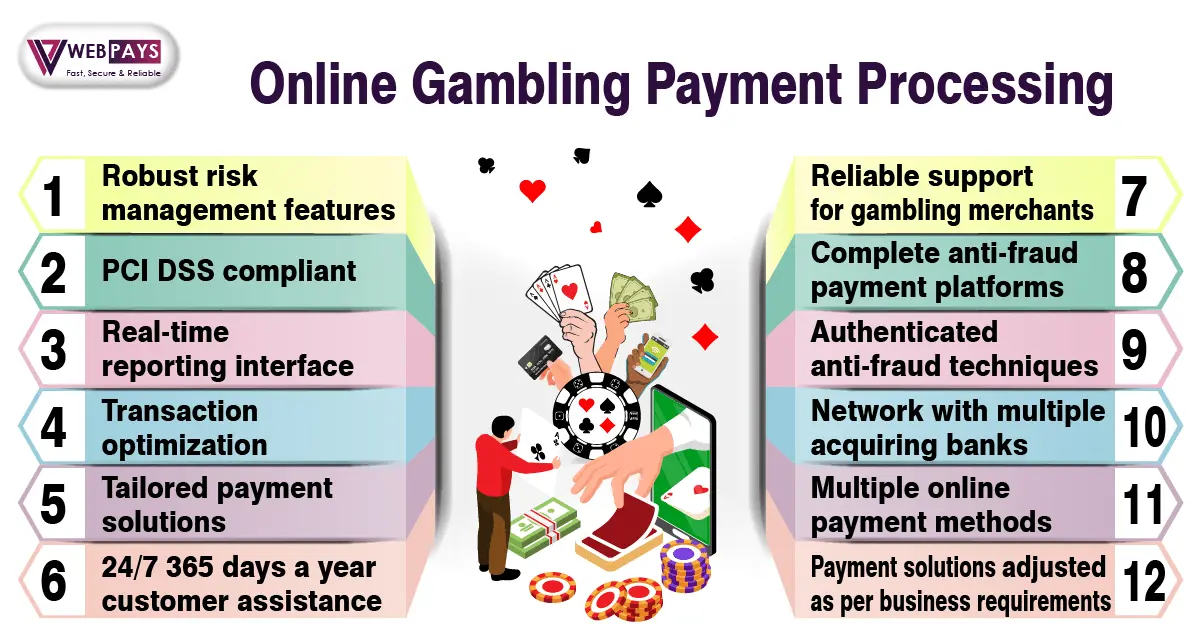
Why WebPays?
Associating with the leading payment solution provider for online casinos globally such as WebPays, you can be able to process all your payments securely that your customers performed via different payment methods. Furthermore, our dedicated payment expert team delivers the most suitable payment processing platforms for you and your customers. At our payment processing platform, your customers from around the world can also experience effortless online gambling payment processing with highly secured transaction details. So, you can apply for an online gambling payment gateway Europe by just filling out an application form. Or you can also send your query via mail. Our payment service provider team will connect with you shortly and assist you properly.