
Stripe and PayPal are the most recognised payment processors in the world — but they are not built for high-risk businesses. If you have been terminated, declined, or are concerned about the risk of sudden account closure, understanding the fundamental differences between mainstream aggregators and specialist high-risk processors is essential before choosing where to process.
The Core Difference: Aggregators vs Specialist Acquirers
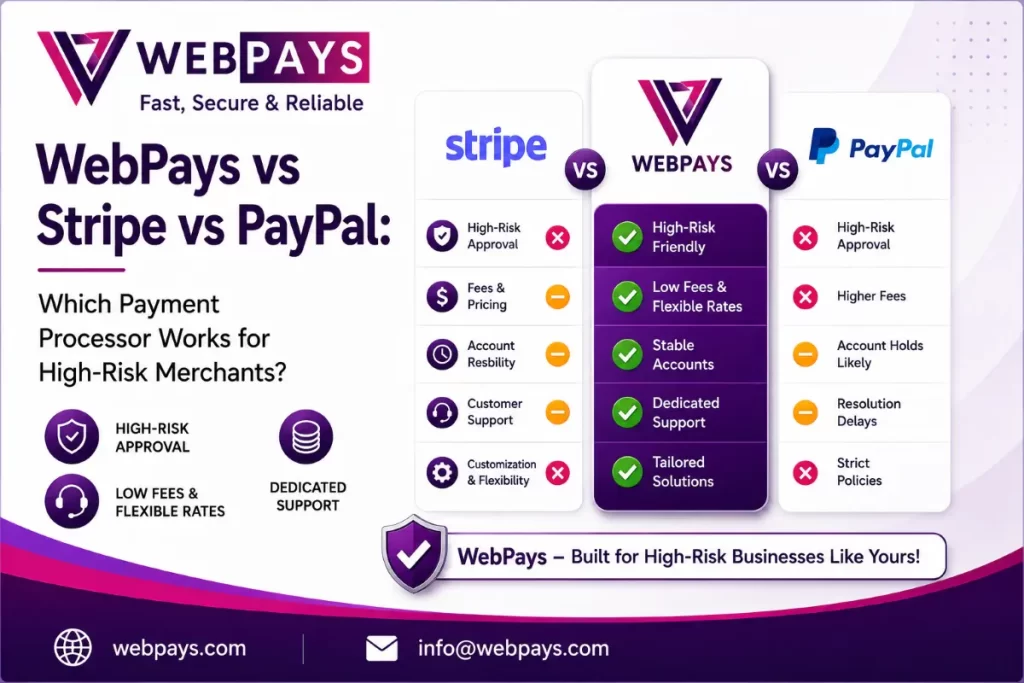
Stripe and PayPal operate as payment aggregators. This means they pool thousands of merchants under a single high risk merchant account — which is why onboarding is instant, but account termination is also instant and non-negotiable. They use automated risk systems to flag and terminate accounts, with no meaningful appeals process. Specialist high-risk processors like WebPays underwrite each merchant individually under a dedicated merchant account — slower to onboard, but infinitely more stable for regulated or elevated-risk businesses.
WebPays vs Stripe vs PayPal: Feature Comparison
| Criteria | WebPays | Stripe | PayPal |
| High-risk industry support | Yes — specialist | Very limited | No |
| iGaming / adult / CBD | Yes | No | No |
| Account type | Dedicated merchant | Aggregator sub-account | Aggregator sub-account |
| Account termination risk | Low | High | High |
| Chargeback management | Active + pre-dispute | Basic notifications | Basic notifications |
| Rolling reserve | Yes — transparent | Hidden restrictions | Account freeze |
| UK/EU acquirer relationships | Yes | Yes (standard only) | Yes (standard only) |
| Onboarding time | 3–7 days | Instant (auto) | Instant (auto) |
| Dispute outcome support | Full representment | Limited | Limited |
Why Stripe Bans High-Risk Merchants
Stripe’s automated risk systems are calibrated for low-risk, tech-forward businesses. Industries including adult content, gambling, firearms, nutraceuticals, CBD, and forex are explicitly prohibited in Stripe’s terms of service. Any merchant in these categories operating on Stripe faces near-certain termination — often without prior warning and with funds held for 90–180 days. Stripe is not a viable long-term processing solution for high-risk businesses.
Frequently Asked Questions
Does Stripe support high-risk merchants?
No. Stripe explicitly prohibits high-risk categories including gambling, adult content, firearms, CBD, nutraceuticals with aggressive health claims, and forex in its restricted business list. High-risk merchants on Stripe face account termination, fund holds, and no meaningful appeals process. Specialist high-risk processors are the appropriate solution.