
The MENA iGaming market is not a simple copy-and-paste opportunity. A payment setup that works well in one country can create serious problems in another because licensing rules, banking policies, customer preferences, and payment acceptance can vary considerably across the region.
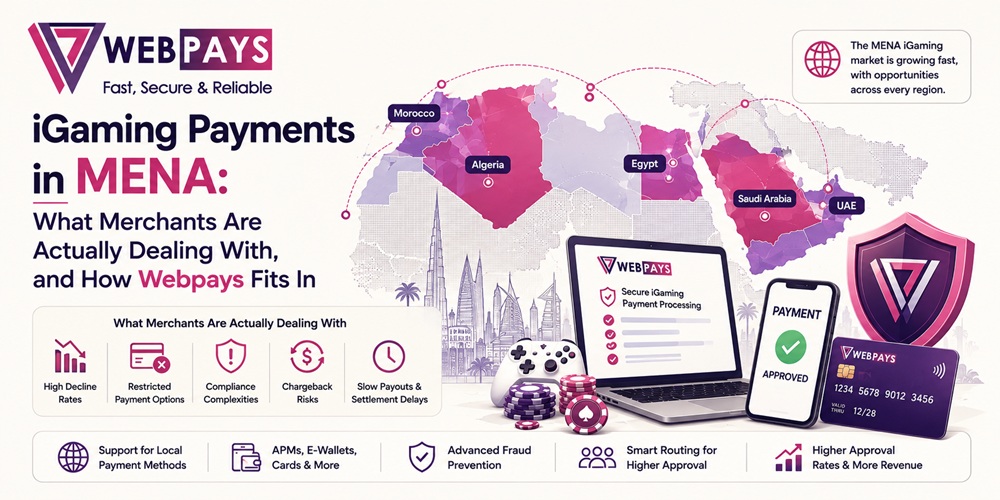
For casino and betting operators, the payment side of the business often becomes complicated long before transaction volume reaches its full potential. Declined cards, limited acquiring options, chargebacks, account reviews, cross border payments, and compliance checks can all affect the customer experience.
This is where choosing the right iGaming payment gateway in MENA becomes important. Merchants need more than a checkout page. They need a payment infrastructure that can handle the particular risks of gaming transactions while supporting customers across different markets.
Why MENA Is a Complicated Market for iGaming Payments
MENA is made up of very different markets, so treating the region as one payment territory can be misleading.
Each country has its own approach to gambling, financial services, online commerce, and payment activity. The UAE, for example, has established the General Commercial Gaming Regulatory Authority (GCGRA), which regulates commercial gaming activities including internet gaming and sports wagering. The authority states that commercial gaming without the required licence is unlawful.
That distinction matters for payment providers.
A merchant cannot simply enter a market, connect a gateway and assume that payment acceptance will follow. The operator’s licence, target customers, transaction flows, business structure and acquiring arrangement may all be examined during onboarding.
For businesses looking at iGaming payment solutions for casino gambling, the first question should therefore be whether the proposed activity is permitted in the specific market being targeted. Payment processing should support a compliant business model rather than attempt to work around local restrictions.
The Payment Problems iGaming Merchants Commonly Face
Gaming payments have characteristics that make them different from ordinary eCommerce.
A customer may deposit several times during a session, request a withdrawal later, use different payment methods, or dispute a transaction they do not recognise. From an acquirer perspective, this creates more variables to monitor.
Some of the biggest issues include:
- Higher scrutiny during merchant onboarding
- Limited acquiring options for gambling-related businesses
- Transaction declines and inconsistent approval rates
- Chargebacks and friendly fraud
- Customer verification requirements
- Suspicious transaction monitoring
- Cross-border settlement challenges
- Currency conversion and settlement considerations
- Restrictions around particular payment methods
- Maintaining clear records for deposits and withdrawals
The Central Bank of the UAE specifically identifies gambling businesses as an example of merchants that can create additional risk where an activity is legal in one jurisdiction but not another. It also highlights the increased risk that can arise from cross border payment networks and unclear merchant activity.
In practical terms, this means an operators payment setup needs to make sense to the financial institutions sitting behind it.
Why Payment Risk Management Matters So Much
For an iGaming operator, iGaming payment risk management is not something that should be added after problems appear. It needs to be considered when the payment architecture is designed.
Risk controls can include transaction monitoring, customer verification, velocity checks, fraud screening, 3D Secure where appropriate, chargeback monitoring and sensible withdrawal controls.
The UAE gaming regulator places particular emphasis on financial crime prevention. Its framework refers to customer due diligence, enhanced due diligence for higher-risk relationships, transaction monitoring, suspicious activity reporting and ongoing risk assessments.
The payment journey should also be easy to understand. Customers should know what they are paying for, see a recognisable merchant descriptor and have access to support if a transaction needs clarification.
This sounds basic, but small details can have a noticeable effect on disputes.
Deposits Are Only Half of the Payment Journey
One mistake operators sometimes make is focusing heavily on deposits while treating withdrawals as a separate issue.
For iGaming, both sides need to work together.
A customer may deposit through one payment method and later expect a smooth withdrawal. If the payment infrastructure cannot support the return journey efficiently, frustration can build quickly.
Closed-loop payment practices are also important from a risk perspective. Gambling regulators have highlighted the money-laundering risks associated with open-loop payment processes, where funds can move between unrelated payment methods.
Payment networks can also have specific rules for gaming transactions. Mastercard’s rules for the Middle East/Africa region, for example, include requirements concerning gaming payment transactions and their identification.
This is why an iGaming payment processor needs to understand the entire transaction lifecycle rather than simply provide a card form.
Local Payment Preferences Cannot Be Ignored
Card payments remain important, but customers in different MENA markets may have different expectations around how they pay.
A modern iGaming payments platform may therefore need to support more than traditional card acquiring. Depending on the market and the merchant’s eligibility, this can include digital wallets, bank-based payment methods and other locally relevant alternatives.
The broader payments industry is already moving in this direction. The 2026 Global eCommerce Payments & Fraud Report found that cards, digital wallets and bank transfers were among the most widely accepted online payment methods, while real-time payments also continued to grow.
For gaming merchants, the lesson is straightforward: adding more payment methods is not automatically better. Each method needs to be assessed for availability, compliance, fraud exposure, settlement, customer demand and operational cost.
What Merchants Should Look for in an iGaming Payment Provider
Choosing between iGaming payment providers should go beyond comparing transaction fees.
A provider should be evaluated on the complete payment setup, including:
1. Merchant onboarding
The provider should understand the gaming business model and be able to assess the operator based on its actual activities, licensing position and target markets.
2. Payment gateway integrations
An effective payment gateway for iGaming should integrate cleanly with the operator’s website, app, wallet system or gaming platform.
Good integration reduces unnecessary redirects and gives the merchant greater control over the payment experience.
3. Fraud and transaction monitoring
Gaming businesses need controls that can identify unusual activity without creating unnecessary friction for legitimate customers.
4. Multiple payment options
A broader payment mix can help merchants serve customers with different payment preferences, provided every method is suitable for the market and business model.
5. Settlement and reconciliation
Operators need clear reporting around deposits, refunds, withdrawals, fees and settlements. Poor reconciliation can create operational headaches even when the gateway itself is functioning correctly.
6. Scalability
The payment infrastructure should be capable of handling higher transaction volumes as the operator expands into additional markets.
Where Webpays Fits Into the Picture
Webpays approaches iGaming payments from the perspective of merchants that need a more structured payment setup for online businesses operating in higher-risk categories.
For an operator evaluating payments solution for iGaming, the objective should not simply be to find a gateway that accepts gaming transactions. The more useful approach is to build a payment environment around the merchant’s licensing position, target markets, transaction profile and risk controls.
This is where Webpays can fit into the wider payment strategy.
The role of a provider such as Webpays can extend across payment gateway connectivity, merchant processing, payment method integration and the operational requirements surrounding online transactions. For an iGaming business, that means looking at the payment flow as a complete system rather than treating the gateway as an isolated piece of technology.
The exact solution will naturally depend on the merchant, jurisdiction, licence and available acquiring arrangements. No payment provider should be viewed as a substitute for the operator’s own regulatory obligations.
Payment Gateway Integrations: Why the Technical Side Matters
A good payment relationship can still become frustrating if the integration is poorly designed.
Payment gateway integrations should ideally allow the gaming platform and payment infrastructure to communicate reliably while keeping transaction information organised.
Important areas include:
- Deposit status updates
- Payment confirmations
- Refund handling
- Withdrawal workflows
- Transaction reporting
- Fraud signals
- Customer verification
- Reconciliation
- Error and decline handling
A clean integration also makes it easier for operators to understand where transactions are failing.
For example, there is a major difference between a payment being declined because of issuer rules, a fraud-screening decision, an unsupported card, insufficient funds or a technical integration problem. Good reporting helps the merchant identify the actual reason instead of simply seeing a generic “payment failed” message.
Why One Payment Route May Not Be Enough
Relying on a single payment route can create operational exposure for an iGaming business.
If a processor changes its risk appetite, introduces new requirements, experiences an outage or stops supporting a particular transaction type, the merchant can suddenly lose an important part of its payment flow.
A more resilient setup may involve multiple acquiring or payment routes where appropriate and permitted.
That does not mean connecting every available processor. Too many providers can make reconciliation, compliance and technical management unnecessarily difficult.
The better approach is to create a payment structure that provides useful redundancy without making the operation unnecessarily complicated.
Compliance Comes Before Conversion
It is tempting to judge a payment provider by approval rates alone. For iGaming, that can be a mistake.
A high approval rate means little if the merchant later faces account restrictions, settlement delays or compliance problems.
The stronger approach is to consider three things together:
Acceptance + Risk Controls + Compliance
A payment solution should help legitimate transactions move efficiently while making it possible to identify suspicious activity and maintain the records needed for ongoing oversight.
This becomes particularly important as regulators in the region develop more structured approaches to gaming and financial crime.
The UAE provides a useful example of this direction. Its GCGRA framework combines licensing with financial crime controls, responsible gaming requirements and ongoing supervision.
How to Choose an iGaming Payment Solution for MENA
Before signing with an iGaming payment provider, merchants should ask practical questions rather than focusing only on headline pricing.
Does the provider support the merchant’s exact business model?
Casino, sportsbook, poker, fantasy gaming and other forms of gaming can have different risk profiles and regulatory considerations.
Which MENA markets are actually supported?
Regional coverage does not necessarily mean that every country or payment method is available.
How are deposits and withdrawals handled?
The complete customer payment journey should be understood before implementation.
What happens when a transaction is declined?
Clear decline information can help operators reduce failed payments and identify recurring issues.
How are fraud and chargebacks managed?
The provider should have a clear approach to transaction monitoring and dispute management.
How does settlement work?
Merchants should understand settlement currencies, timing, reconciliation and any reserve arrangements before going live.
What integrations are available?
The gateway needs to work reliably with the merchant’s existing gaming platform and technology stack.
The Bigger Picture for MENA iGaming Payments
The MENA payments environment is changing, but the opportunity should not be confused with an open market where every gaming operator can simply switch on online payments.
Regulation, licensing, financial crime controls and payment acceptance are becoming increasingly connected.
The UAE is a particularly clear example. The GCGRA now explicitly regulates internet gaming and sports wagering, and Google updated its UAE gambling advertising policy in March 2026 to permit certified advertising by GCGRA-licensed entities.
For merchants, this points toward a more structured future.
The operators most likely to build sustainable payment operations will be the ones that treat payments as part of their overall business infrastructure—not as a last-minute technical requirement.
Final Thoughts
MENA can be an attractive region for iGaming businesses, but payment processing requires careful planning.
The right igaming payment gateway MENA strategy needs to account for local regulations, licensing, customer payment preferences, fraud exposure, chargebacks, withdrawals, settlement and technical integration.
Webpays can be considered as part of that broader payment strategy for merchants looking for an iGaming payments platform and payment processing infrastructure suited to more complex online business models.
The important point is not simply finding a provider that can process a transaction. It is finding a payment structure that can support the business as its transaction volume, customer base and market coverage grow—while keeping compliance and risk management firmly in the picture.
Frequently Asked Questions
1. What is an iGaming payment gateway?
An iGaming payment gateway connects an online gaming platform with payment processing infrastructure so customers can make deposits and, where supported, receive withdrawals. It can also support transaction reporting, fraud controls and payment-method management.
2. Why are iGaming payments considered higher risk?
Gaming transactions can involve frequent deposits, withdrawals, chargebacks, fraud attempts and cross-border activity. In addition, gambling is regulated differently across jurisdictions, which can increase the level of scrutiny from financial institutions and payment providers.
3. What should merchants look for in an iGaming payment processor?
Merchants should consider licensing compatibility, supported markets, payment methods, transaction approval, fraud controls, chargeback management, settlement terms, reporting and technical integration rather than looking at processing fees alone.
4. Can an iGaming payment gateway support multiple payment methods?
Potentially, yes. Depending on the market, merchant eligibility and provider capabilities, an iGaming payment setup may include cards, bank-based methods, digital wallets and other local options. Each method should be assessed for regulatory and risk suitability before being offered.
5. Is Webpays suitable for MENA iGaming merchants?
Webpays can be considered by iGaming businesses looking for payment processing infrastructure and gateway solutions for higher-risk online operations. Actual availability depends on the merchant’s business model, licensing status, target market and underwriting requirements.