
Securing dependable payment infrastructure is often the single biggest hurdle standing between an ambitious forex broker and global trading volume. Because foreign exchange involves cross-border settlements, high ticket transactions, volatile market movements, and strict regulatory oversight, standard commercial banks and aggregators reject most forex applications outright.
To process credit card deposits and regional alternative payment methods reliably, brokers must secure a dedicated forex merchant account. Because these accounts fall squarely into the high-risk vertical, acquiring banks run thorough, multi-layered underwriting checks.
Getting approved quickly without endless back-and-forth requires submitting a clean, organized, and compliant documentation packet. At WebPays, we specialize in bridging the gap between FX brokerages and global acquiring banks. This detailed guide breaks down every document you need to prepare for a smooth, delay-free onboarding process.
Why High-Risk Underwriters Ask for Extensive Documentation
When a financial institution evaluates a high risk forex merchant account, risk managers aren’t just verifying whether your company exists. They are evaluating operational solvency, regulatory footprint, and Anti-Money Laundering (AML) safeguards.
A complete document submission acts as proof that your brokerage:
- Operates legitimately under an established corporate structure.
- Maintains adequate liquidity to handle refunds, settlements, and chargebacks.
- Identifies its key decision-makers (Ultimate Beneficial Owners) in line with international Know Your Customer (KYC) directives.
- Protects retail traders with clear operational rules and transparent policies on its trading platform.
Submitting incomplete or outdated files usually leads to immediate application holds or outright rejections. Having your paperwork organized from day one speeds up review times significantly.
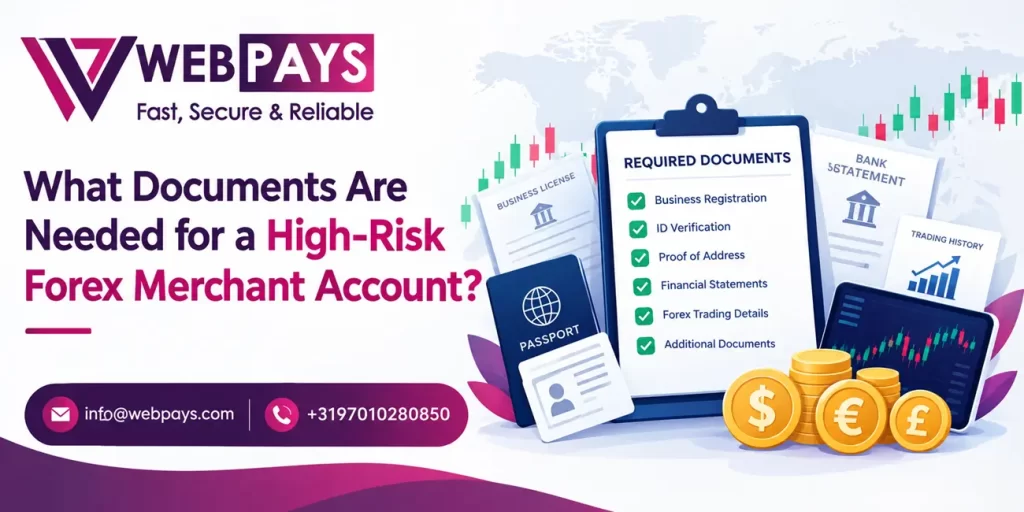
The Master Checklist: Required Documents for Forex Brokers
Underwriters categorize their document review into four primary areas. Having these documents organized in a clear, digital folder structure before applying ensures your application moves rapidly through the underwriting pipeline.
├── 1. Corporate Legal Records
├── 2. Personal Identification (KYC)
├── 3. Financial & Processing History
└── 4. Technical & Compliance Evidence
1. Corporate Legal and Incorporation Records
Underwriters must verify that your entity is legally registered, active, and compliant with corporate governance standards in its home jurisdiction.
- Certificate of Incorporation: The primary document proving legal entity establishment issued by your corporate registry office.
- Articles & Memorandum of Association (AoA / MoA): Corporate documents detailing company governance, operational scope, and shareholder rights.
- Certificate of Good Standing: Typically required for corporate entities registered over 12 months ago to confirm ongoing legal and tax standing.
- Proof of Corporate Address: A official utility bill, lease contract, or bank statement issued in the company’s legal name, dated within the last 90 days.
- Shareholder Structure / Organizational Chart: A clear breakdown listing all directors and Ultimate Beneficial Owners (UBOs) holding a 10% stake or higher.
2. Personal KYC Documents for Directors and Shareholders
Under global Anti-Money Laundering rules, acquiring banks must verify the identity and residential status of every individual who owns or directs the company.
- Valid Passport / Photo Identification: Clear, full-color copies of unexpired passports for all UBOs and operational directors.
- Proof of Residential Address: Recent utility bills (water, gas, electricity), bank statements, or official government correspondence displaying the director’s full name and address (issued within 90 days).
- Source of Wealth / Capitalization Proof: Formal statements detailing how initial operating capital was sourced (e.g., dividends, retained earnings, personal investment).
3. Financial Statements and Processing Records
To confirm that a forex broker merchant account can withstand chargeback risks and financial market swings, risk managers perform an in-depth audit of your financial standing.
- Recent Corporate Bank Statements: 3 to 6 consecutive months of bank statements showing regular operational balances and account health.
- 6 Months of Processing Statements (For Existing Brokers): If you are switching payment providers or adding an additional high risk forex payment gateway, provide detailed processing logs. These statements should display gross volume, transaction counts, refund rates, and chargeback ratios.
- Financial Audits / Balance Sheets: P&L statements and current balance sheets verified by an independent accountant, especially for higher transaction tiers.
4. Technical Website Compliance & Operational Setup
Your digital platform acts as your storefront. Banks thoroughly inspect your live domain to ensure it meets strict credit card scheme rules (Visa, Mastercard) and regional financial guidelines.
- Domain Ownership Document: Invoices or portal domain details proving your company owns the active domain.
- Mandatory Website Pages: Clear links directly accessible from your platform footer, including:
- Comprehensive Terms and Conditions.
- Detailed Privacy Policy & GDPR Compliance Statements.
- Deposit, Withdrawal, and Refund Policies outlining operational timelines.
- Risk warnings regarding margin trading and leverage risks.
- Regulatory Financial License (If Applicable): Offshore or local FX regulatory license copies where required by your operating jurisdictions.
Document Requirements at a Glance
| Document Category | Primary File Needed | Why Underwriters Require It |
| Corporate | Certificate of Incorporation & AoA | Verifies legal existence and ownership distribution. |
| Identity (KYC) | Passports & Utility Bills for all UBOs | Prevents money laundering and verifies real management. |
| Financials | 3–6 Months Corporate Bank Statements | Evaluates financial stability and operational liquidity. |
| Processing History | 6 Months Gateways Statements | Analyzes past chargeback ratios and volume patterns. |
| Compliance | Live Website + KYC/AML Policies | Ensures compliance with card network and user safety rules. |
Common Pitfalls That Delay Approval (And How to Avoid Them)
- Submitting Blurred or Cropped KYC Documents: Scanning files properly avoids instant rejection. Always ensure all four corners of passports and utility bills are fully visible and readable.
- Mismatched Corporate Information: Ensure company names, registration numbers, and addresses on bank statements match corporate registration records word-for-word.
- Broken Links on the Trading Portal: Underwriters run technical checks across your entire site. Ensure payment checkout pages, contact forms, and legal footers are live and functional prior to applying.
- Hiding Processing History: Hiding past chargeback statistics or processing disruptions creates red flags. Providing transparent processing history helps underwriters properly structure your account limits and reserve terms.
How WebPays Streamlines Forex Merchant Onboarding
Attempting to apply directly to acquiring banks without industry representation often results in flat rejections or long delays. WebPays simplifies high-risk payment acquiring by offering pre-evaluation services that review your profile before official submission.
- Pre-Underwriting Review: We evaluate your document package, highlight missing items, and optimize your application upfront.
- Global Acquiring Network: We connect your brokerage with banking partners that match your specific operational jurisdiction and monthly volume target.
- Built-in Fraud & Risk Controls: Protect your gateway with automated 3D Secure 2.0 verification, real-time transaction monitoring, and chargeback prevention tools designed for trading platforms.
- Fast Turnaround: Initial approvals typically take 24 to 48 hours once clean documentation is received, allowing you to start accepting deposits without operational downtime.
Frequently Asked Questions
What makes a forex merchant account “high-risk”?
Forex trading is categorized as high-risk due to potential transaction disputes, large settlement sizes, cross-border payments, market volatility, and differing global regulations. Dedicated high-risk payment processors provide tailored security, multi-currency features, and chargeback tools specifically built for FX brokerages.
Can startup forex brokers without processing history get approved?
Yes. Startups can secure a forex broker merchant account by presenting clean legal documentation, clear UBO identification, proof of adequate reserves, and a fully compliant website with working terms and conditions. WebPays specializes in helping emerging brokerages structure compliant applications.
How long does the approval process take for a high-risk forex gateway?
With complete documentation, pre-evaluation and initial approval typically take 24 to 48 hours. Full underwriting, technical API integration, and live testing are usually completed within 2 to 5 business days.
Are unregulated or offshore forex brokerages eligible for merchant accounts?
Yes. Many payment acquiring banks specialize in offshore jurisdictions. As long as your corporate entity can provide verifiable incorporation papers, clear UBO documentation, and robust internal AML/KYC policies, offshore brokerages can secure stable payment processing.
How can a forex brokerage maintain low chargeback rates?
To prevent dispute issues, clearly state deposit, withdrawal, and trading terms on your platform. Use explicit billing descriptors so customers easily recognize transactions on their statements, and integrate automated 3D Secure authentication alongside real-time transaction screening tools.