
Most business owners find out they’re “high-risk” the hard way: an application gets declined with no real explanation, or an existing account gets frozen after a run of chargebacks. Standard processors like Stripe or PayPal are built for low-risk retail, and they tend to walk away from anything outside that comfort zone rather than price in the extra risk.
A high-risk payment gateway exists for exactly that gap. It does the same basic job as any payment gateway — capturing card details and routing them for authorization — but it’s built around businesses that standard processors won’t touch, with the underwriting, reserves, and fraud tooling to match. This guide covers what makes a business “high-risk,” how a high-risk gateway actually works end to end, what it costs, and how to evaluate a provider before you sign anything.
Key Takeaways
- A high-risk payment gateway isn’t a judgment on your business — it’s a classification based on industry, chargeback history, ticket size, and geography that determines how a processor prices and monitors your account.
- Expect processing fees roughly 4–8%, versus 2–3% for standard retail, plus a rolling reserve held against future disputes.
- Visa’s chargeback-ratio threshold for its Excessive Merchant tier drops to 150 basis points (1.5%) on April 1, 2026 — tightening what counts as an acceptable dispute rate right when many merchants are already seeing chargebacks rise.
- The two contract terms worth scrutinizing most before you sign: the exact reserve percentage and release schedule, and the chargeback ratio that triggers a review or termination.
What Is a High-Risk Payment Gateway?
A high-risk payment gateway is a payment gateway built specifically for merchants that fall outside the risk appetite of standard processors. It performs the same core function as any gateway — securely passing payment data from your checkout to a processor for authorization — but layers on stricter underwriting, more aggressive fraud monitoring, and financial safeguards like rolling reserves.
It helps to separate three terms that get used interchangeably but aren’t the same thing:
- Payment gateway — the software that captures and encrypts payment details at checkout and passes them along for authorization.
- Payment processor — the company that actually routes the transaction between the card networks and the banks involved.
- Merchant account — the account that holds your funds after a sale clears, before they’re transferred to your business bank account.
A high-risk provider typically bundles all three into one relationship, because separating them makes underwriting harder to coordinate. That bundling is also why switching high-risk providers later tends to be more involved than switching a standard payment plugin — you’re not just changing software, you’re changing who’s underwriting your risk.
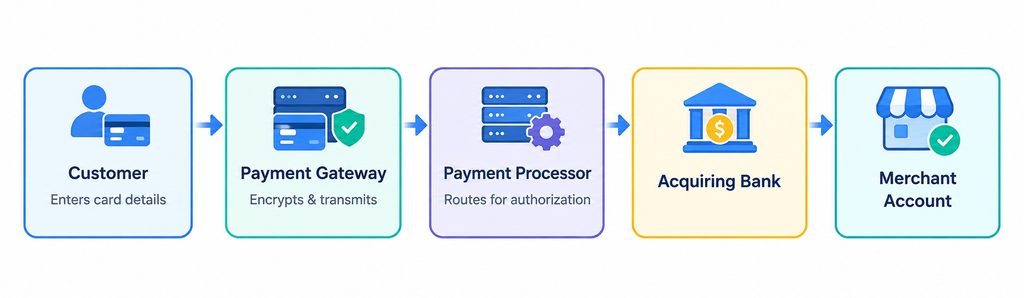
How funds move from a customer to a merchant account, with the underwriting and risk checks concentrated at the processor and acquiring-bank stages for high-risk accounts.
Why Are Some Businesses Classified as High-Risk?
Banks and acquirers don’t make this call arbitrarily — they’re pricing in factors they’ve seen correlate with fraud and disputes. The main ones:
- Industry type. Gambling and iGaming, adult content, forex and CFD trading, crypto, nutraceuticals and CBD, subscription and continuity billing, travel, and IPTV/streaming all carry industry-level risk flags, independent of how well any individual business in that space is run.
- Chargeback ratio. The percentage of transactions that end up disputed. This is the single biggest lever in how a business gets classified and re-classified over time.
- Average ticket size. Larger transactions carry more fraud exposure per incident.
- Cross-border sales. International cards and unfamiliar billing patterns are harder to risk-score than domestic, repeat-customer traffic.
- Business and founder history. Prior processing terminations, weak personal or business credit, or a short operating history all raise the risk profile.
This is getting more consequential, not less. Visa’s chargeback-monitoring program (VAMP) is dropping its Excessive Merchant threshold to 150 basis points — 1.5% of transactions — starting April 1, 2026 (Visa VAMP fact sheet). That’s a tightening of the bar for what counts as an acceptable dispute rate, and it lands at a time when global card fraud losses already sit at $33.41 billion, with U.S. merchants absorbing 41.87% of that loss on just 26.31% of global transaction volume (Nilson Report, 2024 data). Put simply: the industries and behaviors that get a business classified as high-risk are under more scrutiny in 2026, not less.
How Does a High-Risk Payment Gateway Work?
The transaction flow itself looks similar to a standard gateway — the difference is almost entirely in what happens before the first transaction and how funds move afterward.
- Application. You submit business documentation, processing history (if you have any), and details about your product or service.
- Underwriting and risk review. This is the step standard gateways mostly skip. An underwriter evaluates your industry, chargeback history, financials, and sometimes your website and marketing claims directly.
- MID assignment. You’re issued a merchant identification number (MID) tied to an acquiring bank. Some high-risk providers use MID cascading — automatically routing declined transactions to a secondary MID — to improve approval rates without a manual retry.
- Live processing. Transactions run largely the same way they would on any gateway, but with heavier real-time fraud scoring layered on top.
- Settlement with reserve withheld. Instead of the full transaction amount clearing to your bank account on a standard schedule, a percentage is held back as a rolling reserve against future chargebacks, and released on a delay.
That reserve step is the part first-time high-risk merchants are usually least prepared for, and it’s worth understanding in detail before you sign anything — more on that below.
High-Risk vs. Standard Payment Gateways: Key Differences
| Standard Gateway | High-Risk Gateway | |
| Typical processing fees | ~2–3% | ~4–8% |
| Rolling reserve | Rare | Common (percentage held, released on a delay) |
| Underwriting depth | Automated, fast | Manual review of business, history, and financials |
| Fraud tooling | Basic rule-based checks | Real-time scoring, device fingerprinting, manual review queues |
| Approval odds for flagged industries | Often declined outright | Purpose-built for these industries |
| Contract flexibility | Standard terms, easy to leave | Longer commitments, termination fees more common |
The gap in fees and reserve requirements isn’t arbitrary markup — it reflects the processor’s own exposure. A high-risk acquirer is on the hook if your chargeback ratio spikes or your business closes with a reserve still owed to customers, so the pricing and reserve structure exist to cover that downside.
What to Look For in a High-Risk Payment Gateway Provider
Not all high-risk providers are built the same way, and the difference shows up fastest during a fraud spike or a dispute wave — not during the sales call. Prioritize:
- Real-time fraud monitoring. Device fingerprinting, velocity checks, and risk scoring that happens before authorization, not just after-the-fact reporting.
- PCI DSS compliance, confirmed in writing, not just implied by marketing copy.
- Multi-currency and multi-acquirer routing, especially if you sell internationally — this also improves resilience if one acquiring relationship has issues.
- Chargeback management and representment support — someone who actually helps you contest disputable chargebacks, not just a dashboard that reports them.
- Transparent reserve and termination terms, in the actual contract, not summarized verbally.
- A dedicated account or risk manager you can reach when something goes wrong, not a generic support queue.
Fraud tooling depth matters more this year than it used to. Friendly fraud — cardholders disputing legitimate charges rather than requesting a refund directly — now accounts for roughly 20% of fraudulent disputes globally, and up to 30% among high-volume online merchants (Visa, 2025 Global eCommerce Payments & Fraud Report). Chargebacks911’s 2026 Chargeback Field Report found 83.4% of enterprise merchants have seen friendly fraud increase over the past three years, and nearly two-thirds of merchants now use or plan to adopt AI-based fraud prevention tools in response. A provider whose fraud stack hasn’t kept pace with that shift is passing the cost straight to you, either through declined legitimate sales or through disputes you end up eating.
How to Get Approved for a High-Risk Payment Gateway
The application process is more document-heavy than a standard gateway signup, but it’s a known, repeatable sequence:
- Prepare your business documentation. Business registration, bank statements, a clear description of what you sell, and your website or app if it’s already live.
- Gather processing history if you have it. Even a few months of prior processing statements (even from an account that was later terminated) help an underwriter assess your real chargeback ratio rather than guessing from industry averages alone.
- Go through underwriting. Expect questions about your refund policy, your marketing claims, and how you handle customer disputes — underwriters are trying to predict your future chargeback ratio, not just verify you’re a real business.
- Get your MID and integrate. Once approved, you’ll integrate the gateway via API, a hosted checkout, or a plugin, depending on your platform.
- Go live and monitor closely. The first 60–90 days are when most providers watch your actual chargeback ratio most closely against what you projected during underwriting.
Timelines vary widely by industry and documentation quality — treat any provider promising truly instant approval for a genuinely high-risk category with some skepticism, and ask what “instant” actually covers (provisional approval vs. full underwriting sign-off are not the same thing).
Costs, Reserves & Contract Terms to Watch For
This is the section worth reading twice before you sign anything, because it’s where the difference between a solid provider and a bad one actually shows up.
Rolling reserves. A rolling reserve is a percentage of your revenue — commonly somewhere in the 5–10% range, though this varies by provider and risk profile — held back for a set period (often 90–180 days) before it’s released, specifically to cover chargebacks that come in after settlement. Ask for the exact percentage, the exact hold period, and the exact release mechanism in writing. “Flexible” or “case-by-case” reserve language in a sales conversation should become a specific number in the contract before you sign.
Chargeback-ratio thresholds. Ask what ratio triggers a review, and what triggers termination. With Visa’s own Excessive Merchant threshold dropping to 150 basis points on April 1, 2026, any provider whose internal threshold is meaningfully looser than that is either absorbing more risk than they’re letting on, or setting you up to get caught by the network-level threshold even if you’re technically within their own limit.
Termination and early-exit fees. High-risk contracts commonly run longer terms than standard gateway agreements, with real financial penalties for leaving early. Know this number before you need it.
Disputing chargebacks after they happen is a weaker strategy than most merchants assume. Merchants who formally fight chargebacks win only around 44.6% of the time, and after factoring in the cost of fighting every case, net-recover just 10.7% across all chargebacks (Chargebacks911, 2026 Chargeback Field Report). That’s the real argument for prioritizing fraud prevention and clear reserve terms upfront over relying on your ability to win disputes later.
A provider-neutral note worth stating plainly: this guide deliberately doesn’t rank or recommend specific named providers. If a separate roundup or comparison post on this site names vendors, verify their track record independently — regulatory filings, direct references, and third-party review patterns over time — rather than taking a provider’s own marketing claims at face value. That’s true of every provider in this space, not just the ones with a visible complaint history.
Is a High-Risk Payment Gateway Right for Your Business?
If your business falls into a flagged industry, has an elevated chargeback ratio, or has already been declined or dropped by a standard processor, a high-risk gateway usually isn’t optional — it’s the only realistic path to reliably accepting payments. The trade-off is real: higher fees, a rolling reserve, and more contractual friction than a standard gateway. But “high-risk” is a pricing and monitoring category, not a verdict on whether your business is legitimate.
Before you apply anywhere, get clear on your actual chargeback ratio, have your business documentation ready, and go into underwriting and contract negotiations already knowing what reserve percentage, hold period, and chargeback threshold you’re willing to accept. That preparation is what separates merchants who get a fair deal from merchants who sign whatever’s in front of them and find out the reserve terms the hard way.
Frequently Asked Questions
What’s the difference between a payment gateway, a payment processor, and a merchant account?
The gateway captures and encrypts payment data at checkout. The processor routes that transaction between card networks and banks for authorization. The merchant account holds your funds after a sale clears, before they transfer to your business bank account. High-risk providers usually bundle all three together.
Do all high-risk gateways require a rolling reserve?
No — it depends on the provider and your specific risk profile, including your industry, processing history, and financial strength. Businesses with a longer track record and lower chargeback ratios sometimes negotiate reduced reserves or none at all. Always get the actual terms in writing rather than relying on what’s discussed in a sales call.
How long does approval usually take?
It varies significantly by industry and how complete your documentation is. Treat “instant approval” claims for genuinely high-risk categories with some skepticism, and ask specifically whether that means full underwriting sign-off or just a provisional account that could still be reviewed or reversed.
Can I switch high-risk providers later if I’m unhappy?
Usually, but check your contract’s termination terms first. High-risk agreements commonly run longer terms than standard gateway contracts and can include early-termination fees. Factor in the operational cost of migrating gateways and re-establishing processing history with a new provider before you commit to a switch.