Managing payments across different countries can become complicated when a business receives money in several currencies and needs to distribute it among sellers, partners, suppliers, or service providers. Tracking incoming transactions, calculating individual shares, handling currency conversion, and processing payouts separately can create extra work for finance teams.
WebPays brings multi-currency collections and automated fund distribution together in one money management flow, helping businesses manage incoming payments and outgoing transfers through a single platform.
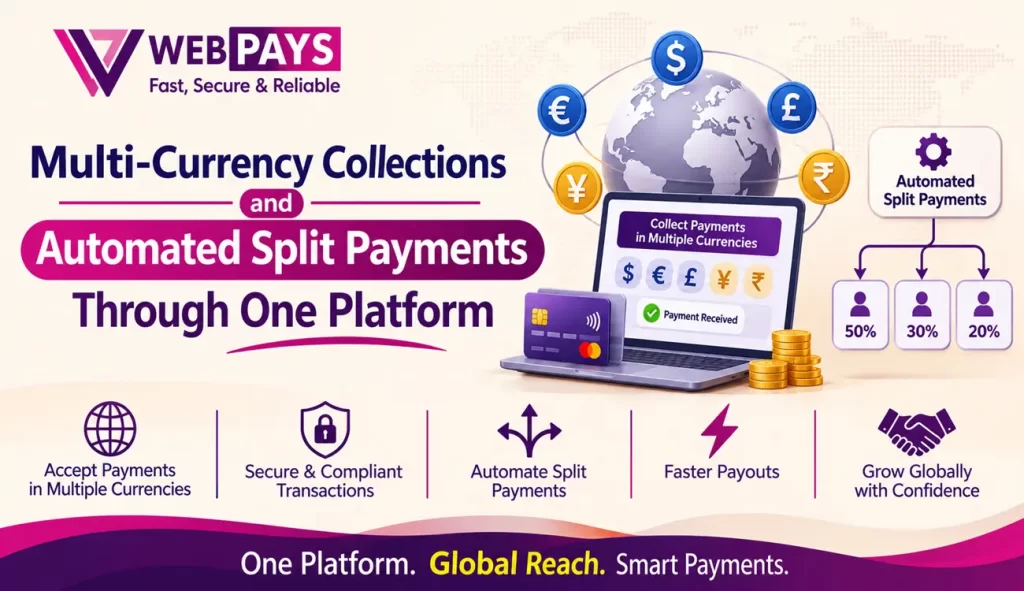
Collect Payments in Multiple Currencies Through Virtual Accounts
Businesses serving international customers need payment options that suit different markets. A customer in the US may prefer USD, a European buyer may pay in EUR, and a Hong Kong customer may use HKD. Managing these collections through separate banking arrangements can make reconciliation and cash-flow tracking more difficult.
With WebPays, businesses can collect funds through dedicated local virtual accounts in multiple currencies. This allows them to receive payments from different regions while managing their collections from a centralized platform.
The system can support collections in currencies such as:
- USD from customers in the United States
- EUR from customers across European markets
- HKD from customers in Hong Kong
- Multiple other currencies for international payment operations
Instead of checking different accounts to track incoming funds, businesses can view their collections in one place, making it easier to monitor payment activity and manage balances across markets.
Automate Split Payments Based on Business Rules
Collecting money is only one part of the payment process. Marketplaces, digital platforms, and businesses working with multiple partners often need to distribute incoming funds according to predefined agreements.
WebPays allows businesses to configure payout rules based on their payment arrangements, including:
- Split ratios: Assign a specific percentage of collected funds to each recipient.
- Settlement schedules: Define when payouts should be released to recipients.
- Fee structures: Set how applicable fees are calculated or allocated.
- Currency conversion: Convert funds into recipient currencies using real-time FX rates across 100+ currency pairs, subject to supported currencies and conversion conditions.
These settings help businesses establish a payout process that follows their commercial agreements without calculating every payment manually.
How Multi-Currency Split Payments Work
Example: Marketplace payment distribution
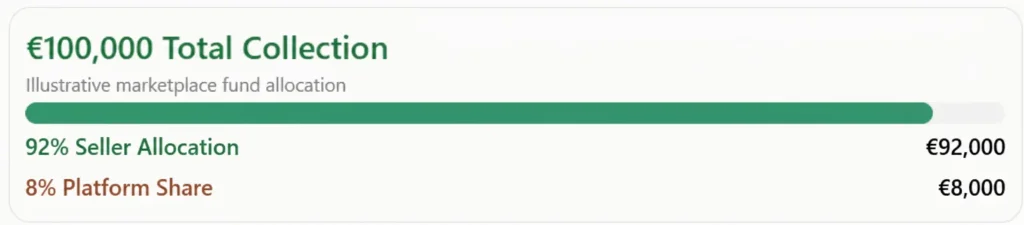
Imagine an online marketplace collects €100,000 from customers during a settlement period. The business has agreed to allocate 92% of the collected amount to sellers and retain 8% for its platform share, subject to applicable fees and settlement conditions.
The marketplace can configure these allocation rules in advance. Once payments are collected, the payout process follows the defined instructions, and recipient funds can be converted into their required currencies where supported.
For example, sellers operating in different countries may receive their payouts in USD, GBP, EUR, or other supported currencies. This removes the need for the marketplace finance team to calculate each seller’s share and initiate every transfer individually.
Why Businesses Need Automated Payment Distribution
Manual payment allocation can become a bottleneck as transaction volumes increase. A business dealing with dozens of recipients may manage payouts without much difficulty, but hundreds or thousands of sellers can turn the same process into a demanding financial operation.
Automated payout rules help address several common challenges:
Less manual reconciliation: Incoming collections and payout instructions remain connected, making it easier for finance teams to track how funds are allocated.
Fewer repetitive calculations: Percentage-based splits can be configured in advance, reducing the need to calculate recipient shares for every settlement cycle.
Better payout planning: Settlement schedules give businesses more control over when funds are distributed.
Simplified international operations: Multi-currency collections and conversion capabilities make it easier to manage recipients operating across different markets.
Centralized financial visibility: Teams can monitor incoming funds, allocation rules, and payout activity without switching between multiple systems for every task.
For businesses handling international transactions, payment infrastructure that combines collections, currency management, and payouts can simplify everyday financial operations.
Who Can Benefit From Multi-Currency Collections and Split Payments?
This payment setup can be useful for several business models where money is collected from customers and subsequently distributed to other parties.
- Online marketplaces: Collect customer payments and distribute seller earnings based on agreed commission rates.
- Freelance platforms: Receive client payments and allocate funds to freelancers or service providers.
- Travel platforms: Process bookings and manage payments owed to hotels, property owners, or travel partners.
- Affiliate networks: Distribute commissions according to predefined earnings or percentage-based rules.
- International businesses: Collect funds in different currencies and manage cross-border payments to suppliers, partners, and subsidiaries.
The main advantage is having collection and payout operations connected within the same payment workflow rather than treating them as separate financial tasks.
A More Connected Approach to International Money Management
Multi-currency collections become more useful when businesses can do something with the funds immediately after receiving them. Connecting incoming payments with allocation rules, settlement schedules, fee arrangements, and currency conversion creates a more organized way to manage money across business relationships.
WebPays brings these functions into one payment management flow, giving businesses a centralized way to collect funds internationally and distribute them according to their configured rules.
For companies expanding into new markets or managing large networks of sellers and partners, this approach can make payment operations easier to oversee while reducing the administrative work involved in moving money between recipients.
FAQs
1. What is multi-currency payment collection?
Multi-currency payment collection allows businesses to receive payments in different currencies, such as USD, EUR, and HKD, without managing every transaction as a separate payment operation.
2. How do automated split payments work?
Automated split payments distribute collected funds between multiple recipients based on predefined rules, such as percentages, fees, or settlement schedules.
3. Can businesses collect payments and pay recipients in different currencies?
Yes, supported payment systems can collect funds in one currency and convert them into another for recipient payouts, depending on available currencies, FX rates, and settlement conditions.
4. Who needs automated payment splitting?
Marketplaces, freelance platforms, affiliate networks, travel businesses, and digital platforms often use payment splitting to distribute earnings, commissions, or partner shares.
5. How does currency conversion help international businesses?
Currency conversion allows businesses to distribute funds in the currencies required by their recipients, reducing the need to coordinate separate manual conversion and transfer processes.