
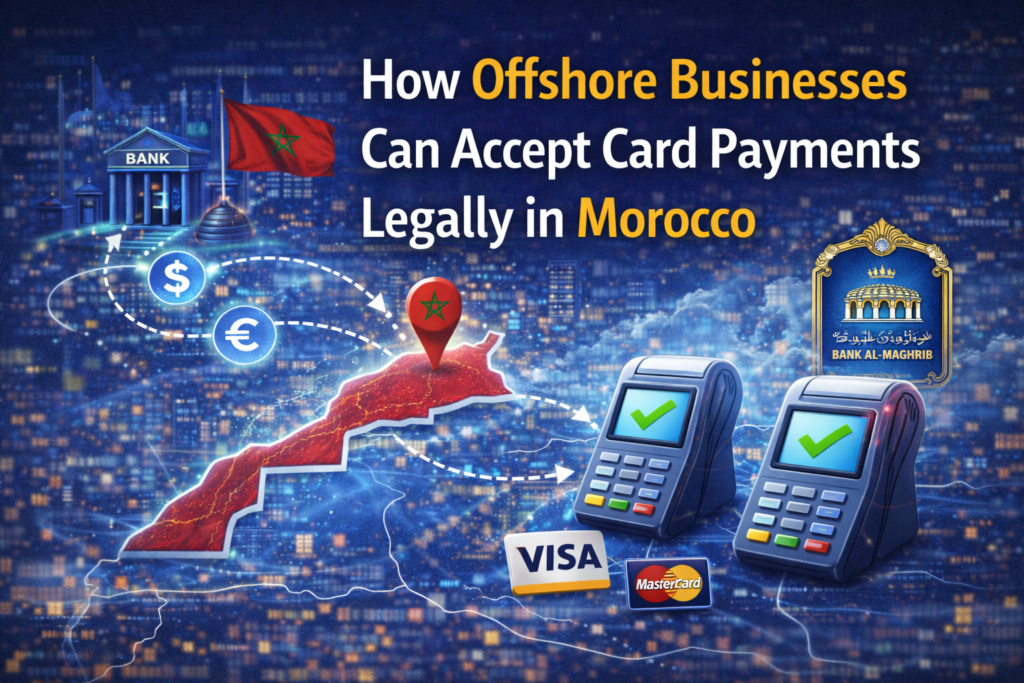
Morocco is increasingly becoming a strategic gateway for businesses targeting Europe, MENA, and Africa.
For offshore companies, this creates a major opportunity — but also a lot of confusion.
Many offshore merchants believe that:
- Card payments are not allowed in Morocco
- Moroccan banks do not work with offshore entities
- Offshore structures automatically lead to rejection
None of these assumptions are entirely true.
Offshore businesses can accept card payments legally in Morocco, but only when the payment structure aligns with how Moroccan banks, regulators, and international card networks evaluate risk.
This article explains what “legal” really means, why offshore merchants get rejected, and how to build a compliant, sustainable card payment setup in Morocco.
Understanding Morocco’s Payment & Regulatory Environment
Morocco’s payment ecosystem is regulated primarily by Bank Al-Maghrib and supported by:
- Local acquiring banks
- International card schemes (Visa, Mastercard)
- Cross-border settlement partners
Morocco does not ban offshore businesses from accepting card payments.
However, it applies strict controls on cross-border flows, currency movement, and merchant transparency.
For offshore merchants, the challenge is not legality —
it is structural alignment.
What Does “Legally” Accepting Card Payments Mean?
For offshore businesses, legal acceptance of card payments in Morocco means:
- Processing payments through approved acquiring channels
- Complying with card network rules
- Maintaining transparent business disclosures
- Aligning transaction geography with acquiring logic
- Following AML, KYC, and consumer protection standards
It does not mean:
- Using unregulated processors
- Masking business activity
- Routing payments without justification
Legality is determined by how payments flow, not where the company is incorporated.
Why Offshore Businesses Are Considered High-Risk in Morocco
Offshore businesses introduce additional risk layers, including:
- Jurisdictional distance
- Cross-border settlement complexity
- Enforcement limitations
- Higher dispute recovery risk
Because of this, offshore merchants are almost always classified as high-risk, even when operating legitimate businesses.
High-risk does not mean prohibited —
it means scrutinized more carefully.
Common Reasons Offshore Merchants Get Rejected in Morocco
1. Using Low-Risk or Domestic Gateways
Many offshore merchants apply using gateways designed for:
- Local Moroccan businesses
- Low-risk industries
These gateways are not built for offshore or high-risk models and often:
- Approve initially
- Monitor aggressively
- Shut down quickly
This creates instability and compliance concerns.
2. Mismatch Between Company Structure & Acquiring Setup
A frequent rejection trigger:
- Offshore company
- Moroccan or EU customers
- Poorly explained acquiring route
Without clear justification, this raises red flags around:
- Regulatory exposure
- Currency controls
- Settlement legitimacy
3. Weak Website Transparency
Moroccan acquirers perform detailed website reviews for offshore merchants.
Red flags include:
- Missing legal pages
- Unclear company identity
- No jurisdiction disclosure
- Hidden pricing or refund logic
Transparency is critical for offshore approval.
4. Single-Gateway Dependency
Offshore merchants relying on one provider face:
- Sudden shutdown risk
- Frozen settlements
- No fallback options
This is one of the biggest long-term risks.
5. Poor Chargeback & Refund Controls
Chargebacks are harder to recover for offshore businesses.
Banks want to see:
- Proactive refund logic
- Clear dispute workflows
- Monitoring thresholds
Without these, approvals rarely last.
How Offshore Businesses Can Accept Card Payments Legally in Morocco
Choose High-Risk Compatible Payment Gateways
Use gateways that:
- Support offshore entities
- Are experienced with high-risk verticals
- Offer cross-border card acceptance
Approval durability matters more than approval speed.
Align Acquiring With Customer Geography
Transactions should make sense geographically:
- Customer location
- Currency used
- Acquiring region
Misalignment is one of the fastest ways to trigger reviews.
Maintain Full Website & Business Transparency
Your website should clearly show:
- Legal entity name
- Country of incorporation
- Contact details
- Refund and cancellation policies
Transparency reduces perceived risk significantly.
Implement Multi-Acquirer or Fallback Routing
Assume that:
“At some point, a provider will review or pause us.”
Your system should continue functioning when that happens.
Build Chargeback Prevention Into the Payment Flow
This includes:
- Clear billing descriptors
- Confirmation screens
- Easy refund access
- Active monitoring
Prevention is essential for offshore stability.
How Webpays Supports Offshore Payment Processing in Morocco
Many offshore businesses fail in Morocco not because they are illegal, but because their payment setup is fragile.
Webpays helps offshore merchants structure card payment systems that align with Moroccan and international risk expectations by focusing on:
- High-risk compatible gateway integrations
- Cross-border card acceptance aligned with acquiring rules
- Multi-acquirer routing to reduce shutdown exposure
- Risk-aware payment architecture
Rather than chasing fast approvals, Webpays focuses on long-term payment continuity.
Why Approval Is Only the First Step
Getting approved is not the end goal.
After approval, offshore merchants face:
- Ongoing monitoring
- Settlement reviews
- Chargeback thresholds
- Traffic quality analysis
Gateways that approve but cannot support offshore behaviour become liabilities.
Sustainable success depends on post-approval resilience.
Common Myths About Offshore Card Payments in Morocco
Myth: Offshore businesses are illegal in Morocco
Reality: They are allowed, but closely evaluated
Myth: One gateway is enough
Reality: Single-provider dependency is risky
Myth: Compliance guarantees stability
Reality: Operations determine survival
Final Thoughts
Offshore businesses can legally accept card payments in Morocco — but only when payments are structured for transparency, control, and resilience.
Most failures happen because merchants:
- Use the wrong gateways
- Ignore geographic logic
- Depend on one provider
- Treat approval as the finish line
Offshore merchants who design for visibility, risk control, and redundancy build payment systems that survive scrutiny and scale sustainably.
Platforms like Webpays are designed to support this reality — helping offshore businesses move from fragile approvals to stable, long-term payment operations.
Frequently Asked Questions
Can offshore companies accept Visa and Mastercard payments in Morocco?
Yes, with high-risk compatible gateways and correct acquiring alignment.
Are offshore merchants automatically rejected?
No — but they are reviewed more strictly.
What is the biggest risk for offshore merchants?
Single-gateway dependency and poor chargeback control.
Is multi-acquirer routing necessary?
Increasingly, yes — especially for scaling offshore businesses.