
Open banking is the regulatory and technical framework that lets banks share account data with licensed third parties at a customer request. Account-to-account (A2A) payments are the transfers that move on top of that framework, sending money directly between bank accounts without a card network in the middle. Together they let a customer pay a merchant straight from their bank app, with funds arriving in seconds instead of days, and at a fraction of typical card processing costs. For merchants — especially those in high-risk or B2B categories, where card fees and reserve holds cut hardest into margin — this is one of the more consequential shifts in payment infrastructure since chip-and-PIN.
Why This Shift Is Happening Now
Card networks were built for a world of manual authorization and overnight batch settlement. Open banking and instant payment rails were built for a world of real-time APIs and mobile-first banking, and adoption is compounding quickly as a result.
On the A2A side, Juniper Research has projected that global account-to-account payment transaction volume will climb from roughly 60 billion in 2024 to 186 billion by 2029, a jump the firm attributes largely to the spread of instant payment systems and the growth of open banking features such as variable recurring payments. On the open banking side, market-size estimates vary considerably by research firm — anywhere from the low $30 billions to over $50 billion for 2026 — but nearly every forecaster agrees the trajectory points toward several multiples of that figure by the early 2030s, driven by regulatory mandates and fintech partnerships rather than organic consumer demand alone.
Two forces are behind the acceleration: regulators requiring banks to open up account access (starting with PSD2 in Europe and expanding through frameworks like the UK’s Open Banking standard and the US’s Section 1033 rules), and central banks rolling out real-time settlement rails that make instant transfers technically possible at national scale.
Open Banking, Defined
Open banking does not move money. It is the consent and connectivity layer that allows a regulated third party — commonly called a Third-Party Provider (TPP) — to either view a customer’s account data or trigger a payment on their behalf, once the customer has explicitly agreed to it. Two roles matter here:
- Account Information Service Provider (AISP): reads account data, such as balances or transaction history, for purposes like income verification or budgeting tools.
- Payment Initiation Service Provider (PISP): initiates a payment directly from the customer’s account, which is the role relevant to checkout.
How the API Layer Works
Banks expose this functionality through APIs rather than screen-scraping, which used to be the workaround before regulation caught up. This matters for three reasons:
- Clean, structured data. A TPP receives a structured response (typically JSON) straight from the bank’s core system, rather than parsing a rendered web page that could change layout at any time.
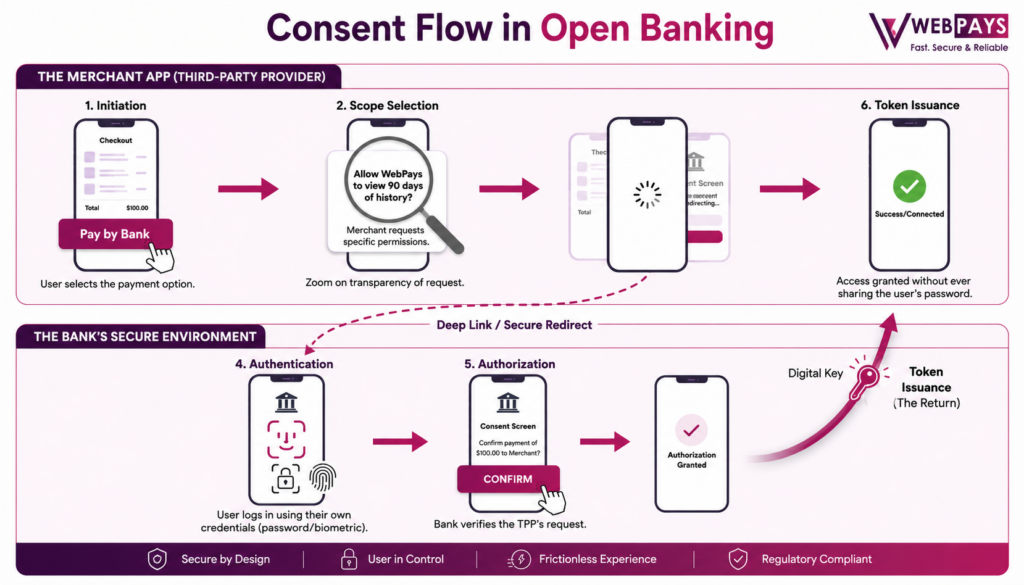
- No shared credentials. The customer never hands their banking password to the merchant or TPP. They authenticate directly with their bank, which then issues a scoped, revocable access token — a digital permission slip that only unlocks what the customer agreed to.
- Real-time responses. Balance checks, identity verification, and payment confirmations happen in the time it takes to load a page, not overnight.
Consent Is the Control Mechanism
Every open banking payment runs through a consent step, usually referred to as the redirect or app-to-app flow:
- The TPP states exactly what it’s asking for — for example, a single payment of a specific amount to a specific merchant.
- The bank displays that request back to the customer in its own app or portal and asks for explicit confirmation.
- The customer can view and revoke any active permission at any time from their banking app, which cuts off the TPP’s access immediately.
This consent architecture is a meaningful improvement over stored-card-on-file models, where a customer often has limited visibility into which merchants still hold their payment details.
A2A Payments: The Execution Layer
If open banking is the permission system, A2A payments are what actually happens once permission is granted: money moves directly from the payer’s bank account to the payee’s, with no card scheme, issuing bank, or acquiring bank taking a cut along the way. A2A transfers themselves aren’t new — bank wires and ACH batches are decades old — but pairing them with open banking APIs is what makes a bank transfer feel like a checkout option instead of a manual back-office task.
Why A2A Costs Less Than Card Payments
A typical card transaction splits its fee across several parties:
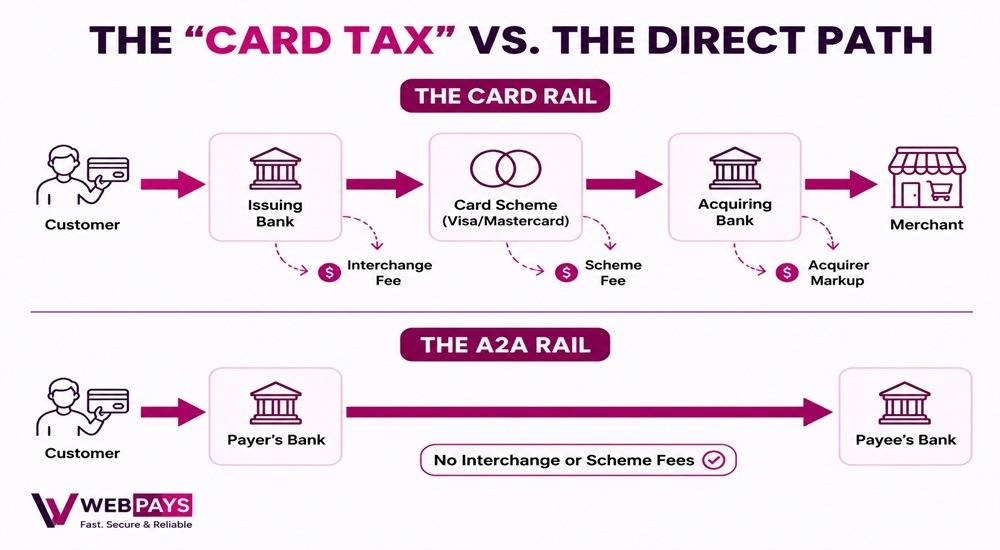
- Interchange, paid by the merchant’s acquiring bank to the customer’s issuing bank, funding rewards and risk management. Rates vary widely by region and card type — regulated consumer debit cards in some markets sit well under 1%, while unregulated commercial and cross-border cards can run past 2%.
- Scheme fees, paid to the card network itself (Visa, Mastercard, and others) for use of their rails.
- Acquirer markup, the processor’s own margin for underwriting, settlement, and support.
Stacked together, these commonly produce a merchant discount rate (MDR) in the broad range of 1.5% to 3.5% of transaction value — higher still for merchants classified as high-risk, where acquirers price in extra chargeback and fraud exposure.
A2A payments skip this stack entirely. Because the transfer moves bank-to-bank, there’s no interchange and no scheme fee to collect. Providers typically charge a flat fee or a small capped percentage instead.
Illustrative example: on a $12,000 B2B invoice payment, a 2.9% card rate would cost roughly $348 in fees. An A2A payment charged at a flat rate capped around $5–$10 would cost a small fraction of that. The exact savings depend entirely on the provider’s pricing and the transaction size — this is a worked example to show the mechanism, not a guaranteed outcome for every merchant or provider.
Push Payments vs. Pull Payments
- Push payments (credit transfers): the customer actively authorizes and sends the funds. Because the customer initiated it themselves, these transfers are generally treated as final and are harder to reverse than a card charge.
- Pull payments (debit transfers): the merchant draws funds based on a standing mandate, similar to a direct debit. These tend to settle more slowly, fail more often on insufficient funds, and are easier for the payer to recall.
Instant Payment Rails to Know
- SEPA Instant (Eurozone): settles euro transfers in under 10 seconds, around the clock. Under the EU’s Instant Payments Regulation, euro-area banks and payment firms have been required since January 2025 to receive instant euro transfers at the same cost as standard transfers, with the obligation to send instant payments and verify payee names taking effect from October 2025.
- Faster Payments (UK): the rail underpinning most UK pay-by-bank activity.
- RTP and FedNow (USA): two parallel real-time rails — one run by the banking industry, one by the Federal Reserve — both offering near-instant settlement.
- Pix (Brazil): the central bank’s instant payment system and one of the most widely cited examples of rapid A2A adoption at national scale.
- UPI (India): a mobile-first, bank-to-bank system handling enormous transaction volumes each month.
How a Pay-by-Bank Checkout Actually Works
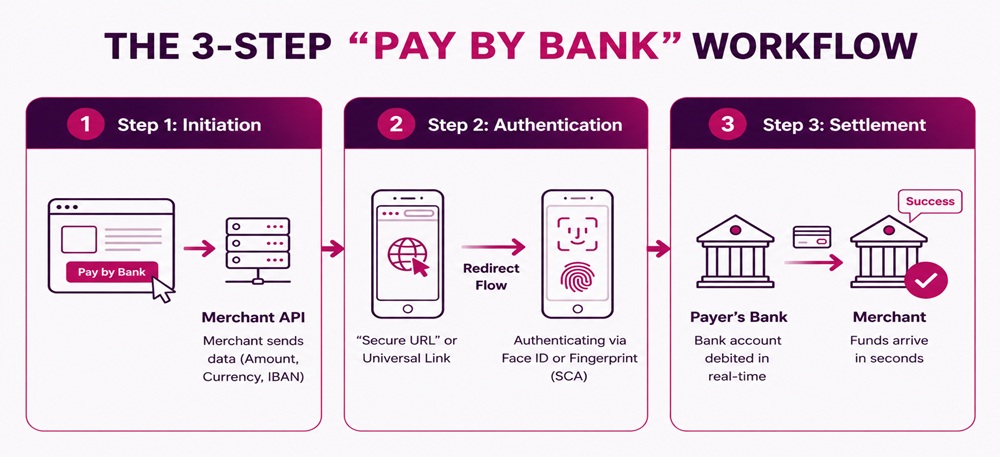
- Initiation: the customer selects “Pay by Bank” instead of entering card details. The merchant’s system passes the amount, currency, and a reference ID to the payment initiation provider.
- Authentication: the customer is redirected into their banking app (often via a direct app-to-app link on mobile) and confirms the payment using their bank’s own login and biometric checks.
- Settlement: the bank debits the account and routes the instruction through an instant payment rail. Funds typically land in the merchant’s account within seconds, and the order can be marked paid immediately.
What This Means for High-Risk and B2B Merchants
The economics of open banking and A2A payments land hardest on merchant categories that pay the most for card acceptance today, including high-risk verticals like iGaming, forex, and adult content, alongside B2B businesses moving large invoice values.
- Lower cost on high-ticket transactions. Because A2A pricing is typically flat or capped, the savings scale with transaction size — the opposite of card fees, which grow with the amount charged.
- Faster access to funds. High-risk card acquiring often comes with rolling reserves, where a percentage of revenue is withheld for months to cover potential chargebacks. A2A settlement doesn’t carry that structure, since there’s no card-scheme dispute mechanism sitting behind it.
- Cleaner B2B reconciliation. Open banking APIs let merchants attach structured reference data, like an invoice ID, to the payment itself. That data travels with the transfer and shows up on the bank statement, cutting down the manual matching that plagues wire payments.
- A different dispute reality, not a risk-free one. It’s accurate to say A2A payments don’t carry a card-scheme chargeback mechanism, since there’s no card network dispute process behind a direct bank transfer. But that isn’t the same as being dispute-proof. In the UK, for example, a mandatory reimbursement scheme for authorised push payment fraud has applied to Faster Payments transactions since October 2024, run by the Payment Systems Regulator, so merchants accepting push payments in that market should still budget for fraud controls rather than assume finality removes all risk.
Regulatory treatment of payment methods varies by vertical and jurisdiction — this is especially true for iGaming, forex, and adult payment categories — so merchants should confirm specifics with their payment provider or counsel before relying on any single funding rail for a regulated product line.
The Regulatory Push Behind A2A Adoption
One thing often left out of open banking explainers: adoption in Europe isn’t purely market-driven anymore, it’s a compliance deadline. The EU’s Instant Payments Regulation, adopted in March 2024, required euro-area payment service providers to fully support receiving SEPA Instant Credit Transfers by 9 October 2025, alongside earlier obligations from January 2025 covering receipt and pricing parity with standard transfers. The 2025 SEPA Instant rulebook also introduced mandatory Verification of Payee checks and real-time customer notifications, tightening the operational bar for any PSP touching euro transfers. Merchants planning open banking acceptance in the EU should expect their providers to already be built around these requirements, not treat them as optional extras.
Getting Started
Open banking and A2A payments won’t replace cards outright, but for merchants carrying high card costs, rolling reserves, or messy B2B reconciliation, adding pay-by-bank as an option is a low-effort way to cut processing costs on a meaningful share of transactions. WebPays works with high-risk and B2B merchants across iGaming, forex, adult, CBD, and IPTV to build out payment stacks that combine card acceptance with newer rails like open banking and A2A transfers, matched to what’s actually licensed and workable in each merchant’s markets.
FAQ
What is open banking?
Open banking is a regulatory and technical framework that lets banks share account data or accept payment instructions from licensed third parties, only after the account holder explicitly consents.
What are A2A payments, and how do they relate to open banking?
A2A payments are direct transfers from a payer’s bank account to a payee’s, without a card network involved. Open banking APIs are what let a merchant trigger an A2A payment automatically at checkout, rather than requiring a manual bank transfer.
How much cheaper is pay-by-bank than card payments?
Card payments typically carry a combined merchant discount rate of roughly 1.5% to 3.5% once interchange, scheme fees, and acquirer markup are added together. A2A payments skip that stack and are usually priced as a flat fee or small capped percentage, so the relative savings tend to grow with transaction size.
How fast do A2A payments settle compared to cards?
Card settlement to a merchant’s account commonly takes two to three business days. A2A payments over instant rails like SEPA Instant, Faster Payments, or FedNow typically settle within seconds.
Are A2A payments completely dispute-proof?
No. A2A transfers don’t carry a card-network chargeback process, but that isn’t the same as zero dispute risk. Some markets have their own protections — the UK, for instance, requires banks to reimburse victims of authorised push payment fraud on Faster Payments transactions — so fraud controls still matter.
Which instant payment rails matter most for merchants right now?
SEPA Instant in the Eurozone, Faster Payments in the UK, RTP and FedNow in the US, Pix in Brazil, and UPI in India are the rails most commonly built into current pay-by-bank integrations.