
Most betting apps don’t fail because of the odds engine or the UX. They fail at the cashier. A player taps deposit, the bank declines, and that player is gone. Fix that and everything downstream gets easier.
Here is how the pieces fit: a merchant account that’s allowed to take gambling money, a gateway that connects it to your app, and dispute numbers low enough that neither gets pulled.
If you run a gambling app, you need three things to take deposits: a merchant account approved for gambling, a payment gateway that connects it to your app, and dispute numbers low enough to keep both. Most operators get stuck on the first one. Card networks put gambling in its own restricted category, so a standard processor will usually decline you before you get to integration.
This guide covers how a high risk gambling merchant account is assessed, what integration involves, and which payment methods are worth adding.
Why betting is treated as high risk
Gambling sits under MCC 7995. Visa and Mastercard restrict it, so your acquirer has to approve you specifically and give you separate merchant IDs. A lot of issuing banks also decline the code out of the box, which is why some deposits fail even after you’re approved.
The risk isn’t only about how the industry looks. Disputes run high because players regret losses and contest charges. Visa’s own rules also close a common workaround: if you load a gambling wallet, the transaction must be coded 7995, not as a foreign-currency purchase.
Don’t try to hide under a friendlier code. Miscoding is a compliance problem that often ends in account closure and withheld funds.
High risk gambling merchant account vs online gaming merchant account
In practice, providers use these labels loosely, and casino, betting and gaming merchant accounts overlap heavily. The useful question is what your players are doing:
- Real money staked, real money paid out. This is gambling. It needs a high risk gambling merchant account under 7995.
- Virtual chips, skill contests or esports with no wagering. This may qualify as an online gaming merchant account with different underwriting. Be honest about it, because underwriters check whether chips can be cashed out.
A high risk gaming payment gateway is the technical layer on top: the API, hosted checkout and reporting that plug into whichever account you’re approved for.
What underwriters ask for
Expect to hand over more than a business registration. Providers generally want:
- A gambling licence for the markets you serve, or proof you’re in the process of getting one
- A business plan and clear descriptions of how money moves. PSPs expect a full plan, proof of regulatory compliance and detailed transaction descriptions.
- Responsible gambling tools such as deposit limits, self-exclusion and cooling-off periods. Underwriters review these, and they test your geo-blocking themselves.
- KYC and AML procedures for players and for your own company
If you serve several countries, the file gets heavier. Each jurisdiction needs its own evidence of compliance.
The dispute limits that end accounts
This is where good operators lose their processing. Visa’s VAMP program changed in 2026. On 1 April 2026 the merchant “excessive” threshold dropped from 2.2% to 1.5%, with an $8 fee per disputed or fraudulent transaction and no warning tier. The ratio counts events, not money: fraud reports plus disputes, divided by settled transactions. A pile of small disputes hurts as much as a few big ones.
Your acquirer is under tighter pressure than you are. Acquirer thresholds sit at 0.5% (above standard) and 0.7% (excessive). So a merchant can be under Visa’s line and still get restricted, reserved or dropped by a bank protecting its own portfolio. Some regions differ (CEMEA merchants keep 2.2%), and monitoring can depend on minimum volumes, so ask your provider which numbers apply to you.
Mastercard runs its own program too. Its excessive chargeback program starts at 100 chargebacks and a 1.5% ratio, and its BRAM program covers MCC miscoding.
Practical takeaway: aim well under 0.5%, and turn on 3-D Secure and dispute alerts from day one.
How gambling payment gateway integration works
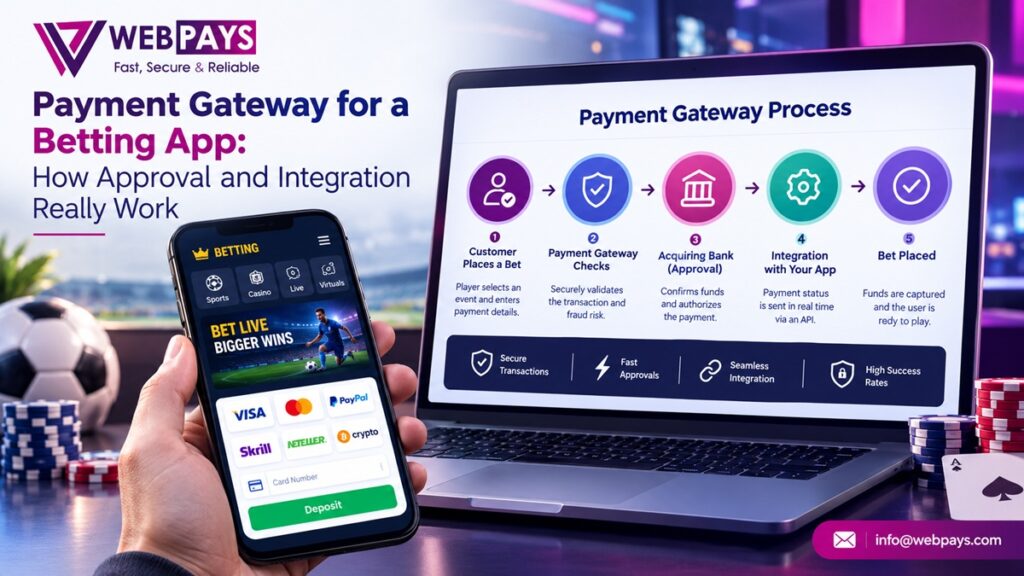
Gambling payment gateway integration services differ in detail, but the sequence is usually the same:
- Get approved first. Build against a sandbox, but don’t plan a launch date until the merchant account is live.
- Pick the integration style. A hosted checkout page keeps card data off your servers and shortens compliance work. A direct API gives you full control of the cashier design but puts more on you.
- Wire up 3-D Secure. It’s strongly recommended and in many jurisdictions mandatory for gambling.
- Handle webhooks properly. Credit a player balance only on a confirmed webhook, and make the handler safe to receive twice, otherwise retries create duplicate credits.
- Reconcile daily. Match gateway settlements against your player wallet ledger. Gaps show up here before they show up in a dispute.
- Build payouts alongside deposits. Withdrawals need their own rails, KYC checks and limits.
- Test the failure paths. Soft declines, timeouts, 3-D Secure abandonment and partial refunds cause more incidents than the happy path.
Payment methods worth adding
Cards stay the base, but they shouldn’t be your only rail. One industry directory estimates card decline rates in iGaming at 20-40% depending on region and issuer, so treat that as a rough guide, not a benchmark. A second rail recovers deposits that would otherwise vanish.
- Pay by bank (open banking). Trustly reports conversion as high as 98% on deposits and more than 95% of payouts settling instantly. These are the provider’s own figures, but the direction matches what operators report.
- E-wallets and local methods. Players in many markets choose these before cards.
- Crypto and stablecoins. Useful as an extra option for licensed operators. In Europe, crypto payment gateways must comply with MiCA, in force since 2025.
- Orchestration. Routing across several acquirers and retrying declines through another route reduces failed payments and protects uptime.
Payout speed deserves as much attention as deposits. Surveys cited in one 2026 industry report show most players expect winnings within 24 hours, and fewer than a third of operators deliver.
Choosing a provider
| Check | Why it matters | Red flag |
| Licences and jurisdictions covered | Determines which markets you can legally take | “We work in every country” |
| Acquirer relationships for MCC 7995 | Your account is only as stable as the bank behind it | No answer on who the acquirer is |
| Reserve, fee and settlement terms in writing | Rolling reserves change your cash flow | Vague or verbal terms |
| Dispute tooling | Alerts and 3-D Secure protect your VAMP ratio | Chargebacks left entirely to you |
| Payout support | Withdrawals decide retention | Deposits-only integration |
| Multi-currency and crypto options | Needed for cross-border play | Single-currency setups |
Specialists in this space, such as Webpays, position themselves around high-risk gateways for gaming, casino, gambling and forex, with multi-currency processing and merchant account approval support. Whoever you talk to, ask for terms and acquirer details in writing before you sign.
Apply Now!
FAQ
What is the best payment gateway for a betting app?
There is only webpays gaming payment gateway best. The right one holds the licences and acquirer links for your target markets, supports payouts and offers a backup rail beyond cards.
Can I use Stripe or PayPal for a betting app?
Generally no. Mainstream processors restrict gambling, which is why operators use specialist providers approved for MCC 7995.
How long does approval take?
It depends on your licence status, jurisdictions and documents. Complete KYC and AML files and a clear business plan speed it up. Any provider promising a fixed timeline before seeing your file is guessing.
Do I need a licence to get a high risk gambling merchant account?
Almost always, or proof one is in progress. Underwriters treat licensing as a baseline.
What happens if my chargebacks get too high?
You can face fees, reserves, restrictions or termination, and your acquirer may act before Visa does.