
Casino payment solutions cover two related but distinct things: the payment methods players use (cards, e-wallets, crypto, bank transfer) and the casino payment gateway providers that process those transactions on the operator’s behalf. This guide compares both, so you can evaluate what’s actually right for your platform rather than defaulting to whatever a broker recommends.
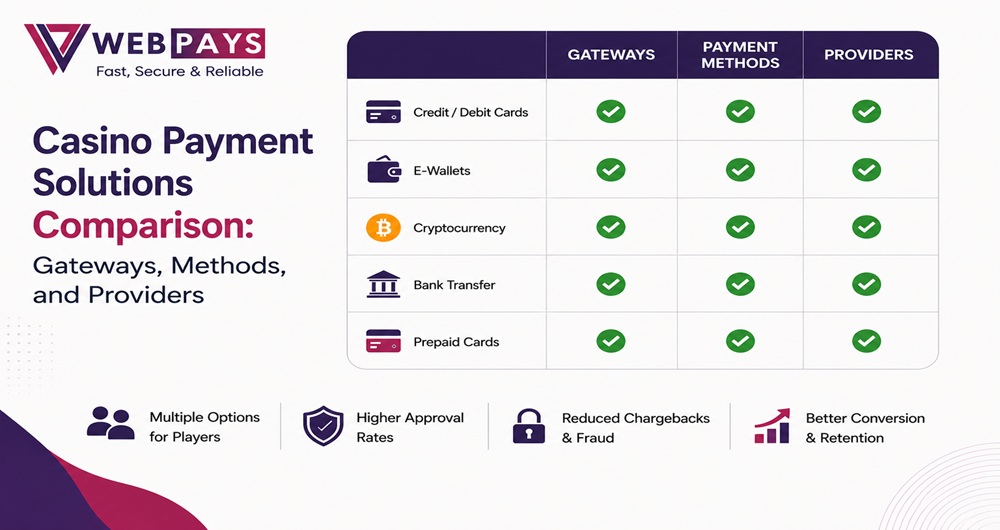
Casino Payment Methods, Compared
| Method | Speed | Player Privacy | Chargeback Risk | Best For |
| Credit/debit cards | Instant deposit | Low | High | Broad player reach |
| E-wallets (Skrill, Neteller) | Instant | Moderate | Low-moderate | Fast repeat depositors |
| Bank transfer / open banking | Minutes to instant | High | Very low | Regulated European markets |
| Cryptocurrency | Minutes | High | Near-zero | Privacy-focused, international players |
| Prepaid vouchers | Instant | High | Near-zero | Unbanked or privacy-conscious players |
No single method covers every player segment — most successful casino payment solutions strategies support at least three of the five categories above.
What a Casino Payment Gateway Actually Adds
A casino payment gateway is the infrastructure that connects those payment methods to your platform. Rather than integrating each method separately, a gateway provides:
- A single integration point for multiple payment methods
- Real-time fraud screening and 3D Secure authentication
- Intelligent routing — sending each transaction through whichever acquiring relationship has the best approval odds for that specific method and region
- Consolidated reporting across all payment methods in one dashboard
How to Compare Casino Payment Gateway Providers
When evaluating casino payment solutions providers, weigh them against these factors:
- Approval rate track record — a provider’s historical approval rate for card transactions in your target markets matters more than headline fee percentages
- Rolling reserve terms — most high-risk casino accounts carry a 5–10% rolling reserve; compare the percentage and release timeline, not just the processing fee
- Payment method breadth — confirm the provider supports the specific e-wallets and local methods your player base actually uses
- Multi-currency and multi-region support — critical if you operate across licensed markets with different local payment preferences
- Underwriting consultancy — some providers assist with company incorporation, licensing structure, and compliance in addition to pure processing
Common Pitfalls in Choosing Casino Payment Solutions
- Focusing only on the lowest fee — a slightly higher processing fee with a materially better approval rate almost always wins on net revenue
- Ignoring withdrawal speed — players judge a casino’s trustworthiness heavily on how fast withdrawals clear; slow payouts drive churn even when deposits work fine
- Single-provider dependency — relying on one casino payment gateway with no backup creates a single point of failure if that provider has downtime or tightens risk appetite
Why Webpays Stands Out Among Casino Payment Solutions Providers
Compared to brokers who route you to third-party acquirers, or generic high-risk processors treating casino as one vertical among many, Webpays differentiates in a few measurable ways:
- Native casino underwriting — approval decisions are made against gambling-specific risk models rather than generic high-risk scoring, which typically improves both approval speed and rate.
- Broad method coverage in one integration — cards, e-wallets, bank transfer/open banking, and crypto through a single connection, rather than needing three separate merchant relationships.
- Transparent rolling reserve terms — clearly stated reserve percentages and release schedules upfront, rather than terms that shift after onboarding.
- Multi-currency settlement — built for operators running across multiple licensed jurisdictions simultaneously, not bolted on as a regional exception.
FAQ: Casino Payment Solutions Comparison
1. What’s the difference between a casino payment solution and a casino payment gateway?
“Casino payment solutions” is the broader term covering both the payment methods players use and the providers that process them. A “casino payment gateway” specifically refers to the technology that connects those payment methods to your platform and routes transactions to acquiring banks.
2. Which payment method has the lowest chargeback risk for online casinos?
Cryptocurrency and prepaid vouchers carry near-zero chargeback risk because funds are collected upfront with no reversal mechanism. Bank transfers and open banking are close behind. Credit and debit cards carry the highest chargeback exposure of common casino payment methods.
3. What is a rolling reserve and why do casino payment gateways require one?
A rolling reserve is a percentage of transaction volume (typically 5–10%) that a payment provider holds back for a set period, released after that window closes. It exists to cover potential future chargebacks or disputes, and is standard practice for high-risk categories like gambling.
4. Should I use more than one casino payment gateway provider?
Many operators use two to three providers to improve overall approval rates, add redundancy against downtime, and route different payment methods through whichever provider handles them most efficiently in a given region.
5. Do casino payment solutions differ by region?
Yes. Regulated European markets favor bank transfer and open banking due to PSD2 requirements, while other regions may lean more heavily on cards or e-wallets. A provider’s local payment method coverage should match your specific target markets.