Winning a major jackpot is one of the most exciting moments for an online casino player. However, paying out a substantial prize involves much more than transferring money from a gaming platform to a players bank account. iGaming operators must manage payment security, identity verification, regulatory requirements, transaction limits, liquidity, and fraud prevention before releasing large winnings.
Jackpot payouts aren’t like everyday deposits—they can run into the thousands or even millions of dollars. For online casinos and sportsbooks, getting the payment infrastructure right isn’t optional; it’s essential.
Modern iGaming payment solutions help operators process high-value withdrawals through secure payment channels, automated verification systems, transaction monitoring, and multiple payout methods. These systems are designed to make large payouts more manageable while protecting both the gaming business and its customers.
Let’s explore how the process works and what operators should consider when handling significant jackpot winnings.
1. What Makes Large Jackpot Payouts Different?
Regular gaming withdrawals are generally smaller and follow predictable transaction patterns. Jackpot payouts are different because they involve unusually high amounts, additional verification requirements, and greater financial exposure.
For example, a player withdrawing $200 may complete the process through an ordinary withdrawal workflow. A player winning a $500,000 jackpot may need to complete additional identity checks, provide supporting documents, and receive approval before the funds are released.
Several factors make large jackpot payouts more complicated:
- High transaction values: Large withdrawals require additional financial controls and careful payment authorization.
- Identity verification: Operators must confirm that the winner is the legitimate account holder.
- Anti-money laundering checks: Unusual or high-value transactions may require enhanced due diligence and additional monitoring.
- Payment restrictions: Banks and payment providers may apply transaction limits or additional approval requirements.
- Liquidity management: Casinos must maintain sufficient available funds to honor significant winnings.
- Fraud prevention: Operators need to identify suspicious accounts, account takeovers, and potentially fraudulent jackpot claims.
A reliable payment infrastructure helps operators manage these requirements without creating unnecessary delays for legitimate winners.
2. How iGaming Payment Solutions Process Large Jackpot Withdrawals
Large jackpot payments typically pass through several stages before reaching the winner’s account. Payment providers and gaming operators coordinate these stages to maintain security, accuracy, and regulatory compliance.
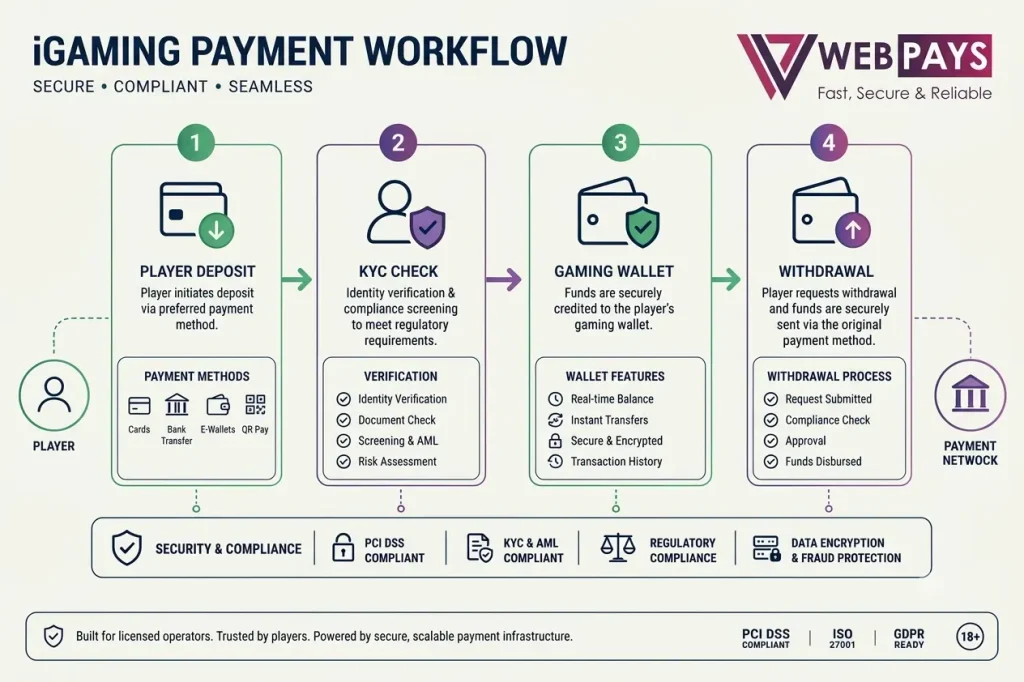
Step 1: Jackpot Verification
Before releasing the winnings, the gaming operator confirms that the jackpot is legitimate.
The verification process may include:
- Reviewing the player’s gaming activity.
- Confirming the winning game session.
- Checking jackpot calculations.
- Validating the applicable game rules.
- Reviewing account activity for suspicious behavior.
This step helps prevent disputes and ensures that the correct prize amount is approved.
Step 2: Player Identity Verification
The operator confirms the winner’s identity before processing a substantial withdrawal.
Depending on the jurisdiction, payment amount, and operator’s compliance policies, this may involve:
- Government-issued identification.
- Proof of residential address.
- Bank account ownership verification.
- Source-of-funds documentation.
- Additional due diligence for higher-risk transactions.
These checks help prevent identity theft, unauthorized withdrawals, and financial crime.
Step 3: Compliance and Risk Assessment
Payment providers and gaming operators evaluate whether the transaction meets applicable legal and regulatory requirements.
Automated monitoring systems can flag unusual payment patterns, inconsistent account information, or transactions that require manual review.
For large jackpot payouts, enhanced due diligence may be necessary. However, not every large transaction automatically indicates suspicious activity. Reviews should be based on applicable regulations and risk assessments.
Step 4: Payment Method Selection
Once the payout is approved, the operator selects an appropriate withdrawal channel.
Common options include bank transfers, supported digital wallets, and other locally available payment methods.
The best option depends on the player’s location, payout amount, provider restrictions, currency, and processing capabilities.
Step 5: Payment Authorization and Settlement
The payment provider receives the withdrawal instruction and processes the transfer through the selected payment network.
For particularly large payouts, additional authorization or manual approval may be required.
The operator should also receive payment status updates so that the finance team can monitor whether the transaction has been accepted, processed, completed, or rejected.
3. Which Payment Methods Are Used for Large Jackpot Payouts?
Not every payment method is suitable for high-value casino withdrawals. iGaming operators generally need payment channels that support larger transactions, provide reliable settlement information, and operate within the relevant regulatory framework.
Bank Transfers
Bank transfers are among the most established options for paying large jackpot winners.
They are particularly useful when the withdrawal amount exceeds the limits supported by digital wallets or other payment methods.
Advantages:
- Suitable for substantial withdrawal amounts.
- Established banking infrastructure.
- Clear transaction records.
- Supports international transfers where available.
Limitations:
- Processing times can vary.
- Additional bank verification may be required.
- International transfers may involve currency conversion fees.
- Receiving banks may apply their own restrictions.
Digital Wallets
Digital wallets provide an alternative for customers who prefer electronic payment methods.
However, wallet providers often impose account-specific and jurisdiction-specific transaction limits. Therefore, operators must verify whether the selected wallet supports the required payout amount.
Advantages:
- Convenient electronic transfers.
- Familiar withdrawal experience.
- Useful for eligible smaller and medium-sized payouts.
- Potentially faster settlement than traditional international transfers.
Limitations:
- Maximum balance and withdrawal limits.
- Additional verification requirements.
- Geographic restrictions.
- Not every wallet supports large jackpot payments.
Cryptocurrency Payments
Some licensed gaming platforms operating in jurisdictions where cryptocurrency payments are permitted may support crypto-based withdrawals.
These transactions can use blockchain networks to transfer digital assets between supported wallets.
However, cryptocurrency payouts require careful consideration of wallet ownership, applicable licensing requirements, sanctions screening, exchange restrictions, and blockchain transaction monitoring.
Operators should also account for cryptocurrency price volatility and the possibility of network congestion.
Local Payment Methods
Local bank transfers and domestic payment networks can be useful for operators serving players across multiple countries.
They may reduce cross-border transfer complexity and provide payment options familiar to local customers.
The availability of high-value withdrawals depends on local banking regulations, payment provider policies, and transaction limits.
4. How Do Payment Providers Prevent Fraud During Jackpot Payouts?
Large jackpot payouts can attract fraudulent activity because of the significant amounts involved. Payment providers therefore use multiple security measures to protect operators and legitimate winners.
Some of the most important mechanisms include:
Multi-factor authentication (MFA): Additional authentication helps confirm that the person requesting the withdrawal has access to the legitimate account.
Transaction monitoring: Automated systems review transaction patterns and flag unusual activity for further investigation.
Account ownership verification: The operator checks whether the receiving account belongs to the verified winner.
Device and IP monitoring: Changes in device behavior, login locations, or account access patterns may trigger additional security checks.
Withdrawal approval controls: Large transactions may require approval from authorized finance or compliance personnel.
AML screening: Relevant screening processes help identify potential money laundering, sanctions exposure, or other prohibited financial activity.
These controls should work together rather than operate as isolated security features. A well-designed iGaming payment system combines automated monitoring with human review when necessary.
5. How Do iGaming Operators Manage Liquidity for Million-Dollar Jackpots?
Liquidity management is one of the most important aspects of handling substantial jackpot payouts.
Imagine an online casino announces a $2 million jackpot. The operator must be financially prepared to honor the winning amount according to the applicable game rules and payment obligations.
Payment processing technology alone cannot guarantee that an operator has enough money available to pay its winners. Operators need proper financial planning and funding arrangements.
Common liquidity management practices include:
Maintaining Dedicated Payout Reserves
Operators may maintain designated funds or other permitted financial arrangements to cover expected player winnings.
These reserves help businesses prepare for large withdrawals without disrupting everyday financial operations.
Working With Multiple Banking Partners
Relying on a single banking relationship can create operational challenges if that institution imposes restrictions or experiences service interruptions.
Multiple approved banking relationships can provide additional flexibility, subject to regulatory requirements and contractual arrangements.
Using Jackpot Insurance
Some gaming businesses use jackpot insurance or prize indemnity arrangements to manage exposure to exceptionally large prizes.
The availability and structure of these arrangements depend on the game, jurisdiction, insurer, and contractual terms.
Forecasting Payment Obligations
Historical gaming data can help operators estimate expected withdrawals and prepare for potential jackpot liabilities.
Financial forecasting supports better cash-flow planning and reduces the possibility of unexpected payout disruptions.
6. Why Multi-Currency Payment Processing Matters for International iGaming Platforms
Many online gaming platforms serve customers in different countries. As a result, jackpot payouts may involve multiple currencies, international banking networks, and different regulatory requirements.
For example, a player in Germany might win a jackpot on a gaming platform operated by a company based elsewhere. The operator must determine which payout methods are permitted, how the currency conversion will work, and whether the receiving bank can accept the transfer.
Multi-currency payment processing helps operators manage these requirements.
Important capabilities include:
- Support for multiple settlement currencies.
- Transparent foreign exchange calculations.
- International bank transfer connectivity.
- Country-specific payment routing.
- Currency conversion reporting.
- Reconciliation across different payment channels.
Operators should also communicate any applicable conversion fees and settlement conditions before processing the payout.
A payment provider with international acquiring and payout capabilities can help gaming businesses coordinate payment operations across supported markets.
7. What Happens When a Jackpot Payout Is Delayed?
Even when a player has won a legitimate jackpot, the withdrawal may not arrive immediately.
Several factors can affect the payment timeline:
| Reason for delay | What it means |
| Additional KYC checks | The operator needs further identity documents |
| AML review | The transaction requires compliance assessment |
| Bank transfer limits | The receiving or sending bank restricts the amount |
| Incorrect banking details | The payment cannot be delivered successfully |
| Payment provider review | Additional authorization is required |
| International settlement | Cross-border banking networks take additional time |
| Currency conversion | The transfer requires foreign exchange processing |
Operators should maintain clear communication with winners throughout the process.
Rather than displaying a generic pending status, gaming platforms should explain whether a withdrawal is awaiting verification, approval, payment processing, or settlement.
This improves transparency and helps reduce customer complaints.
8. What Features Should Operators Look for in an iGaming Payment Gateway?
Choosing a payment gateway is an important decision for any gaming business, particularly when the platform handles high-value withdrawals.
Not all payment processors support gambling-related businesses, and not all providers can accommodate large payout requirements.
Before selecting a payment partner, operators should evaluate the following features.
| Feature | Why it matters |
| High-value transaction support | Helps accommodate substantial withdrawals |
| Multiple payout methods | Provides flexibility across different markets |
| KYC and AML integration | Supports identity verification and compliance workflows |
| Fraud monitoring | Helps identify suspicious transactions |
| Multi-currency support | Facilitates international payment operations |
| Payment reporting | Improves transaction tracking and reconciliation |
| API integration | Connects payment infrastructure with casino platforms |
| Technical support | Helps resolve payment issues and operational interruptions |
| Regulatory coverage | Confirms whether the provider supports the operator’s licensed markets |
A provider should be evaluated on its actual capabilities, supported jurisdictions, licensing arrangements, settlement terms, and experience with gaming merchants.
9. Comparing Payment Providers for iGaming Businesses
The payment provider an operator selects can influence withdrawal reliability, payment acceptance, compliance workflows, and international expansion.
Here are some providers and platforms worth evaluating when researching payment infrastructure.
| Provider | Areas to evaluate |
| WebPays | High-risk merchant services, international payment connectivity, and supported payment methods |
| Inquid | Payment gateway capabilities and merchant integration |
| PayCly | Merchant account services and payment acceptance |
| BoxCharge | Payment processing infrastructure and merchant support |
| Nuvei | International payment processing and alternative payment methods |
| Paysafe | Digital wallets and payment processing |
| Worldpay | Merchant acquiring and payment acceptance |
| Adyen | Enterprise payment processing and international acquiring |
| Checkout.com | Payment acceptance and payment technology |
Important: These providers do not all offer identical services or necessarily support gambling merchants in every jurisdiction. Operators should confirm gaming-sector acceptance, high-value payout capabilities, licensing requirements, and contractual restrictions directly with each provider.
For iGaming operators considering WebPays, the relevant questions include whether their gaming model and operating jurisdictions are supported, which payout channels are available, and what transaction limits and settlement arrangements apply.
10. How Can Operators Make Large Jackpot Payouts Faster and More Reliable?
Speed is important, but it should never come at the expense of security or regulatory compliance.
Gaming businesses can improve their payout operations by focusing on a few practical areas.
Automate routine verification: Automated KYC workflows can reduce unnecessary manual work when customer information is complete and verification requirements are satisfied.
Establish clear payout policies: Publish withdrawal conditions, verification requirements, applicable limits, and expected processing timelines.
Integrate multiple payment channels: Alternative payout methods can help operators manage different transaction sizes and geographical requirements.
Create an approval hierarchy: Define which employees can authorize different withdrawal amounts and when additional review is necessary.
Monitor payment performance: Track failed withdrawals, processing times, settlement delays, and payment provider response rates.
Maintain sufficient liquidity: Keep appropriate financial reserves and funding arrangements to meet payout obligations.
Provide customer updates: Notify winners when their withdrawal moves from verification to approval and settlement.
These practices help create a more predictable payment experience while giving finance and compliance teams greater control over high-value transactions.
11. The Future of Large Jackpot Payouts in iGaming
Payment technology is changing how online gaming businesses manage large withdrawals.
Several developments are likely to influence jackpot payment operations over the coming years.
AI-Powered Fraud Detection
Machine learning systems can analyze transaction behavior and identify unusual patterns. These tools can help payment teams prioritize suspicious transactions while reducing unnecessary manual reviews.
Real-Time Payment Networks
Instant payment infrastructure is expanding in several markets. Where supported, permitted, and within applicable limits, these networks may reduce the time required to transfer winnings.
However, large international jackpot payments may still require additional verification and settlement arrangements.
Better Payment Orchestration
Payment orchestration platforms allow operators to connect multiple payment providers through a centralized integration.
This can improve routing decisions, reporting, and operational flexibility.
Improved Compliance Automation
Automated identity verification, transaction screening, and payment monitoring can help operators manage regulatory obligations more consistently.
The goal is not simply to process payouts faster. It is to build payment systems that can handle large transactions reliably while maintaining appropriate financial controls.
Conclusion
Large jackpot payouts are an important part of the iGaming customer experience, but processing them requires careful coordination between gaming operators, payment providers, banks, and compliance teams.
A reliable iGaming payment infrastructure brings together high-value transaction support, identity verification, fraud monitoring, multi-currency capabilities, liquidity planning, and transparent payout reporting.
For gaming businesses operating across international markets, selecting the right payment partner is particularly important. Providers such as WebPays, Inquid, PayCly, and other payment technology companies are worth evaluating based on their actual gaming-sector coverage, integration capabilities, and supported payout arrangements.
Ultimately, the best iGaming payment solution is not simply the one that transfers money quickly. It is the one that helps operators pay legitimate winners accurately, securely, and in accordance with applicable regulations.
Frequently Asked Questions
1. How do iGaming payment solutions handle million-dollar jackpot payouts?
They coordinate jackpot verification, player identity checks, compliance reviews, payment authorization, and settlement. Operators also need sufficient liquidity and payment partners capable of supporting the required transaction amounts.
2. How long does a large casino jackpot payout take?
There is no universal processing time. Some withdrawals may be completed relatively quickly, while larger payments can take several business days or longer if additional verification, banking approvals, or international settlement procedures are required.
3. Which payment method is best for large casino jackpot withdrawals?
Bank transfers are commonly considered for substantial payouts because they support high-value financial transfers. However, the most suitable method depends on the player’s country, bank restrictions, operator licensing, and payment provider limits.
4. Why do casinos request additional documents before releasing jackpot winnings?
Casinos may request additional documents to verify the winner’s identity, confirm account ownership, assess source of funds, and meet applicable AML and regulatory requirements.
5. Can cryptocurrency be used for large iGaming jackpot payouts?
Some gaming platforms support cryptocurrency withdrawals where permitted by local laws and licensing conditions. Operators must consider wallet verification, blockchain monitoring, sanctions requirements, asset volatility, and applicable transaction restrictions.
6. Do all payment gateways support high-value iGaming transactions?
No. Many payment gateways restrict gambling-related businesses or impose transaction limits. Operators should confirm the provider’s gaming acceptance policy, supported jurisdictions, payout limits, and settlement capabilities before integration.
7. What should an iGaming operator do if a jackpot payment fails?
The operator should identify the failure reason, check the receiving account details, contact the payment provider, and verify whether the transaction needs to be resubmitted. The winner should receive clear updates until the payment is resolved.