
The UK is one of the most attractive markets for high-risk businesses — and one of the easiest places to get rejected.
Many high-risk merchants assume their approval failed because of their industry.
In reality, most payment gateway rejections in the UK happen because of avoidable structural mistakes, not because high-risk businesses are banned.
Understanding these mistakes — and fixing them before applying — can dramatically improve approval outcomes.
Why the UK Is Unforgiving for High-Risk Payment Approvals
The UK payment ecosystem is heavily influenced by:
- FCA-regulated financial institutions
- Strict acquiring bank risk models
- Card network monitoring programs
- Consumer-first protection rules
UK acquirers are particularly sensitive to predictability and transparency.
High-risk businesses are allowed — but they are evaluated early, deeply, and decisively.
What Makes a Merchant “High-Risk” in the UK
High-risk classification in the UK is driven by business behaviour, not just category.
Common factors include:
- Cross-border customer bases
- Subscription or recurring billing
- Digital or intangible services
- High refund or dispute potential
- Offshore or complex corporate structures
Industries often classified as high-risk include:
- Online gaming & betting
- Forex & CFDs
- Crypto-related services
- IPTV & streaming
- Adult & dating platforms
- Nutraceuticals & supplements
Being high-risk is not disqualifying — but it requires precision.
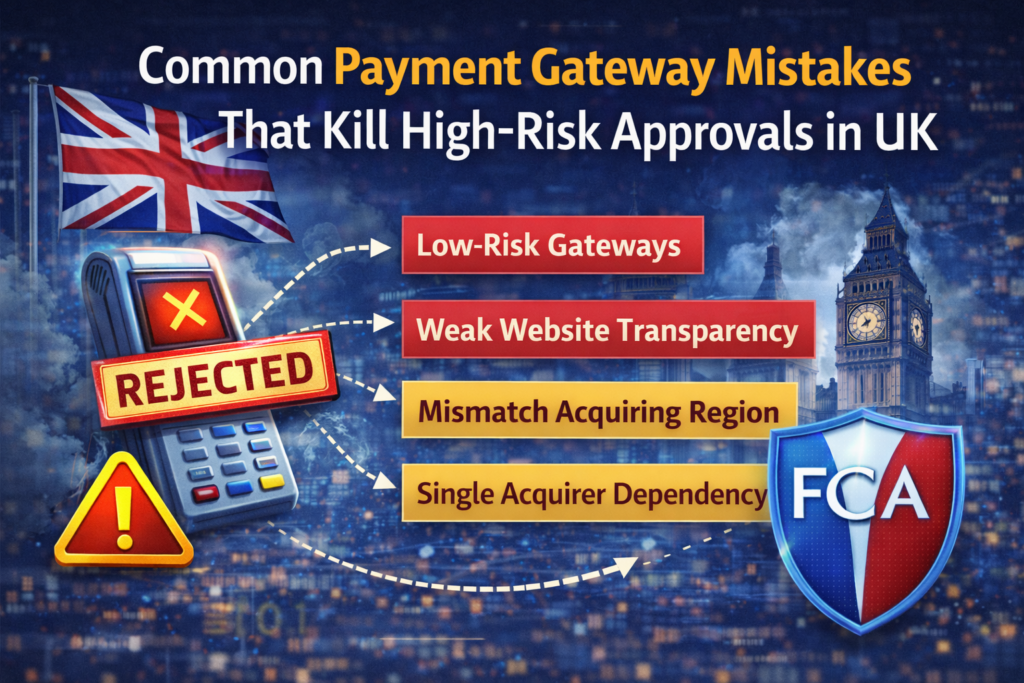
Mistake #1: Applying With a Low-Risk or Domestic Payment Gateway
One of the fastest ways to get rejected in the UK is using a gateway built for low-risk merchants.
These gateways:
- Approve quickly
- Monitor aggressively
- Shut down without flexibility
They are not designed to support high-risk transaction patterns or cross-border volume.
UK acquirers identify these mismatches immediately.
Mistake #2: Website Transparency Gaps
UK underwriting teams conduct detailed website audits.
Common red flags include:
- Missing or weak Terms & Conditions
- Unclear refund and cancellation policies
- Hidden pricing or billing logic
- No visible company information
Even compliant businesses fail approvals when their website signals consumer risk.
Mistake #3: Poor Subscription & Billing Disclosure
Subscription models are closely scrutinised in the UK.
Rejections often occur when:
- Billing cycles are unclear
- Free trials convert automatically without explanation
- Cancellation flows are hidden or complicated
Lack of transparency here is viewed as consumer harm — a major red flag.
Mistake #4: Geographic Mismatch Between Customers & Acquiring
A common UK rejection trigger:
- UK customers
- Non-UK acquiring routes
- No clear justification
Without proper routing logic and explanation, this raises immediate compliance concerns.
Mistake #5: Over-Reliance on a Single Acquirer
UK banks prefer risk distribution.
Merchants relying on:
- One gateway
- One acquiring bank
- One processing route
are viewed as operationally fragile.
A single review can halt all payments.
Mistake #6: Treating Compliance as a Finish Line
Many merchants believe that:
“PCI DSS or GDPR compliance guarantees approval.”
In the UK, compliance is expected, not rewarded.
Underwriters focus on:
- Operational readiness
- Refund behaviour
- Chargeback control
Paper compliance without operational proof leads to rejection.
Mistake #7: Weak Chargeback & Refund Controls
Chargebacks are one of the strongest rejection signals in the UK.
Red flags include:
- No dispute monitoring
- No refund escalation logic
- No thresholds or alerts
Banks want to see prevention, not reaction.
Mistake #8: “Test First, Fix Later” Strategy
This approach no longer works in the UK.
Acquirers now:
- Reject incomplete setups early
- Monitor transactions immediately
- Terminate faster
Merchants must be approval-ready on day one.
How Webpays Helps UK High-Risk Merchants Avoid These Mistakes
Most high-risk rejections in the UK happen because the payment structure is wrong, not because the business is unacceptable.
Webpays helps UK-focused high-risk merchants by:
- Integrating high-risk compatible gateways
- Aligning acquiring routes with UK risk expectations
- Implementing multi-acquirer routing for resilience
- Structuring payment flows for transparency and control
Instead of forcing high-risk businesses into low-risk systems, Webpays focuses on approval durability.
What UK Acquirers Actually Want to See
Approval success increases when merchants demonstrate:
- Transparent customer journeys
- Clear billing and refund logic
- Geographic alignment
- Risk distribution
- Operational readiness
Merchants who prepare for these expectations are approved more consistently.
Conclusion
High-risk payment approvals in the UK are not about luck.
They are about structure, transparency, and readiness.
Merchants who avoid these common mistakes don’t just get approved —
they build payment systems that survive long-term scrutiny.
Platforms like Webpays are designed to help high-risk merchants move from fragile approvals to stable UK payment operations.