
Selling CBD products in Australia comes with many payment challenges that go far beyond meeting legal requirements. Even if a business is fully compliant with Therapeutic Goods Administration (TGA) rules, it can still be denied by traditional banks and payment processors, as CBD is often labelled as a high-risk industry. Thus, getting a CBD merchant account in Australia is not as simple as applying for a regular payment account. It requires working with providers that understand the regulatory landscape and high-risk underwriting.
Whether you operate a prescription-based CBD business, sell hemp-derived wellness products, or are preparing for future ARTG-approved product launches, understanding how payment processors assess risk can significantly improve your approval chances. Webpays explains the current Australian CBD regulations in 2026, why mainstream payment providers reject CBD merchants, what documentation underwriters expect, typical payment processing costs, and practical steps to secure a compliant high-risk merchant account with confidence.
Understanding Why CBD Is Considered High Risk
Many merchants assume that obtaining the necessary licenses is enough to qualify for payment processing. In reality, acquiring banks evaluate far more than legal compliance. CBD merchants are typically placed in the high-risk category because of changing regulations, higher-than-average chargeback potential, cross-border sales, and strict card network policies. Even a fully compliant business may require specialized underwriting before payment processing is approved.
Common Mistakes That Delay CBD Merchant Account Approval
Many applications are delayed or declined because merchants overlook important underwriting requirements. Common issues include:
- Making unapproved therapeutic or medical claims on product pages.
- Missing or outdated Certificates of Analysis (CoAs).
- Unclear refund and shipping policies.
- Inconsistent business information across the website and registration documents.
- Lack of previous payment processing history.
- Selling internationally without explaining compliance procedures.
Correcting these issues before applying can significantly improve approval speed.
Choosing the Right CBD Payment Provider
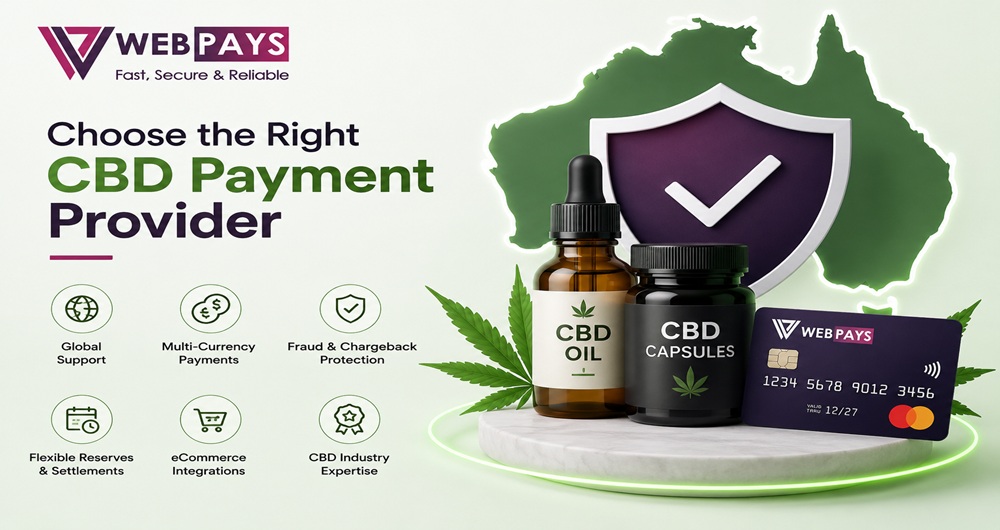
Not every payment provider supports CBD businesses. Before selecting a provider, compare:
- Support for Australian and international merchants.
- Multi-currency payment acceptance.
- Chargeback monitoring and fraud prevention.
- Reserve requirements and settlement timelines.
- Integration with eCommerce platforms.
- Experience underwriting CBD and other regulated industries.
Working with a processor experienced in high-risk industries often leads to faster approvals and more competitive pricing.
Where Australian CBD Law Actually Stands in 2026
This is the part most payment guides get wrong, so it’s worth being precise about it.
In 2020–2021, the Therapeutic Goods Administration (TGA) down-scheduled certain low-dose cannabidiol preparations from Schedule 4 (prescription-only) to Schedule 3 (pharmacist-only), permitting up to 150 mg/day for adults without a prescription — but only for products that meet strict formulation rules (oral, sublingual, or oromucosal only; no vaping, smoking, or topical products) and that are individually approved and listed on the Australian Register of Therapeutic Goods (ARTG).
That second condition is the catch. For years, no product actually cleared TGA approval for Schedule 3 listing, meaning the “over-the-counter” pathway existed on paper but not in practice. In October 2025, the TGA issued a fresh final decision confirming the Schedule 3 framework and inviting sponsoring companies to formally lodge ARTG applications. As of mid-2026, there are still no Schedule 3 CBD products listed on the ARTG — applications are in progress, but the review process (which can run close to a year) means most Australian consumers still access CBD either through prescription channels (Special Access Scheme or Authorised Prescriber pathways) or through the unregulated hemp/wellness market, which sits in a legal grey area outside the therapeutic goods framework entirely.
Why this matters for your merchant account: underwriters will ask which category your product falls into. “TGA-scheduled medicine pending ARTG approval,” “prescription-only medicinal cannabis,” and “hemp-derived wellness product marketed outside therapeutic claims” are three very different risk profiles to a bank, even though all three might reasonably be called “CBD” by a customer. Knowing exactly which one you are — and being able to say so precisely in your application — is the single biggest factor in how fast you get approved and at what rate.
Why Mainstream Processors Decline CBD Merchants
It’s rarely about legality. It’s about risk exposure that mainstream acquirers aren’t set up to underwrite:
- Card network policy, not Australian law – Visa and Mastercard classify CBD and hemp-derived products under restricted merchant category codes globally, largely because of inconsistent regulation in the US market where card networks set policy centrally. An Australian bank processing for you still inherits that network-level restriction.
- Chargeback and refund exposure – Wellness and nutraceutical categories generally run higher dispute rates than average retail, driven by subscription cancellations, unclear labeling, and customers disputing charges they don’t recognize on a statement.
- Advertising and claims risk – Direct-to-consumer advertising of Schedule 3 medicines is banned in Australia. If your marketing implies a therapeutic claim your product isn’t approved to make, that’s a compliance exposure the processor is underwriting too, not just you.
- Cross-border complexity – Many Australian CBD brands source formulations or fulfil orders internationally, which pulls in a second jurisdiction’s rules on top of the TGA’s.
What a High-Risk Underwriter Actually Wants to See
A complete, well-organized application moves faster than a compliant-but-thin one. At minimum, expect to provide:
- Product classification documentation — lab-tested Certificate of Analysis (CoA) per SKU confirming THC content, ARTG status if applicable, and clear labeling that matches TGA rules.
- Business registration and beneficial ownership — standard KYB, but expect enhanced due diligence given the category.
- Website and marketing review — no therapeutic claims beyond what’s approved, no imagery suggesting recreational cannabis use, clear terms of service, refund policy, and age-gating if required.
- Sourcing and supply chain documentation — where the CBD is extracted, manufactured, and imported from, with import permits where relevant.
- Processing history — prior statements if you’ve processed elsewhere; a clean history (even at a lower volume) meaningfully improves your offer.
- Financial projections and average ticket size — underwriters size reserve requirements around expected volume and refund patterns, not just the category label.
What It Actually Costs
Webpays own CBD guide never publishes indicative pricing — which leaves merchants guessing. Real-world ranges for CBD merchant accounts in Australia and comparable markets typically look like this:
| Factor | Typical Range |
| Discount rate | 3.5% – 6.5% per transaction |
| Rolling reserve | 5% – 15% of volume, held 90–180 days |
| Chargeback threshold before review | Usually 1% of transaction count |
| Setup / underwriting fee | Often waived or capped under AU$500 for well-documented applicants |
These figures move based on your processing history, average order value, subscription vs. one-time sales mix, and how cleanly your marketing matches your actual product classification. Merchants selling ARTG-track Schedule 3 products with clean documentation consistently land at the lower end; merchants with thin documentation or aggressive health claims get pushed toward the higher end or declined outright.
Conclusion
Obtaining a CBD merchant account in Australia is no longer simply about proving your business is legal. Payment providers evaluate regulatory compliance, product classification, marketing practices, financial stability, and overall risk before approving an application. Merchants who prepare comprehensive documentation, follow TGA advertising requirements, and partner with an experienced high-risk payment gateway provider are far more likely to receive favorable underwriting terms. By understanding the current regulatory environment and preparing in advance, CBD businesses can accept online payments confidently while supporting long-term growth in Australia’s evolving cannabis industry.
FAQ
Is CBD legal to sell online in Australia in 2026?
It depends on the product. Low-dose CBD approved and listed on the ARTG as a Schedule 3 medicine can, in principle, be sold through pharmacists without a prescription — but as of mid-2026 no product has completed that approval. Higher-dose or unapproved CBD generally requires a prescription pathway. Hemp seed-derived products without cannabidiol activity sit outside this framework entirely. Get your specific product classified before marketing it.
Why was I declined by my bank even though my CBD product is legal?
Card network restricted-category policy applies regardless of local legality. This is a processor risk decision, not a reflection of your compliance.
How long does high-risk CBD underwriting take?
With complete documentation, most applications are reviewed within 5–10 business days. Incomplete applications (missing CoAs, unclear TGA classification) are the most common cause of delay.
Do reserve requirements ever come down?
Yes — most high-risk agreements include reserve step-downs after a clean processing history, typically reviewed at 6 and 12 months.