
High risk merchants relocate for a narrower set of reasons than most people assume. It’s rarely about avoiding regulation entirely — regulated jurisdictions are usually easier to bank with, not harder. It’s about finding a jurisdiction whose licensing regime, banking relationships, and tax treatment actually match the merchant’s business model, instead of fighting a domestic banking system that treats an entire category as untouchable regardless of how compliant the individual business is.
This is a practical playbook for iGaming operators, forex brokers, and CBD/high-risk e-commerce businesses evaluating a move — what’s actually driving relocation decisions in 2026, which jurisdictions come up most often, and what genuinely changes (and what doesn’t) once you’ve moved.
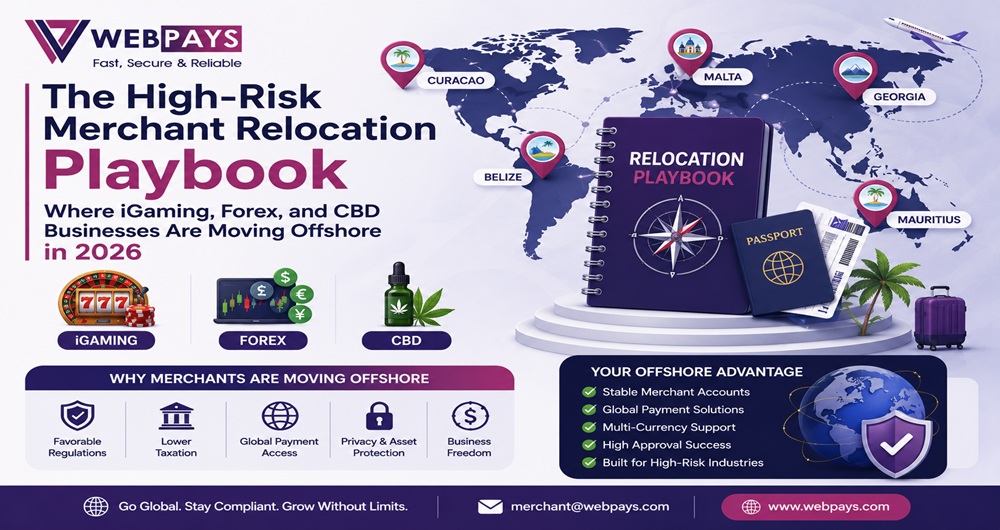
Why Merchants Relocate
Banking access, not banking avoidance. Domestic banks in many markets simply won’t open accounts for iGaming, forex brokerage, or CBD businesses — not because the business is doing anything wrong, but because the bank’s own risk appetite excludes the category entirely. A licensed operator in a jurisdiction with an established regulatory framework (Malta, Cyprus, Estonia, Isle of Man, and others) has access to banks and EMIs that specifically underwrite these categories, because the regulator itself has already done a layer of due diligence the bank can rely on.
Licensing speed and market access. A single EU-recognized license (Malta Gaming Authority for iGaming, CySEC for forex) can open passporting rights across the EU/EEA, replacing what would otherwise be a country-by-country licensing slog.
Tax structure that matches the business model. High-risk categories often run thin net margins after processing costs, chargebacks, and compliance overhead. Jurisdictions offering credible, substance-based tax treatment matter more to these merchants than to lower-margin, lower-risk businesses. This is distinct from pure tax avoidance, which regulators and banks now actively screen against.
Reputational lift with payment partners. A license from a Tier-1 regulator materially improves how quickly and cheaply a merchant gets approved for payment processing anywhere in the world, because it signals a baseline of compliance infrastructure already in place.
The 2026 Jurisdiction Shortlist, by Vertical
iGaming and Esports
Malta remains the default Tier-1 EU choice. A B2C Type 1 gaming license (casino, RNG-based games) requires a minimum €100,000 share capital and a €25,000 annual license fee, with realistic all-in year-one costs — including compliance infrastructure, legal, and working capital — running well into six figures for most operators. The tradeoff is real EU market access and strong banking relationships, since MGA-licensed operators are broadly recognized by payment providers worldwide.
Forex and CFD Brokerage
Cyprus is the standard EU entry point via a CySEC-licensed Cyprus Investment Firm (CIF). Capital requirements are tiered by the services offered: roughly €75,000 for advisory-only firms that don’t hold client funds, up to €125,000–€150,000 for straight-through-processing brokers, and €730,000+ for market makers holding client funds directly. Note: Cyprus raised its standard corporate tax rate from 12.5% to 15% effective January 1, 2026, narrowing — though not eliminating — its cost advantage over some competing jurisdictions.
Crypto-Adjacent Payment and CBD/Nutraceutical E-commerce
Estonia has undergone the single biggest jurisdictional shift affecting relocating merchants in 2026: its Crypto Asset Market Act, aligned with the EU’s MiCA regulation, moved licensing authority from the Financial Intelligence Unit (FIU) to the Financial Supervision Authority (FSA), and the transitional grace period for old FIU-issued VASP licenses expired on July 1, 2026. Any business still operating on a legacy Estonian VASP license without a completed FSA/MiCA authorization is, as of this writing, operating outside current licensing requirements. This is the single most time-sensitive fact for any merchant with existing Estonian crypto-payment infrastructure. Estonia remains attractive for its e-Residency model and EU passporting rights, but the compliance bar (minimum capital from €100,000 to €250,000 depending on service class, mandatory Estonian registered office, DORA cybersecurity obligations) is now materially higher than the “easy Estonian crypto license” reputation the country built between 2017–2020.
What Actually Changes When You Relocate
- Banking relationships. This is the primary win — access to EMIs and banks that already underwrite your category.
- Regulatory reporting burden. Increases, not decreases. Licensed jurisdictions require ongoing audits, AML reporting, and capital adequacy monitoring that unlicensed or loosely regulated jurisdictions don’t.
- Tax residency and substance requirements. Modern jurisdictions increasingly require genuine local substance (registered office, local staff, real decision-making presence) to qualify for favorable tax treatment — a “letterbox” company with no local operations is exactly what current EU substance rules and bank due diligence teams are designed to catch.
- What doesn’t change: your obligations in your home market. Relocating your corporate structure doesn’t remove tax reporting obligations for beneficial owners who remain tax residents elsewhere — see our dedicated guide on US reporting obligations for high risk merchants operating offshore.
A Realistic Relocation Timeline
| Phase | Typical Duration |
| Jurisdiction selection and legal structuring | 4–8 weeks |
| Local company incorporation | 1–4 weeks (varies significantly by jurisdiction) |
| License application preparation (business plan, KYC docs, technical review) | 2–4 months |
| Regulatory review and approval | 3–12 months, jurisdiction-dependent (Malta gaming: often 6–12 months; Cyprus CIF: 6–9 months typical, longer with information requests; Estonia CASP: 6–12 months) |
| Banking relationship establishment | Can run in parallel, but typically finalizes only once licensing is confirmed |
Total time from decision to fully operational, licensed status: realistically 9–18 months for most merchants, not the 8–12 weeks some jurisdiction-marketing content implies.
FAQ
Is relocating offshore the same as evading tax?
No — legitimate relocation involves genuine corporate substance, licensing, and compliance in the new jurisdiction, and does not remove personal tax residency obligations for beneficial owners. Structures designed purely to avoid reporting obligations, without genuine substance, face increasing scrutiny from both banks and regulators.
Which jurisdiction is “best” for a high risk merchant?
It depends entirely on vertical: Malta for iGaming, Cyprus for forex/CFD brokerage, and increasingly stringent options like Estonia for crypto-adjacent payment activity. There’s no single best answer independent of your business model.
Does a Malta or Cyprus license guarantee payment processing approval elsewhere?
It significantly improves your odds and often your rates, because it demonstrates a baseline compliance infrastructure — but individual processors still conduct their own underwriting.
What happened with Estonia crypto licensing in mid-2026?
The transitional period allowing legacy FIU-issued VASP licenses to remain valid ended on July 1, 2026. Businesses operating on old licenses without completed FSA authorization under the Crypto Asset Market Act/MiCA framework need to address this immediately.