
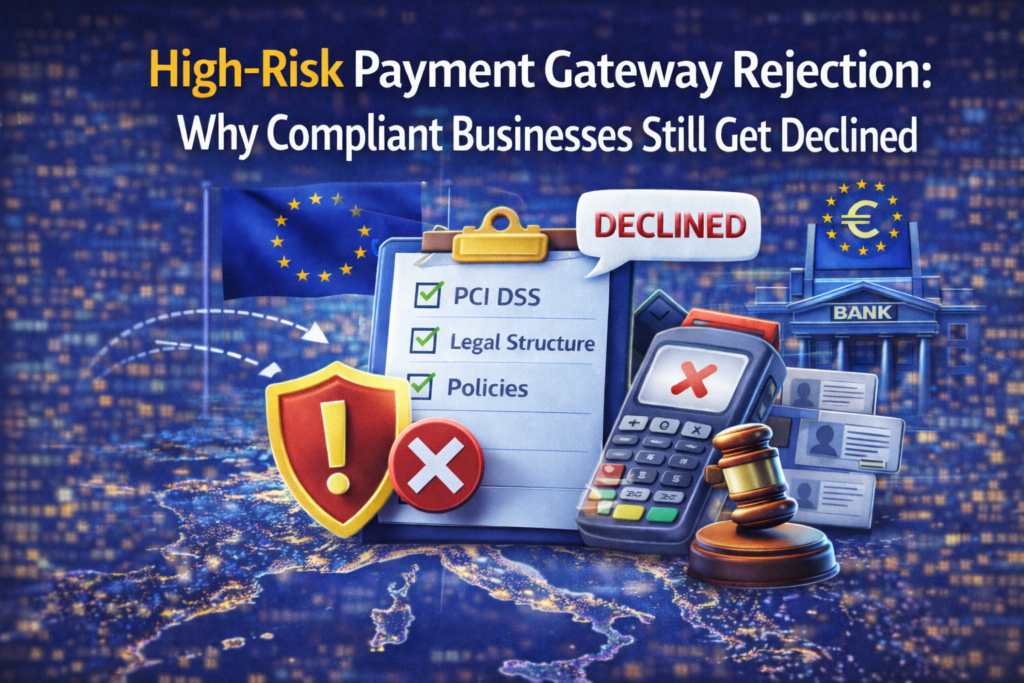
For many high-risk merchants, payment gateway rejection feels illogical.
The business is registered.
Compliance documents are in place.
PCI DSS is completed.
Policies are published.
And yet — the application is declined.
This leads to a common and costly assumption:
“If we’re compliant, payment gateway approval should be automatic.”
In today’s high-risk payment landscape, that assumption is no longer true.
High-risk payment gateway rejection happens not because businesses are non-compliant, but because compliance alone does not prove control.
This article explains why compliant high-risk businesses still get declined, what payment gateways actually evaluate, and how merchants can close the gap between compliance and approval.
The Biggest Misunderstanding in High-Risk Payments
Compliance is often treated as a finish line.
Many merchants believe:
- PCI DSS guarantees approval
- Legal registration builds trust
- Published policies reduce risk
In reality, compliance only allows your application to be reviewed.
Modern payment gateways and acquiring banks no longer ask:
“Is this business compliant?”
They ask:
“Can this business be controlled when risk increases?”
That difference explains most high-risk payment gateway rejections.
What Payment Gateways Evaluate Beyond Compliance
When a high-risk merchant applies, gateways evaluate four core layers:
- Payment Structure – how transactions are set up
- Transaction Behavior – how payments are expected to behave
- Operational Readiness – how issues will be handled
- Resilience – what happens when something goes wrong
Compliance addresses none of these directly.
Reason #1: Compliance Does Not Predict Transaction Behavior
Payment gateways are risk engines.
They try to predict:
- Refund ratios
- Chargeback probability
- Transaction velocity
- Dispute frequency
A compliant business with unpredictable transaction behavior is still high risk.
Examples include:
- Aggressive funnels with fast volume spikes
- Subscription models with high churn
- Global traffic without geographic segmentation
None of these violate compliance — but all of them increase rejection probability.
Reason #2: Structural Payment Misalignment
One of the most common causes of high-risk payment gateway rejection is structural mismatch.
This includes:
- Customer geography not aligned with acquiring region
- Currency logic that doesn’t match traffic sources
- Unsupported or misused MCCs
- Offshore entities using domestic gateways
These are not compliance failures — they are architecture failures.
Gateways decline businesses when payment flows don’t “make sense” from a risk perspective.
Reason #3: Weak Refund and Chargeback Readiness
Gateways assume disputes will happen.
What they want to see is how merchants respond.
High-risk rejections often occur when:
- Refund logic is unclear
- Disputes are handled manually
- No thresholds or alerts are defined
- There is no documented escalation process
Compliance certifications do not demonstrate operational readiness.
Behavior does.
Reason #4: Single-Point Dependency
A compliant business that relies on:
- One payment gateway
- One acquiring bank
- One processing route
is considered fragile.
Modern payment providers increasingly view risk distribution as part of approval criteria.
If one review or policy change can stop all payments, the business is declined — regardless of compliance status.
Reason #5: Approval-First Payment Design
Many high-risk merchants design payment setups only to:
- Get approved quickly
- Start processing fast
They delay thinking about:
- Scale risk
- Monitoring thresholds
- Post-approval reviews
- Policy changes
Gateways identify this mindset early.
Approval-focused setups rarely survive long-term scrutiny.
Why High-Risk Payment Gateway Rejections Are Increasing
Even compliant businesses are being rejected more often because:
- Banks are de-risking
- Card networks are tightening thresholds
- Regulators expect proactive control
- Monitoring happens earlier than before
Grace periods are disappearing.
A business that cannot demonstrate control under pressure is filtered out early.
How Webpays Helps Reduce High-Risk Payment Gateway Rejection
Most compliant high-risk businesses fail not because they ignore rules, but because their payment architecture does not demonstrate stability.
Webpays helps merchants move beyond surface-level compliance by focusing on:
- High-risk compatible gateway selection
- Acquiring alignment with customer geography
- Multi-acquirer routing to reduce dependency
- Risk-aware transaction flow design
- Operational readiness from day one
Instead of treating compliance as a checkbox, Webpays helps merchants turn compliance into approval confidence.
What Compliant High-Risk Businesses Should Do Differently
To reduce rejection risk, merchants should:
Design for Predictability
Control velocity, segment traffic, and avoid sudden spikes.
Build Refund Logic Into the Payment Flow
Prevent disputes before they escalate.
Distribute Risk
Avoid single-gateway dependency.
Align Structure With Reality
Ensure acquiring, currency, and customer geography match.
Prepare for Post-Approval Monitoring
Approval is the beginning, not the finish line.
Common Myths About High-Risk Payment Gateway Rejection
Myth: Rejection means non-compliance
Reality: Rejection usually means operational uncertainty
Myth: More certificates improve approval
Reality: Better control improves approval
Myth: Gateways dislike high-risk merchants
Reality: Gateways dislike fragile setups
Final Thoughts
Compliance is mandatory — but it is no longer impressive.
In high-risk payments, approval is earned through structure, behavior, and resilience, not paperwork alone.
Merchants who understand this stop chasing certificates and start building payment systems that banks trust.
Platforms like Webpays exist to support this shift — helping compliant high-risk businesses move from rejection to stable, scalable payment acceptance.