
Businesses operating in high-risk industries often focus on finding a payment gateway without realizing that payment acceptance depends on more than the checkout technology. A payment gateway and a merchant account work together, but they serve different purposes. Choosing the right combination is essential for businesses that want reliable payment processing, long-term account stability, and fewer operational disruptions.
Many merchants assume that installing a payment gateway automatically allows them to accept card payments. In reality, payment approval depends on whether the business has a properly underwritten merchant account. Without the right merchant account, even the most advanced gateway cannot keep payments flowing.
For companies operating in industries such as online gaming, IPTV streaming, CBD, forex trading, travel merchant account, nutraceuticals payment gateway, digital services, subscription platforms, and other regulated sectors, selecting both the right payment gateway and merchant account is a critical business decision.
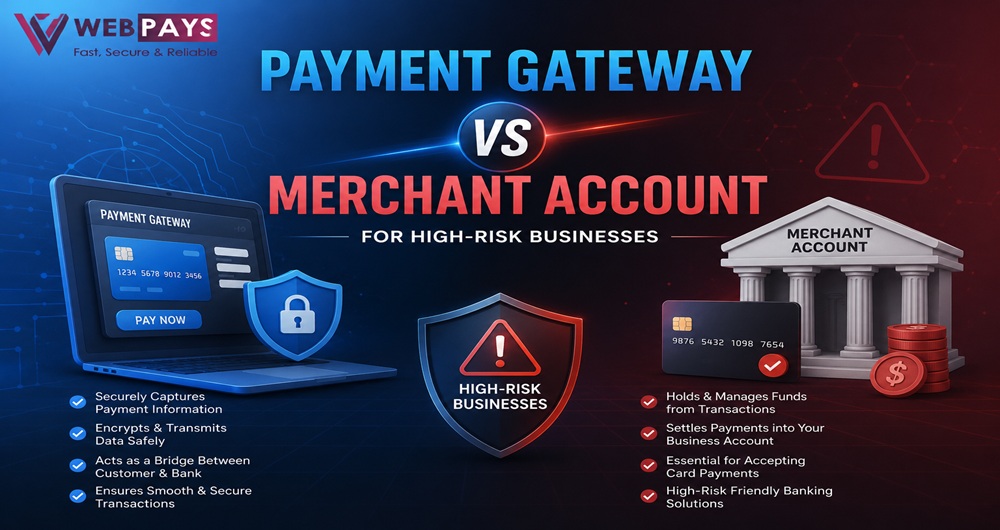
What Is a Payment Gateway?
A payment gateway is the technology that securely transfers payment information between a customers checkout page and the payment processor. It encrypts sensitive cardholder data, verifies transaction requests, and communicates with financial institutions to determine whether a payment should be approved or declined.
In simple terms, the payment gateway acts as the bridge connecting your website or application with the payment processing network.
Modern payment gateways typically support features such as:
- Online card payments
- Virtual terminals
- Mobile payments
- Recurring billing
- Payment links
- Multi-currency acceptance
- Fraud screening tools
- API integrations
- Tokenization for stored cards
Although these features improve the customer payment experience, a payment gateway alone does not determine whether your business is authorized to process payments.
What Is a Merchant Account?
A merchant account is a specialized business account provided by an acquiring bank or payment processor that allows merchants to accept debit and credit card payments.
The merchant account evaluates the business itself. During the underwriting process, providers review several factors, including:
- Business model
- Industry classification
- Processing history
- Average transaction value
- Monthly sales volume
- Chargeback ratio
- Financial stability
- Regulatory compliance
Once approved, the merchant account temporarily receives customer payments before transferring the funds to the business bank account according to the agreed settlement schedule.
For high-risk merchants, obtaining approval for a suitable merchant account is often more challenging than integrating a payment gateway because providers carefully assess the financial and operational risks associated with the business.
Payment Gateway vs Merchant Account – Key Differences
Although these terms are often used interchangeably, they perform entirely different functions within the payment ecosystem.
| Feature | Payment Gateway | Merchant Account |
| Primary Function | Securely transmits payment data | Allows businesses to receive card payments |
| Purpose | Connects checkout with payment processor | Holds and settles customer funds |
| Focus | Payment technology | Business underwriting and financial approval |
| Handles Customer Data | Yes | Yes |
| Determines Business Approval | Yes | Yes |
| Required for High-Risk Merchants | Yes | Yes |
A business can integrate a payment gateway within minutes, but without an approved merchant account, payment transactions cannot be processed successfully.
For high-risk industries, both components must work together to create a reliable and compliant payment infrastructure.
Conclusion
Choosing between a payment gateway and a merchant account is not the right approach for high-risk businesses because both are essential for accepting online payments. A payment gateway securely captures and transfers customer payment details, while a merchant account processes card transactions and settles funds into your business account. Together, they create a complete payment infrastructure that supports secure, reliable, and scalable payment acceptance. For industries such as online gaming, forex trading, CBD, IPTV, travel, and adult services, working with an experienced high-risk payment provider helps improve approval rates, reduce payment disruptions, support multiple payment methods, and provide the stability needed for long-term business growth.