
Every successful online gaming platform relies on a secure and well-structured payment process. Although players only experience a simple checkout page, numerous systems work together behind the scenes to authorize payments, verify security, detect fraud, settle funds, and complete transactions.
A professional online gambling payment processing solution is designed to make every payment fast, secure, and trusted while helping operators meet regulatory and compliance requirements.
Below is a step-by-step overview of how a typical online gambling payment transaction works.
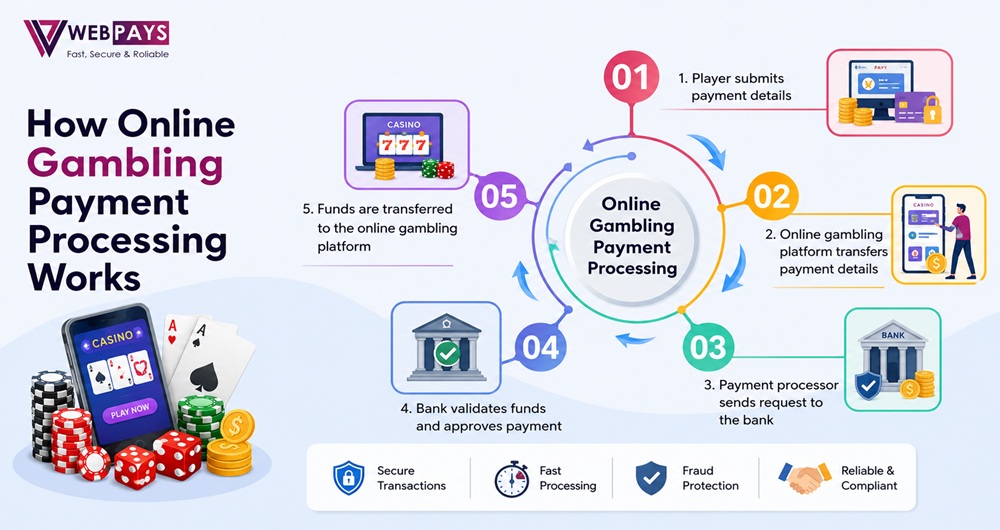
Step 1: The Player Initiates a Payment
The payment journey begins when a player chooses to add funds to their gaming account.
Depending on the operator supported payment methods, the player may use a credit card, debit card, bank transfer, digital wallet, or another approved payment option. The player enters the required payment information through a secure payment page integrated into the gaming platform.
At this stage, all payment information is encrypted before it leaves the player’s device, helping protect sensitive financial data during transmission.
For operators, a reliable payment gateway for online gambling provides a smooth payment experience while maintaining strong security standards.
Step 2: The Gaming Payment Gateway Encrypts and Transfers Data
Once the player submits the payment, the gaming payment gateway securely receives the transaction request.
Rather than storing card information, the gateway encrypts the payment data and securely forwards it to the payment processor and acquiring bank for authorization.
Modern payment gateways use industry-standard encryption protocols and tokenization technologies to help protect sensitive payment information throughout the transaction lifecycle.
A dependable payment gateway for gaming should also support API integration, transaction logging, and secure communication between every financial institution involved in the payment process.
Step 3: Fraud Screening and Risk Assessment
Before a payment request reaches the acquiring bank, many transactions are evaluated using automated fraud detection systems.
Risk management tools analyze multiple factors, including:
- Transaction value
- Device information
- IP address
- Geographic location
- Velocity checks
- Card usage patterns
- Account history
- Behavioral indicators
If unusual activity is detected, the transaction may require additional verification or be declined to reduce the risk of fraud.
Effective fraud prevention helps high risk gaming operators reduce financial losses while protecting legitimate players from unauthorized activity.
Step 4: Payment Authorization
After fraud screening, the payment request is sent to the acquiring bank and then routed through the appropriate card network to the issuing bank.
The issuing bank evaluates several factors before making an authorization decision, including:
- Card validity
- Available funds or credit
- Security checks
- Transaction risk
- Account status
Within a few seconds, the issuing bank either approves or declines the transaction.
The authorization response follows the same secure path back through the payment network, payment processor, and gambling payment gateway before reaching the gaming platform.
If approved, the player receives confirmation that the deposit has been accepted.
Step 5: Payment Confirmation
Once authorization is successful, the gaming platform updates the player account balance.
Players expect deposits to appear quickly so they can begin using the platform without unnecessary delays.
Fast payment confirmation improves customer satisfaction and reduces abandoned payment attempts, particularly during peak gaming periods.
Trusted online gaming payment processing helps maintain consistent payment performance even during periods of high transaction activity.
Step 6: Settlement and Fund Transfer
Payment authorization does not immediately transfer money to the merchant.
Approved transactions are grouped together and processed during settlement.
During settlement, the acquiring bank transfers approved funds into the merchant account according to the agreed settlement schedule.
Settlement timing varies depending on several factors, including:
- Payment method
- Banking relationships
- Business location
- Acquiring partner
- Currency
- Regulatory requirements
Efficient settlement helps high risk gaming operators maintain healthy cash flow while simplifying financial planning.
Step 7: Reconciliation and Financial Reporting
After settlement, merchants reconcile payment records with gaming platform reports.
Reconciliation allows operators to compare:
- Successful transactions
- Declined payments
- Refunds
- Chargebacks
- Player withdrawals
- Settlement totals
Accurate reporting helps finance teams identify discrepancies, monitor revenue, and prepare financial records.
Many modern gaming payment processing platforms provide real-time dashboards that simplify payment monitoring and operational reporting.
Step 8: Player Withdrawals and Payouts
Deposits represent only one side of the payment process.
High risk gaming operators must also process player withdrawals efficiently.
After internal verification procedures are completed, withdrawal requests are reviewed according to the operator’s policies and applicable regulatory requirements.
Once approved, payout instructions are processed through the appropriate financial channels.
Reliable payment infrastructure helps operators manage withdrawals efficiently while maintaining a positive player experience.
Why Payment Speed Matters
Payment performance directly affects customer satisfaction.
Long processing times, failed transactions, or repeated payment declines may cause players to abandon a gaming platform and choose another provider.
A professional online gaming payment gateway helps improve payment performance by supporting stable payment routing, reliable acquiring relationships, and secure transaction processing.
Benefits of optimized payment performance include:
- Higher payment approval rates
- Reduced transaction failures
- Faster player deposits
- Improved operational efficiency
- Better customer experience
- Simplified payment management
Security Throughout the Payment Lifecycle
Security should never be limited to a single stage of the transaction process.
A modern casino payment gateway protects payment data throughout every phase of the payment lifecycle using multiple layers of security.
These protections may include:
- End-to-end encryption
- Tokenization
- Secure API communication
- Fraud detection systems
- Risk monitoring
- Access controls
- Transaction logging
- PCI DSS security practices
By combining these technologies, operators can reduce payment risks while protecting customer information and maintaining confidence in their payment systems.
Why the Right Payment Partner Makes a Difference
The payment provider chosen by a gaming business has a direct impact on operational efficiency, payment reliability, and long-term scalability.
An experienced provider understands the technical, financial, and regulatory requirements of high risk gaming operators and works with acquiring partners that support high-risk industries.
Instead of simply processing transactions, a dependable payment gateway for casino businesses helps operators manage payment acceptance, improve transaction performance, reduce fraud exposure, and support business growth across multiple markets.
Understanding the payment lifecycle also highlights why online gambling requires specialized infrastructure rather than standard retail payment solutions. In the next section, we’ll explore the advanced features that define a modern gaming payment gateway, including payment security, fraud prevention, multi-currency support, API integration, reporting, and chargeback management.