
Online gambling payment processing is the technology and financial infrastructure that enables gambling operators to accept, authorize, process, settle, and manage online payments securely. Every deposit, withdrawal, refund, or recurring transaction passes through multiple financial systems before it reaches its final destination. A trusted payment processing solution allows these transactions to move efficiently while maintaining security, regulatory compliance, and a positive player experience.
Gambling operators face additional challenges when accepting online payments. Transactions often involve higher volumes, international customers, multiple currencies, stricter regulatory requirements, and increased fraud monitoring. Because of these factors, many traditional financial institutions classify gambling businesses as high-risk merchants and apply additional underwriting requirements before approving payment services.
A special custom according to merchant payment processing for online gambling solutions is designed to address these operational challenges. Instead of offering only basic payment acceptance, it combines secure payment technology, acquiring relationships, fraud prevention, compliance support, and transaction management into a single payment ecosystem.
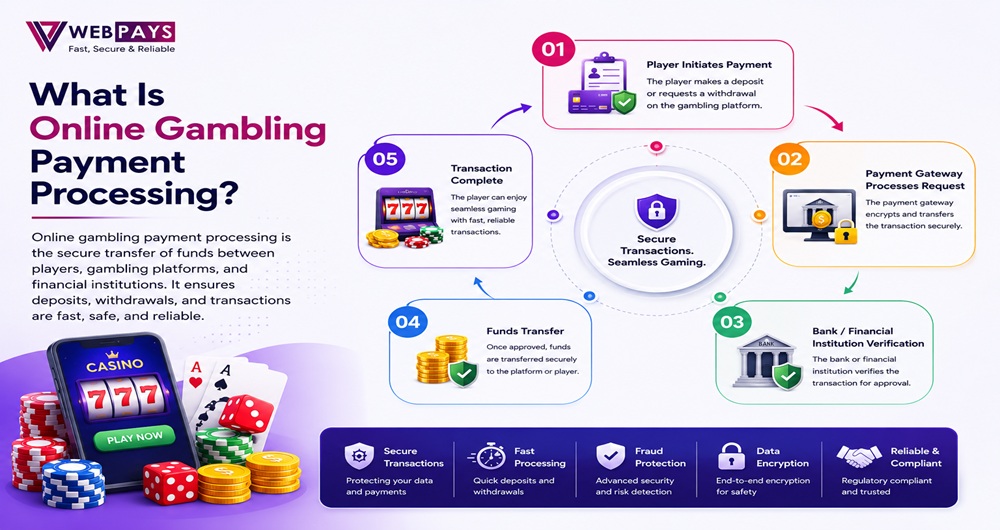
Understanding the Online Gambling Payment Ecosystem
Every successful online gambling merchant platform relies on several financial components working together behind the scenes. Although players only see a payment form, each transaction passes through multiple systems within seconds.
These components include:
Payment Gateway
A gambling payment gateway securely transfers payment information between the customer, the merchant, the acquiring bank, and the payment processor. It encrypts sensitive payment data before transmitting it for authorization, helping protect cardholder information from unauthorized access.
A payment gateway does not store customer funds. Instead, it acts as the secure communication layer that connects every participant involved in the payment process.
For online casino igaming operators, a modern casino gaming payment gateway should support secure API integration, transaction monitoring, fraud screening, and real-time payment authorization.
Merchant Account
A merchant account is a specialized business account that temporarily receives approved card payments before they are settled into the operator business bank account.
Although the terms are often confused, a merchant account is not the same as a payment gateway. The gateway securely transmits payment information, while the merchant account manages the movement and settlement of approved funds.
Casino gambling businesses typically require merchant accounts provided by acquiring banks that have experience supporting regulated high-risk industries.
Payment Processor
The payment processor manages communication between the acquiring bank, card networks, and issuing bank during every transaction. It verifies payment requests, routes authorization messages, and helps complete transactions securely.
Modern processors also provide features such as transaction reporting, settlement management, payment reconciliation, and operational monitoring.
Acquiring Bank
An acquiring bank is the financial institution responsible for processing card payments on behalf of the merchant. It works with payment processors and card networks to authorize and settle transactions while managing financial risk.
Acquiring banks that support gambling operators understand the additional regulatory requirements associated with high-risk payment processing and often implement enhanced underwriting procedures before approving new merchants.
Card Networks
Card networks provide the communication infrastructure between acquiring banks and issuing banks.
When a player submits a payment, the request passes through the appropriate card network for authorization before a response is returned to the merchant.
These networks establish technical standards and operating rules that participating financial institutions must follow during payment processing.
Issuing Bank
The issuing bank is the financial institution that provides the player payment card.
During authorization, the issuing bank verifies available funds, evaluates fraud indicators, confirms account status, and either approves or declines the transaction.
The authorization response is then returned through the payment network to the acquiring bank and ultimately to the gaming platform.
Why Online Gaming Businesses Need Specialized Payment Solutions
Processing payments for online gambling differs significantly from traditional retail or eCommerce businesses.
Gaming operators often process thousands of transactions daily, including player deposits, withdrawals, refunds, bonus credits, and recurring subscription payments where applicable. Managing these transactions requires payment infrastructure capable of maintaining security, stability, and regulatory compliance under varying transaction volumes.
A dedicated online gaming payment processing solution provides merchants with access to payment technology specifically designed for businesses operating within regulated gaming markets.
Rather than relying on generic payment services, gaming operators benefit from infrastructure that supports:
- Secure payment authorization
- High transaction volumes
- Multi-currency processing
- Cross-border payment acceptance
- Fraud prevention tools
- Chargeback monitoring
- Merchant reporting
- Settlement management
- Flexible API integration
- Regulatory compliance support
These capabilities help gaming businesses maintain efficient payment operations while providing players with a secure and reliable payment experience.
Online Gaming Payment Gateway Versus Standard Payment Gateway
Many business owners assume that every payment gateway offers the same functionality. In reality, payment requirements vary considerably between industries.
A standard payment gateway designed for low-risk retail businesses may not provide the acquiring relationships, fraud controls, or underwriting support required by online casino gaming operators.
An online gaming payment gateway is typically designed to support higher transaction volumes, increased fraud monitoring, enhanced security controls, and regulatory requirements associated with gambling businesses.
Depending on the online gaming merchants target markets, the payment gateway may also support multiple currencies, international acquiring, localized payment methods, and advanced transaction reporting.
Casino Payment Solutions Built for Long-Term Growth
As gaming businesses expand into new jurisdictions, payment infrastructure must grow alongside the business.
Modern casino payment solutions are designed to support business expansion without requiring merchants to replace their payment systems every time they enter a new market. Flexible integration options, scalable transaction processing, and experienced acquiring partnerships allow operators to maintain consistent payment performance while serving a larger customer base.
Whether a business operates a sportsbook, poker platform, online casino, bingo website, or another gaming service, selecting the right casino merchant account helps improve operational efficiency while supporting secure payment acceptance.
Choosing the Right Payment Gateway for Online Gaming
Selecting a payment gateway for online gaming involves evaluating far more than transaction fees.
Merchants should consider several important factors, including payment security, integration flexibility, acquiring network coverage, settlement schedules, reporting capabilities, fraud prevention, customer support, and experience within the regulated gaming industry.
A dependable payment gateway for gaming should provide stable payment performance, secure transaction processing, and the flexibility to adapt as business requirements evolve.
When these elements work together effectively, operators can focus on delivering an engaging gaming experience while maintaining reliable payment operations behind the scenes.
Understanding how these financial systems interact provides a strong foundation for selecting the right payment partner. In the next section, we’ll examine the complete transaction lifecycle—from the moment a player initiates a deposit to final settlement—showing how online gambling payment processing works in real-world gaming environments.