
Gaming payment processing is the operational side of moving money for a gambling or iGaming platform — everything that happens after a player clicks “deposit” or requests a withdrawal. Where a payment gateway handles the authorization moment, online gaming payment processing covers the full lifecycle: settlement timing, fraud monitoring, chargeback handling, and the compliance checks running in the background on every transaction.
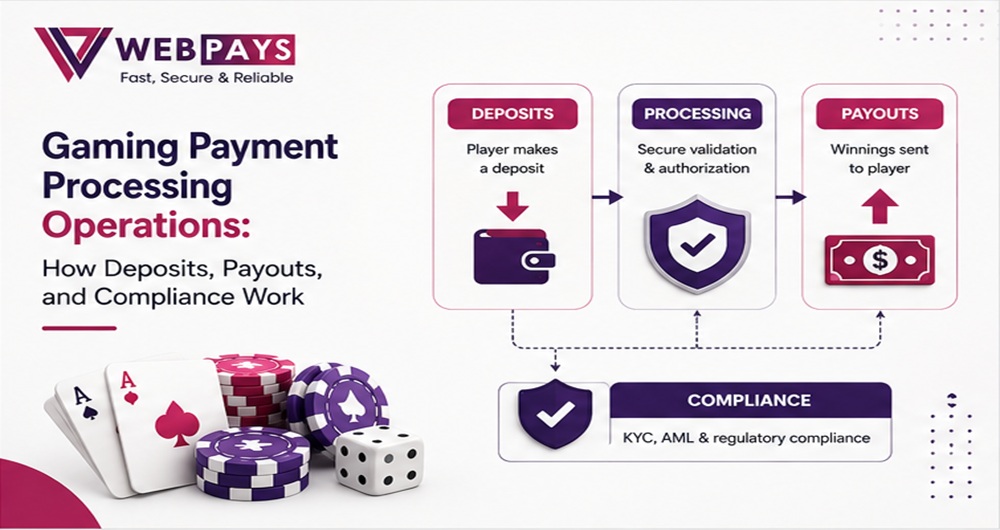
The Deposit Flow
When a player initiates a deposit, the following happens in sequence:
- Player selects a payment method (card, e-wallet, bank transfer, or crypto)
- The payment gateway authenticates the transaction (3D Secure 2.0 is standard for card deposits in regulated EU markets)
- Funds are authorized and credited to the player’s gaming balance, typically within seconds
- The transaction is logged with session data — IP address, device fingerprint, and timestamp — for later dispute or compliance review
The Withdrawal (Payout) Flow
Payouts are where gaming payment processing gets operationally harder than standard e-commerce refunds:
- Same-source rule — in most regulated jurisdictions, card withdrawals must return to the same card used for the original deposit
- Bank transfer fallback — used when card withdrawal isn’t practical, or when withdrawal amounts exceed what a card network will process
- Processing time — typically 24–72 hours depending on the method and any manual review triggers (large withdrawals often require additional verification)
Because deposits and payouts flow in both directions, online gaming payment processing requires infrastructure that a standard one-way e-commerce processor isn’t built to handle.
Fraud Controls Built Into the Processing Layer
Effective gaming payment processing includes several layers of fraud detection running continuously, not just at the moment of transaction:
| Control | Purpose |
| Real-time transaction monitoring | Flags anomalous deposit/withdrawal patterns |
| Device fingerprinting | Detects multi-accounting and bonus abuse |
| Velocity checks | Catches rapid repeated transactions from the same source |
| 3D Secure 2.0 | Authenticates the cardholder at point of deposit |
| Chargeback alerts (e.g., Order Insight, CB-ALERT-style tools) | Gives operators early warning before a formal dispute is filed |
Compliance Operations Running in the Background
Every transaction that passes through a compliant gaming payment processing system is checked against:
- KYC (Know Your Customer) identity verification, typically at signup and again at higher withdrawal thresholds
- AML (Anti-Money Laundering) transaction monitoring, screening for structuring or unusual volume patterns
- Age verification, mandatory before any real-money transaction is permitted
- Jurisdictional licensing rules, which vary by market and can restrict specific payment methods or transaction sizes
Why Chargebacks Are the Central Operational Challenge
Gambling has a structurally higher chargeback rate than most e-commerce categories, because players who lose money have a documented tendency to dispute the transaction rather than accept the loss. Managing this operationally requires clear billing descriptors players will recognize on their bank statement, detailed session logs to support dispute representment, and transparent bonus/deposit terms displayed and accepted at checkout — since disputes citing unclear terms are far harder to win.
How Webpays Handles Processing Operations Differently
Compared to a generic high-risk processor bolted onto a gambling merchant account, Webpays treats the operational layer as core infrastructure rather than an afterthought:
- Bidirectional flow built in — deposit and payout processing are designed together, rather than payouts being handled as a manual or semi-manual exception process.
- Layered fraud detection by default — velocity checks, device fingerprinting, and 3D Secure are active from day one, not offered as a paid add-on tier.
- Chargeback defense tooling — session-level documentation is captured automatically to support dispute representment, rather than left to the operator to assemble after the fact.
- Compliance checks run inline — KYC, AML, and age verification are part of the transaction flow itself, reducing the operational burden of stitching together separate compliance vendors.
FAQ: Gaming Payment Processing Operations
1. How long does online gaming payment processing take for withdrawals?
Most withdrawals process within 24–72 hours, though this varies by payment method and whether the transaction triggers additional manual verification, which is common for larger withdrawal amounts.
2. Why do card withdrawals have to go back to the same card used for deposit?
This “same-source rule” is a regulatory and anti-fraud requirement in most licensed jurisdictions, designed to prevent money laundering and ensure funds return to the verified account holder rather than a third party.
3. What is a chargeback and why is it a bigger issue in gaming payment processing? A chargeback is when a cardholder disputes a transaction directly with their bank rather than the merchant. Gambling has elevated chargeback rates because players who lose money sometimes dispute the deposit rather than accept the outcome, making chargeback defense a core operational function rather than an edge case.
4. What is 3D Secure 2.0 and is it required for gaming payment processing?
3D Secure 2.0 is an authentication protocol that verifies the cardholder’s identity at the point of a card deposit. It’s mandatory under PSD2’s Strong Customer Authentication requirements for card transactions in regulated EU markets, and widely used elsewhere as a fraud-reduction best practice.
5. What compliance checks run automatically during gaming payment processing? KYC identity verification, AML transaction monitoring, age verification, and jurisdiction-specific licensing checks typically run in the background on every transaction, with additional manual review triggered at higher withdrawal thresholds or unusual activity patterns.