
Choosing a payment gateway for online gaming — or specifically a payment gateway for online gambling — is a decision that affects approval rates, payout speed, and how quickly your account can be shut down over a chargeback spike. This guide walks through the selection criteria and the integration steps for setting up an online gaming payment gateway, so you can evaluate providers against the requirements that actually matter for real-money platforms.
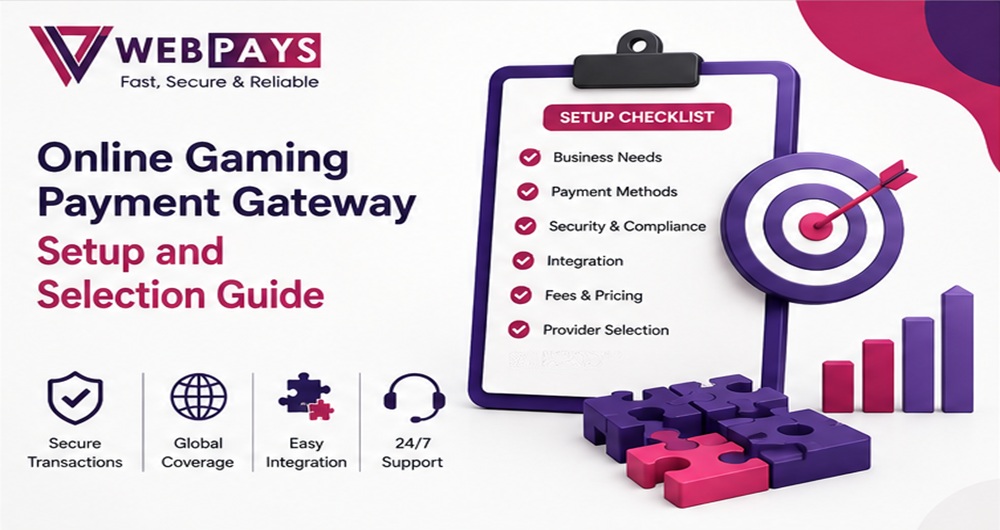
Step 1: Confirm You Need a High-Risk Gateway, Not a Standard One
Before comparing providers, confirm your platform actually needs high-risk classification. If players deposit real money to wager — casino, sportsbook, poker, bingo, lottery — you need a payment gateway for online gambling, not a general-purpose or in-app-purchase gateway. Standard processors will decline the application or terminate the account later, once volume triggers a manual review.
Step 2: Evaluate Providers Against These Five Criteria
| Criterion | What to Check | Why It Matters |
| Approval speed | Days to pre-approval, not weeks | Slow onboarding delays revenue |
| Payment method coverage | Cards, e-wallets, bank transfer, crypto | Wider coverage lifts conversion |
| Chargeback tooling | Dispute alerts, representment support | Reduces account termination risk |
| Multi-currency & local rails | Regional payment methods, FX handling | Critical for cross-border operators |
| Compliance support | KYC/AML built-in, licensing awareness | Avoids regulatory penalties |
Step 3: Understand the Integration Process
Setting up an online gaming payment gateway typically follows this sequence:
- Application and underwriting — submit business documentation, licensing proof, and processing history if available
- API integration — connect your platform via REST API or a hosted checkout page; most providers offer SDKs for common gaming platforms
- Sandbox testing — run test transactions across your expected payment method mix before going live
- Go-live and monitoring — launch with real transactions while monitoring approval rates and early chargeback signals
Integration timelines for a payment gateway for gaming vary widely — a hosted checkout can go live in days, while a fully embedded API integration with custom fraud rules can take several weeks.
Step 4: Common Setup Mistakes to Avoid
- Skipping sandbox testing across all payment methods — a gateway that approves card transactions in testing may still reject specific e-wallets or regional cards in production.
- Ignoring MCC classification — if your transactions are coded incorrectly, you risk both declined payments and account freezes.
- Underestimating payout requirements — many operators focus entirely on deposit flow and treat withdrawals as an afterthought, which creates player trust issues fast.
- Not confirming jurisdictional coverage upfront — a gateway that works well in one licensed market may not support the regions you plan to expand into.
Why Operators Choose Webpays for Setup and Selection
Compared to generic high-risk processors or merchant account brokers, Webpays is built to remove the friction points above:
- Faster pre-approval for gambling and iGaming applicants, since underwriting is done against gambling-specific risk criteria rather than generic high-risk templates.
- Broad payment method coverage out of the box — cards, e-wallets, bank transfers, and crypto rails — reducing the need to stack multiple providers just to cover your player base.
- Sandbox-to-live support with a dedicated integration team, rather than a self-serve API and a support ticket queue.
- Transparent MCC and compliance handling, so operators aren’t caught off guard by misclassification after launch.
FAQ: Online Gaming Payment Gateway Setup and Selection
1. How long does it take to set up a payment gateway for online gaming?
A hosted checkout integration can go live within a few days after underwriting approval. A fully custom API integration with tailored fraud rules typically takes two to six weeks, depending on the platform’s complexity and the number of payment methods being integrated.
2. What documents are needed to apply for an online gaming payment gateway?
Most providers require business registration documents, proof of gambling licensing (where applicable), processing history if you’re switching providers, director identification for KYC, and a description of your payment method requirements.
3. Can I use more than one payment gateway for online gambling at once?
Yes, and many operators do. Running two or three gateways in parallel improves approval rates, provides redundancy if one processor has downtime, and lets you route different payment methods through whichever provider handles them best.
4. What’s the difference between a hosted checkout and an API integration?
A hosted checkout redirects the player to a payment page hosted by the gateway provider — faster to set up but less customizable. An API integration keeps the player on your platform throughout checkout, offering full control over the experience at the cost of a longer development timeline.
5. What should I test before going live with a new gaming payment gateway?
Test every payment method you plan to support (not just cards), confirm both deposit and withdrawal flows, verify 3D Secure or equivalent authentication triggers correctly, and check that decline messaging is clear enough for players to retry successfully.