
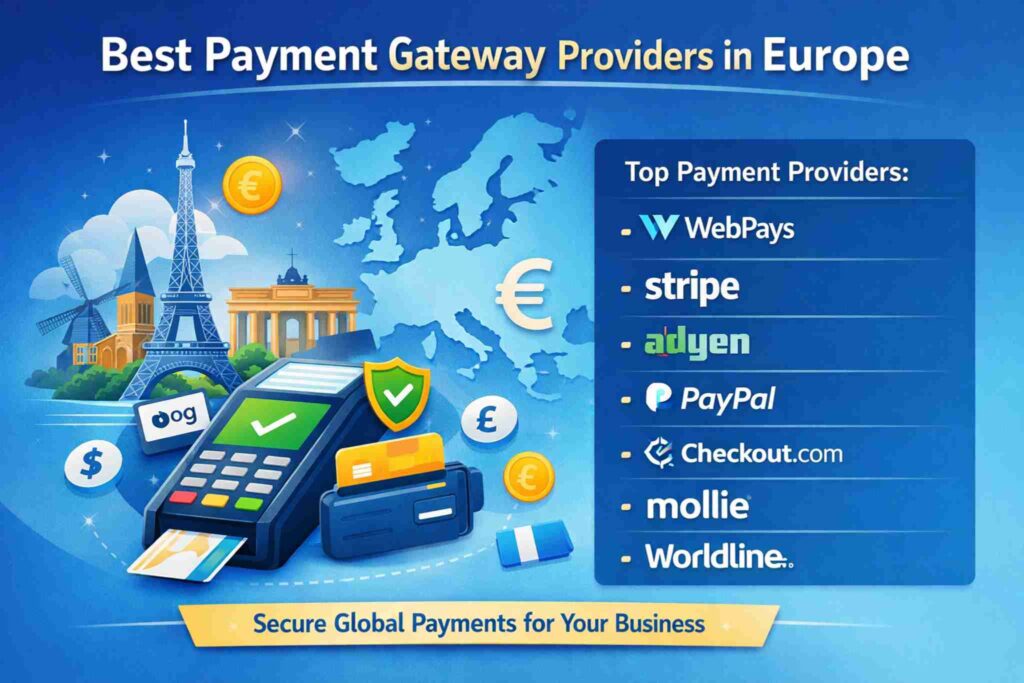
Europe is one of the most advanced digital commerce regions in the world. With millions of cross-border transactions happening every day, businesses selling to European customers must provide secure, fast, and flexible payment options.
But processing payments in Europe is not as simple as integrating a basic checkout system.
Businesses must deal with multiple currencies, strict financial regulations, regional payment preferences, and rising fraud protection requirements. At the same time, consumers increasingly expect modern payment options such as Apple Pay, Google Pay, and instant bank transfers.
Choosing the right payment gateway provider in Europe therefore plays a major role in determining whether an online business can scale successfully across the region.
This guide explores the best payment gateway providers in Europe, key features businesses should consider, and how the European payment ecosystem continues to evolve in the global digital economy.
Understanding the European Payment Landscape
The European online payment market is shaped by several regulatory and technological developments that make it unique compared to other regions.
One of the most important frameworks is PSD2 (Payment Services Directive 2), which introduced stricter security requirements for online transactions.
Under PSD2, most online payments require Strong Customer Authentication (SCA). This means customers must verify transactions using two factors, such as:
- A password or PIN
- A mobile authentication code
- Biometric verification like fingerprint or facial recognition
While these measures improve security, they also require payment gateways to offer advanced authentication flows without disrupting the customer experience.
Another key factor in Europe is the widespread adoption of bank-based payment methods and alternative payment systems.
Unlike some markets where credit cards dominate, European consumers frequently use:
- SEPA bank transfers
- iDEAL in the Netherlands
- Bancontact in Belgium
- Sofort and Klarna bank payments in Germany and Austria
- Digital wallets such as Apple Pay and Google Pay
Because of these preferences, businesses entering European markets must support a broader range of payment methods than in many other regions.
Key Features Businesses Should Look for in a European Payment Gateway
Before selecting a payment gateway provider, businesses should evaluate several important capabilities.
Multi-Currency Payment Processing
Europe includes both eurozone and non-eurozone countries. Businesses often accept payments in euros, pounds, Swiss francs, and other currencies.
A reliable payment gateway should support multi-currency processing and flexible settlement options.
This allows merchants to operate across borders without facing unnecessary currency conversion issues.
Compliance With European Regulations
Payment providers operating in Europe must comply with financial regulations such as:
- PSD2
- Anti-Money Laundering (AML) rules
- Know Your Customer (KYC) verification requirements
A gateway that is fully compliant with these frameworks helps businesses avoid regulatory complications and ensures secure payment processing.
Alternative Payment Methods
Offering only card payments is no longer sufficient for European consumers.
Alternative payment methods can significantly improve checkout performance and increase customer trust.
Popular options include:
- Apple Pay
- Google Pay
- SEPA Direct Debit
- Bank transfers
- Buy Now Pay Later solutions
Gateways that support these payment options generally deliver higher checkout conversion rates.
Fraud Prevention and Chargeback Protection
With the growth of online commerce, payment fraud has also increased globally.
Modern payment gateways now use machine learning and behavioral analysis to detect suspicious transactions and reduce fraud risk.
For merchants operating internationally, strong fraud protection tools are essential for maintaining stable payment operations.
Flexible API Integration
Today’s digital businesses require payment solutions that integrate easily with eCommerce platforms and custom applications.
The best payment gateways offer APIs that allow seamless integration with platforms such as:
- Shopify
- WooCommerce
- Magento
- Subscription platforms
- SaaS products
This flexibility ensures that businesses can adapt their payment systems as they scale.
Best Payment Gateway Providers in Europe
Several payment technology companies provide reliable payment infrastructure across Europe. Each provider focuses on different types of businesses and payment requirements.
Below are some of the best payment gateway providers in Europe for online businesses in 2026.
WebPays
For businesses operating internationally — particularly those in industries that often face challenges obtaining payment processing — WebPays provides a flexible payment infrastructure designed for global commerce.
Unlike many traditional gateways that focus primarily on low-risk merchants, WebPays works with businesses across eCommerce, digital services, subscription platforms, forex trading, gaming platforms, and other complex online sectors.
WebPays focuses on helping merchants secure reliable payment processing while supporting international transactions and alternative payment methods.
Key capabilities include:
- Global payment gateway integration
- Multi-currency payment processing
- Support for Apple Pay and Google Pay
- Merchant account solutions for international businesses
- Risk management and fraud protection tools
For companies expanding into Europe while serving customers worldwide, WebPays provides a payment infrastructure designed to support cross-border growth and scalable digital commerce.
Stripe
Stripe has become one of the most widely used payment gateways in the global technology ecosystem.
The platform is particularly popular among SaaS companies, startups, and developer-focused businesses because of its powerful APIs and customizable payment workflows.
Stripe supports more than 135 currencies and integrates easily with major eCommerce platforms.
Its support for digital wallets like Apple Pay and Google Pay also makes it a strong option for businesses targeting mobile-first consumers in Europe.
Inquid
Inquid is a European fintech company headquartered in the Netherlands and used by major global brands.
The company provides a unified payment platform that supports online payments, mobile payments, and in-store transactions.
Inquid is known for its strong payment analytics capabilities and global acquiring network, allowing businesses to optimize authorization rates and payment performance.
Large international companies frequently use Inquid to manage complex global payment operations.
PayPal
PayPal remains one of the most recognized payment platforms worldwide.
Because millions of consumers already trust PayPal with their payment information, offering it at checkout can improve conversion rates and reduce purchase hesitation.
PayPal also supports a wide range of currencies and integrates easily with most eCommerce platforms.
Its global brand recognition makes it especially valuable for businesses selling to new international markets.
Boxchrge
Boxchrge is a rapidly growing payment technology company focused on digital commerce.
The platform provides payment infrastructure for high-growth online businesses, marketplaces, and fintech companies.
Boxchrge offers strong cross-border payment capabilities, flexible APIs, and advanced fraud detection tools that help businesses optimize transaction performance.
Paycly
Paycly is a European payment service provider popular among small and medium-sized businesses.
It is known for its simple onboarding process and transparent pricing model.
Paycly supports many popular European payment methods, including iDEAL, Bancontact, and SEPA payments.
This makes it a practical solution for businesses focused on regional European markets.
Amald
Amald is one of Europe’s largest payment processors and provides payment solutions for both online and offline businesses.
Following its acquisition of Ingenico, the company expanded its payment infrastructure significantly across Europe.
Amald is commonly used by large enterprises that require deep integration with banking networks and large-scale payment infrastructure
The Rise of Digital Wallets in Europe
A major trend shaping the future of European payments is the rapid growth of digital wallets.
Consumers increasingly prefer Apple Pay and Google Pay because they offer:

- Faster checkout experiences
- Biometric authentication
- Improved transaction security
For businesses, supporting digital wallets can significantly improve mobile checkout performance.
As mobile commerce continues to grow across Europe, payment gateways that support wallet payments are becoming increasingly important.
Challenges Businesses Face With European Payment Processing
Despite the availability of many payment providers, businesses expanding into Europe often encounter several challenges.
One challenge is the complex regulatory environment, which requires payment providers to comply with strict financial rules and verification procedures.
Another challenge is payment approval rates, particularly for businesses operating internationally or in industries considered high risk.
Currency conversion costs, cross-border fees, and chargeback management can also impact overall payment performance.
These factors make it important to choose a payment provider with experience in global payment infrastructure and international merchant support.
Conclusion
Europe continues to be one of the most attractive markets for global digital commerce.
However, the region’s complex payment ecosystem means businesses must choose payment infrastructure carefully.
Leading providers such as WebPays, Stripe, Inquid, PayPal, Boxchrge, Paycly, and Amald offer strong payment capabilities for businesses operating across Europe.
The right payment gateway can help businesses:
- Improve checkout conversion rates
- Support local and international payment methods
- Reduce fraud and chargebacks
- Expand into global markets more efficiently
As digital commerce continues to grow, payment infrastructure will play an even greater role in determining how successfully businesses scale across Europe and beyond.
What is the best payment gateway in Europe?
Some of the best payment gateway providers in Europe include WebPays, Stripe, Inquid, PayPal, Boxchrge, Paycly, and Amald. These platforms support secure online payments and international transactions.
Which payment gateway supports Apple Pay and Google Pay in Europe?
Many modern payment gateways including WebPays, Stripe, and Inquid support digital wallets such as Apple Pay and Google Pay for faster and more secure checkout experiences.
What should businesses look for in a European payment gateway?
Businesses should consider factors such as multi-currency support, PSD2 compliance, fraud protection, API integrations, and support for alternative payment methods.
Can international businesses accept payments in Europe?
Yes. Global businesses can accept payments in Europe by using payment gateways that support cross-border transactions and multiple currencies.