
There is a special kind of chaos that happens when ten thousand players are all buying a $2 in game item within the same five minutes, and another few thousand are simultaneously trying to cash out their winnings amount before the match starts. Most payment infrastructure was never built for that. It was built for one person, one purchase, one receipt — not a stampede.
Gaming platforms live in that stampede constantly. And when the payment gateway was not designed for volume and speed at the same time, it shows up exactly where players notice most: a payment that hangs, a payout that takes three business days when the player expected three minutes, or a checkout that just quietly fails during peak load.
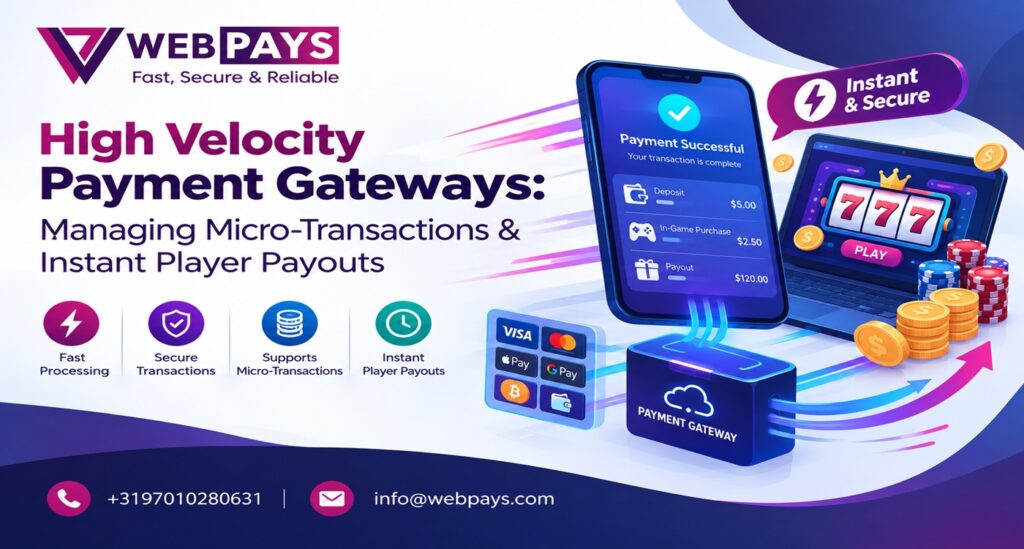
Why High Transaction Velocity Makes Mainstream Processors Nervous
Payment processors built for general retail are tuned around a fairly predictable rhythm — moderate transaction counts, average order values in the tens or hundreds of dollars, and dispute rates that stay within a narrow band. Gaming platforms break that rhythm on purpose. Thousands of small transactions can hit within seconds during a promotion or a tournament, average transaction values can be a fraction of what a “normal” processor expects, and payout requests cluster right after big wins or at predictable times like weekend evenings.
That pattern looks like fraud to a system trained on retail behavior, even when it is just Tuesday night in a busy game. It’s a core reason mainstream processors either cap transaction velocity aggressively or decline to underwrite gaming platforms at all — the traffic pattern itself trips their risk models before any actual bad activity happens.
Micro-Transactions: Small Amounts, Genuinely Big Problems
A single $1.99 purchase looks trivial. A hundred thousand of them in a day is an entirely different operational problem, and it’s where a lot of otherwise-solid payment setups quietly bleed money. Micro transaction payment processing done properly has to account for:
- Fee structures that don’t eat the transaction alive. Flat per-transaction fees that work fine on a $50 purchase can consume a huge share of a $1 purchase if the gateway isn’t built with micro-transaction pricing in mind.
- Transaction batching and aggregation, where it makes sense, to reduce processing overhead without slowing down the player experience.
- Fraud scoring calibrated for low-value, high-frequency behavior instead of flagging every rapid small purchase as suspicious by default.
- Infrastructure that doesn’t buckle under transaction count, since micro-transaction volume is measured in raw quantity, not dollar value — a system built for “fewer, bigger” transactions struggles here.
Get this layer wrong and the symptom isn’t a dramatic outage — it’s a slow leak of margin and a checkout that feels sluggish exactly when players are most impulsive about buying.
Instant Payouts: Where Player Trust Actually Gets Built or Lost
If there’s one thing that separates gaming platforms players stick with from the ones they abandon after one bad experience, it’s payout speed. A player who wins and then waits days to see the money is a player who starts wondering if the platform was ever going to pay out at all — and starts telling other people about it.
A genuine instant payout gaming gateway needs:
- Real-time or near-real-time settlement rails rather than routing every payout through standard multi-day ACH or card refund timelines.
- Automated KYC/AML checks that don’t create bottlenecks, verifying payout eligibility fast enough that “instant” is actually true, not just a marketing word.
- Multiple payout method support — cards, e-wallets, bank rails, and regional methods — because “instant” only matters if it’s instant in a method the player actually wants to use.
- Fraud and risk checks that run in parallel, not in sequence, so security doesn’t have to mean slow.
The tension here is real: faster payouts mean less time for fraud review. That’s exactly why the risk engine, not the payout speed itself, is where the real engineering effort has to go.
What the Infrastructure Actually Needs to Look Like
Handling both ends of this — bursty micro-transactions and time-sensitive payouts — at the same time requires a high velocity payment gateway built with a few non-negotiables:
- Horizontal scaling to absorb sudden spikes without degraded performance, since gaming traffic is inherently spiky around promotions, tournaments, and peak hours.
- Real-time fraud scoring that runs fast enough to not become the bottleneck, using behavioral and velocity signals tuned specifically for gaming patterns.
- High-availability uptime commitments, because a payment outage during a live tournament is a very public, very expensive kind of failure.
- Multi-rail redundancy, so payout speed doesn’t depend on a single banking partner’s processing window.
Webpays vs. PayPal, Stripe, and Paycly on Speed and Volume
PayPal and Stripe are genuinely fast and reliable for the transaction patterns they are built around — but neither is generally positioned or underwritten for sustained high-velocity gaming traffic combined with instant payout expectations at gaming-specific volumes, and both apply standard settlement timelines that don’t match what competitive gaming platforms need for payouts.
Paycly, like Webpays, operates in the gaming-focused high-risk space, so the real comparison isn’t “can it handle volume” in the abstract — it’s how each platform’s infrastructure actually performs under real spike conditions, how payout rails are structured, and what fee model applies to micro-transactions specifically. Those are the questions worth asking directly, with real numbers, before committing — not the ones a comparison chart tends to answer well.
Webpays approach centers on building the fraud scoring and routing layer for gaming-specific traffic patterns from the start, rather than applying general retail risk models to a use case they weren’t designed for.
Common Pitfalls When Scaling a Gaming Payment Gateway
A handful of mistakes show up repeatedly as gaming platforms grow past their original payment setup:
- Pricing built for retail, applied to micro-transactions. A per-transaction fee that looked negligible at launch volume can quietly become one of the largest line items on the books once transaction counts scale into the hundreds of thousands.
- Payout speed promised before the risk engine can actually support it. Marketing “instant payouts” before the fraud and KYC checks are fast enough to genuinely clear in real time creates a gap between promise and reality that players notice immediately.
- Treating peak load as an edge case instead of the normal case. Gaming traffic is spiky by nature — tournaments, promotions, and popular launch windows aren’t rare events, they’re recurring ones, and infrastructure sized for “average” load will keep failing at exactly the moments that matter most.
- Single-rail payout dependency. Relying on one banking partner or payout method for all withdrawals means that partner’s processing window becomes the platform’s payout speed ceiling, no matter how fast the rest of the system runs.
- Fraud rules that never get revisited. Rules tuned for launch-stage volume and player behavior often stay untouched as the platform scales, which either lets new fraud patterns through or starts blocking legitimate high-frequency players who look statistically unusual purely because of their play style.
Measuring Whether a High-Velocity Setup Is Actually Working
It’s easy to assume a payment gateway is performing well just because nothing has visibly broken. A few more reliable signals worth tracking: approval rates broken down by transaction size (since micro-transactions and standard purchases often perform differently on the same rails), payout time distribution rather than just an average (a single slow outlier can hide behind a good average), and how approval rates and latency hold up specifically during peak traffic windows rather than during quiet periods. A gateway that looks solid on a Tuesday afternoon and buckles during a Saturday night tournament isn’t actually solid — it’s untested where it counts.
Frequently Asked Questions
1. Why do gaming platforms need a different payment gateway than standard e-commerce sites?
Gaming platforms generate transaction patterns — high frequency, low average value, sudden spikes, and time-sensitive payouts — that standard e-commerce gateways aren’t built or risk-tuned to handle well.
2. What counts as a “micro-transaction” in payment processing?
There is no universal fixed threshold, but it generally refers to low-value transactions (often a few dollars or less) where standard flat processing fees can disproportionately eat into revenue if the gateway isn’t priced for that transaction size.
3. How “instant” are instant payouts, really?
It depends on the payout method and the platform KYC/verification speed — genuinely real-time rails exist for some methods, while others are “fast” rather than truly instant. Any gateway claiming instant payouts should be able to explain exactly which rails achieve that and which don’t.
4. Does high transaction velocity increase fraud risk?
It increases the appearance of risk to generic fraud models more than it inherently increases actual fraud – which is why gaming-specific risk scoring, rather than blanket velocity limits, is the more effective approach.
5. Can a high-velocity gateway maintain uptime during peak traffic like tournaments or promotions?
That depends entirely on whether the underlying infrastructure is built for horizontal scaling and multi-rail redundancy — platforms without that architecture are the ones most likely to see degraded performance exactly when traffic peaks.