
Ask any iGaming operator what keeps them up at night, and “players” is rarely the answer. It is usually the payment stack. One acquiring bank has a bad quarter and quietly stops supporting gambling MCCs, one region tightens its licensing rules, and suddenly a platform that was processing millions in deposits last month is staring at a “your account has been suspended” email at 2 a.m.
Building a payment architecture that survives contact with the real world — banks that get nervous, regulators that change their minds, and players who want their withdrawal five minutes ago — is a different discipline than bolting a checkout button onto a casino lobby. Here’s what that actually looks like.
Why Mainstream Processors Treat Gambling Like a Fire Alarm
This is not a grudge — it is a documented policy stance. Paypal acceptable use policy restricts gambling-related transactions in most markets, with narrow carve-outs where local law and Paypal own approval process both align. Stripe restricted business list similarly flags online gambling, casinos, and sports betting as categories it generally won’t support outside specific licensed arrangements. These processors are optimized for predictable, low-dispute retail flows, and gambling is neither — deposit and withdrawal patterns are volatile, chargeback risk is elevated by design (a losing session is an easy dispute to file, fairly or not), and licensing requirements shift by jurisdiction in ways that don’t fit a single global policy.
The result: most iGaming operators never even get to the underwriting conversation with a mainstream processor. The application gets auto-declined at the MCC stage.
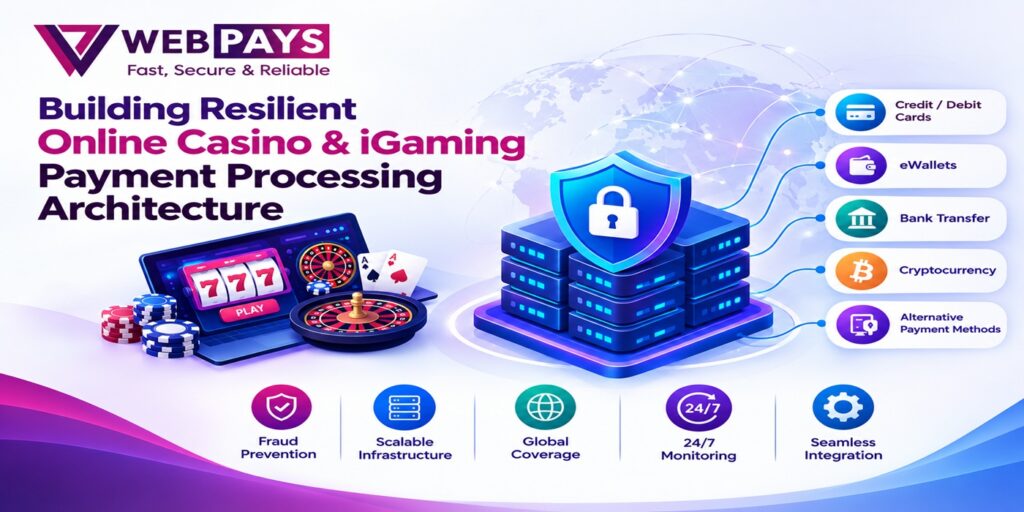
The Anatomy of a Payment Stack That Doesn’t Fold Under Pressure
A resilient gaming payment gateway isn’t one processor with a login page. It’s a system built assuming any single component will eventually fail:
- Multiple acquiring bank relationships, so a single bank’s risk appetite change doesn’t take the whole platform offline.
- Intelligent transaction routing that sends payments through whichever acquirer has the best approval rate for a given card type, region, or currency at that moment.
- Regional and local payment methods — e-wallets, bank transfers, and rails specific to key markets — since card-only checkout quietly excludes a huge share of players in regions where cards aren’t the default.
- Automated failover, so if one route declines or times out, the transaction retries through an alternate path without the player having to start over.
- Segregated player funds handling, which matters both operationally and for the licensing requirements most gaming jurisdictions impose.
This is architecture, not a feature list — each piece exists because the alternative is a single point of failure that eventually gets tested.
Risk Management: The Real Job of an iGaming Payment Gateway
Online casino payment processing lives and dies on how well the risk layer works, because volume alone will bury a poorly built fraud model. A functioning risk management approach for iGaming payment gateway operations generally includes:
- Velocity checks on deposits, withdrawals, and account creation to catch bonus abuse and fraud rings before they scale.
- Device and behavioral fingerprinting to flag accounts exhibiting patterns inconsistent with genuine play.
- KYC/AML screening calibrated to gaming-specific thresholds and triggers, not generic e-commerce fraud rules.
- Chargeback-to-dispute triage, distinguishing genuine fraud from “friendly fraud” disputes that are common in gambling and handling each with the right evidence package.
- License and geo-verification, confirming both the operator’s licensing status in a given market and that the player is actually eligible to play there.
None of this is exciting to read about, which is exactly why operators who skip it end up finding out about it the expensive way.
Licensing and Jurisdiction: The Ground Keeps Shifting
iGaming regulation is genuinely fragmented — a payment flow that’s compliant under one licensing authority can be a problem under another, and “gambling-friendly” jurisdictions change their stance more often than operators would like. This is general context, not a jurisdiction-by-jurisdiction legal guide, and operators expanding into new markets should verify current licensing and payment restrictions with local counsel before launch — the regulatory landscape moves fast enough that anything more specific written today risks being outdated by the time you read it.
How WebPays Approaches iGaming Architecture
WebPays builds around the assumption that gambling payments need redundancy as a default setting, not an upgrade. That means multi-acquirer routing from the start, regional payment method coverage instead of a card-only default, and risk tooling calibrated for gaming-specific dispute patterns rather than retrofitted retail fraud rules. The goal isn’t just “get approved” — it’s staying approved through the inevitable moments when one banking relationship gets shaky.
WebPays vs. PayPal, Stripe, and Paycly for iGaming
PayPal and Stripe aren’t real contenders here for most operators — their own published policies rule out most gambling use cases before underwriting even starts, and the rare carve-outs that exist are narrow and market-specific. That’s not a knock on either company; they’ve simply built for a different kind of business.
Paycly operates in the same high-risk gaming space as WebPays, so the meaningful comparison is architectural: how many acquiring banks are actually behind the platform, how routing and failover work in practice, and how deep the regional payment method coverage goes for the specific markets an operator is targeting. Rather than take any processor word for it, ask to see the acquiring bank list and the actual regions covered — that answer tells you more than any comparison page will.
Where Resilient Architecture Falls Apart in Practice
Most iGaming payment failures aren’t dramatic outages — they’re slow degradations operators don’t notice until player complaints pile up. A few recurring failure points:
- Single-acquirer dependency disguised as redundancy. Some setups technically have a “backup” processor that’s never actually been tested under load, which means the first real failover attempt is also the first time anyone finds out it doesn’t work.
- Region-blind routing. Sending every transaction through the same route regardless of player location ignores that approval rates for the same card type can vary dramatically by region and issuing bank.
- Withdrawal friction treated as a fraud feature. Some platforms slow down withdrawals as an informal anti-fraud measure, which technically reduces certain fraud types but reliably increases player churn — a trade that rarely holds up once you look at retention data.
- KYC bottlenecks at the worst possible moment. Verification checks that were fine at launch volume can become the thing throttling the entire platform once player counts scale, especially around promotions.
- Licensing drift. Operators expanding into new markets sometimes keep using the same payment configuration that worked in their home jurisdiction, without adjusting for local licensing or payment method requirements — a gap that tends to surface during a regulatory review rather than before one.
Building resilience isn’t a one-time setup. It’s an ongoing process of testing failover paths, reviewing routing performance by region, and revisiting risk thresholds as volume and markets change.
The Player Experience Side of Risk Management
It’s worth saying plainly: the best-architected risk system in the world is still a failure if legitimate players feel like they’re being interrogated every time they deposit. Good iGaming payment gateway risk management finds the balance — tight enough to catch genuine fraud patterns, invisible enough that a real player never notices the checks happening. That balance is largely why gaming-specific risk tooling outperforms generic fraud rules borrowed from retail: it’s tuned to let normal gaming behavior through quickly while still catching the patterns that actually matter.
Frequently Asked Questions
1. Why won’t PayPal or Stripe process online casino payments?
Both companies classify online gambling and casino transactions as restricted under their published acceptable use and restricted business policies, generally citing elevated dispute risk and the complexity of jurisdiction-specific licensing. Narrow exceptions exist in some markets, but most operators won’t clear underwriting.
2. What makes an iGaming payment gateway “resilient” rather than just functional?
Resilience comes from redundancy — multiple acquiring banks, automated failover routing, and regional payment method coverage — so that a single bank’s policy change or a regional disruption doesn’t take deposits or withdrawals offline.
3. How is iGaming risk management different from standard e-commerce fraud prevention?
iGaming risk tooling has to account for gambling-specific patterns like bonus abuse, velocity spikes around promotions, and a higher baseline rate of “friendly fraud” disputes from players disputing losses — patterns that generic retail fraud models aren’t built to catch.
4. Do iGaming operators need different payment setups for different regions?
Generally yes. Licensing requirements, accepted payment methods, and player payment preferences vary significantly by jurisdiction, so a single global checkout flow usually underperforms compared to region-specific routing and local payment method support.
5. What should an operator ask a payment provider before signing on for iGaming processing?
Ask which acquiring banks actually support the account, what regions and payment methods are genuinely covered (not just listed), how failover routing works, and what the reserve and chargeback policy looks like in practice — not just in the pitch deck.