
The payment side of a gambling business is really different, from a regular online store. Online gambling businesses have to handle a lot of money moving in and out. This means they do a lot of deposits, withdrawals and refunds. They also have to deal with people trying to cheat the system and getting money back that they should not get. Online gambling businesses also have to follow a lot of rules and make sure they are allowed to operate in places. They have to do all of this while also dealing with customers from parts of the world. Online gambling businesses have to process repeat transactions all the time.
For these reasons, choosing a suitable gambling merchant account is an important part of building a reliable payment infrastructure.
A specialized solution can help eligible gambling businesses manage payment acceptance according to their business model, transaction profile, target markets and applicable regulatory requirements. WebPays provides payment processing solutions designed for businesses operating in higher risk industries, with payment infrastructure intended to support merchants that require more specialized processing than a standard merchant account may provide.
What Is a Gambling Merchant Account?
A gambling merchant account is a specialized payment-processing account that allows eligible gambling and betting businesses to accept customer payments and receive settlements through supported payment methods.
Unlike a conventional retail merchant account, gambling payment processing generally requires closer attention to factors such as transaction risk, chargebacks, fraud, licensing, customer verification and jurisdictional restrictions.
Depending on the business model and market, an online gambling merchant account may be used by businesses involved in:
- Online casino operations
- Sports betting
- Licensed gambling platforms
- Gaming and wagering businesses
- International betting platforms
- Other eligible gambling-related services
The exact eligibility requirements depend on the merchant’s business activity, jurisdiction, licensing position and the policies of the payment provider and acquiring partners.
Why Is Gambling Considered a High Risk Industry?
Payment providers usually think of the gambling business as a risk category. This is because the money transactions that happen in this business can be tricky. They can involve a lot of fraud people asking for their money back and problems with the law.
The gambling business can also have a lot of transactions happening at the time. This often happens when there are sports events or when they are running special promotions. During these times customers of the gambling business can put money into their accounts times ask to take money out and use different ways to pay all within a short time. The gambling business can get really busy, with all these transactions.
Several factors contribute to the risk profile.
Higher Chargeback Exposure
A customer may dispute a transaction for several reasons, including unauthorized card use, misunderstanding of a transaction or fraudulent activity.
A high level of chargebacks can negatively affect a merchant’s processing relationship. Effective transaction monitoring and dispute management therefore become important components of gambling payment processing.
Fraud and Account Abuse
Online gambling platforms can face risks such as:
- Stolen payment credentials
- Account takeover
- Multiple-account activity
- Bonus abuse
- Suspicious transaction patterns
- Payment fraud
A specialized high risk merchant account can be structured with risk-management requirements appropriate to the merchant’s business model.
Regulatory Requirements
Gambling rules are not the same. The rules for Gambling depend on where a company that offers Gambling’s located and where its customers are from. For example a company that offers Gambling may need to get a permit, which is like a license for Gambling. This company also has to check who its customers are, which is known as KYC for Gambling and make sure they are not doing anything with their money, which is called AML for Gambling. The company also has to check how old its customers are so it can make sure they are old enough for Gambling. Additionally the company has to have controls in place to help people who have problems, with Gambling, which is called Gambling. Some places also do not allow types of Gambling.
Payment providers therefore need to understand the merchant’s business and compliance position before processing transactions.
Cross-Border Transactions
Many gambling operators serve customers internationally. This creates additional considerations around currencies, payment methods, settlement, geographic restrictions and local regulations.
A payment setup capable of supporting the merchant’s approved markets can make international transaction management more practical.
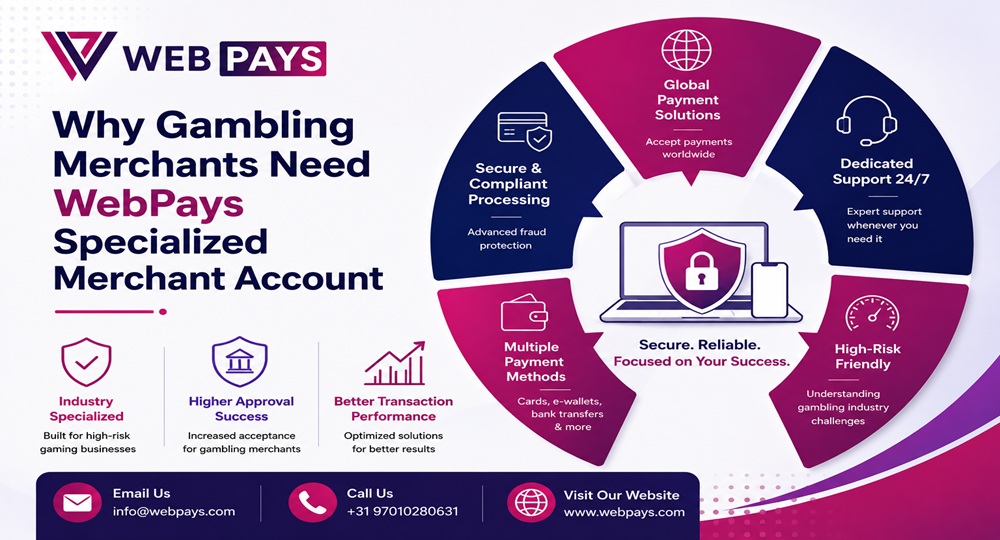
Why Gambling Merchants Need a Specialized WebPays Merchant Account
A standard payment account may not be designed for the operational and compliance requirements of gambling businesses. Working with a provider experienced in higher-risk processing can give merchants a more suitable framework for managing their payment operations.
WebPays focuses on payment-processing requirements for businesses operating in high risk sectors, including eligible gambling and betting merchants.
Payment Processing Designed for Higher-Risk Businesses
A specialized high risk merchant account considers the nature of the business rather than treating every merchant like a conventional online retailer.
For a gambling operator, this can mean reviewing factors such as:
- Business model
- Transaction volume
- Average transaction value
- Target countries
- Licensing status
- Previous processing history
- Chargeback profile
- Payment methods
- Settlement requirements
This assessment helps establish whether the merchant and its intended activity are suitable for the available processing arrangement.
Support for Gambling Payment Gateway Integration
A gambling payment gateway connects the merchant’s website or application with the payment-processing infrastructure required to authorize and process customer transactions.
For gambling businesses, gateway functionality can be particularly important because customers expect quick and convenient payment experiences when funding their accounts.
A suitable gateway may support features such as:
- Secure payment transmission
- Multiple payment methods
- Transaction authorization
- Payment status updates
- Refund processing
- Reporting
- API integration
- Risk controls
The available functionality depends on the merchant’s approved processing setup.
Multiple Payment Methods
Customers in different countries do not necessarily use the same payment methods.
Depending on the approved markets and processing arrangement, gambling operators may need access to card payments, bank transfers, alternative payment methods or other supported options.
Offering appropriate payment choices can reduce unnecessary friction during deposits and improve the overall checkout experience.
Multi-Currency Processing
International gambling businesses may receive transactions in multiple currencies.
Multi-currency capabilities can simplify payment acceptance for customers while helping merchants manage transactions across approved markets. However, currency availability and settlement options depend on the provider, acquiring relationships and merchant approval.
Risk and Fraud Management
Risk management is essential for gambling payment processing.
A suitable processing environment can incorporate measures designed to identify suspicious transaction activity, unusual payment patterns and potentially fraudulent behavior.
These controls may include:
- Transaction monitoring
- Velocity checks
- Fraud screening
- Chargeback monitoring
- Customer verification
- Risk-based transaction review
No payment provider can eliminate fraud or chargebacks completely. The objective is to identify and manage payment risk effectively.
Compliance-Focused Merchant Onboarding
A specialized provider will generally need information about the business before processing can begin.
Depending on the merchant and jurisdiction, onboarding may require:
- Company registration documents
- Ownership information
- Identity documents
- Business address verification
- Banking information
- Website or application details
- Gambling license documentation where applicable
- Terms and conditions
- Privacy policy
- AML/KYC documentation
Providing accurate and complete information can make the onboarding process more efficient.
Is Merchant Account Safe for Gambling Merchant Privacy?
It can be, provided the merchant works with a payment provider that follows appropriate security, compliance and data-protection practices.
However, no payment system should be described as completely risk-free or 100% private.
Gambling businesses process sensitive customer and transaction information, so payment security needs to be considered at several levels.
Payment Data Protection
Payment information should be transmitted and handled through appropriate security controls. Merchants should understand how their payment provider processes sensitive transaction information and what security measures are implemented.
PCI DSS and Card Security
Businesses involved in card payment processing need to consider applicable payment-card security requirements, including PCI DSS obligations where relevant.
The specific responsibilities of the merchant depend on how its payment environment is implemented and which payment technologies it uses.
Limiting Access to Sensitive Information
Customer and payment information should only be accessible to authorized personnel who need it for legitimate business purposes.
Strong authentication, appropriate permissions and internal access controls can reduce the possibility of unauthorized access.
Fraud Prevention and Customer Privacy
Fraud monitoring and customer privacy should work together.
Payment providers need enough information to identify potentially suspicious transactions, while merchants should avoid collecting or retaining unnecessary customer data.
A responsible approach combines risk management with appropriate data-handling practices.
Review the Provider Before Onboarding
Before choosing a gambling payment provider, merchants should review:
- Security practices
- Privacy policies
- Data-handling procedures
- Compliance requirements
- Processing terms
- Chargeback procedures
- Settlement conditions
- Supported jurisdictions
This due diligence is particularly important for businesses operating across borders.
Gambling Payment Gateway vs Gambling Merchant Account
The terms gambling merchant account and gambling payment gateway are related, but they are not the same thing.
A merchant account is associated with the merchant’s ability to accept and settle payment transactions through an acquiring or processing arrangement.
A payment gateway is the technology that securely communicates payment information between the merchant’s checkout and the relevant payment-processing infrastructure.
In simple terms:
Customer → Gambling Website → Payment Gateway → Processor/Acquirer → Payment Network → Issuing Bank
When the transaction is approved, the payment is processed and subsequently settled according to the merchant’s processing arrangement.
For many gambling businesses, the merchant account and gateway work together as parts of the overall payment infrastructure.
How Does a Gambling Merchant Gateway Work?
A gambling merchant gateway can act as the technology layer connecting the gambling platform with payment-processing services.
The general transaction flow looks like this:
1. Customer Starts a Payment – The customer selects a payment method and enters the required payment information.
2. Gateway Receives the Transaction – The payment gateway securely transmits the transaction details for processing.
3. Risk Checks Are Performed – Depending on the payment setup, fraud and risk controls may assess the transaction.
4. Transaction Is Authorized – The payment request is sent through the relevant processing and payment-network infrastructure to determine whether it can be approved.
5. Customer Receives the Result – The gambling platform receives an approval, decline or other transaction status.
6. Settlement Takes Place – Approved funds are settled to the merchant according to the agreed processing and settlement terms.
This process needs to operate efficiently because gambling customers often expect deposits to be reflected quickly in their accounts.
Why Online Gambling Businesses Need an Online Gambling Merchant Account
An online gambling merchant account is particularly important for operators that accept payments through websites and mobile applications.
Unlike a traditional business that may receive occasional purchases, an online gambling platform can process frequent transactions from the same customer.
The payment environment therefore needs to account for:
- Customer deposits
- Withdrawals
- Refunds
- Repeat transactions
- Transaction monitoring
- Fraud prevention
- Chargebacks
- Multiple currencies
- International customers
- Applicable regulatory requirements
A specialized processing arrangement can help an eligible operator align its payment infrastructure with these requirements.
Online Betting Merchant Account: What Should Operators Look For?
An online betting merchant account should be evaluated based on more than transaction fees.
The cheapest payment solution may not necessarily be the most suitable if it cannot support the merchant’s markets, transaction profile or compliance requirements.
Before selecting a provider, betting operators should consider the following.
Processing Reliability
Consistent payment processing is important because customers expect deposits to work when they place bets.
Payment Method Availability
The provider should support the payment methods relevant to the operator’s approved customer markets.
Risk Management
Fraud detection and transaction monitoring can help operators manage suspicious payment activity.
Chargeback Management
Operators should understand how disputes are handled and what support is available when chargebacks occur.
Settlement Terms
Merchants should review settlement currencies, settlement timelines, reserves and other financial conditions before signing a processing agreement.
Integration Options
The online betting payment gateway should be compatible with the operator’s website, mobile platform or gambling software.
API-based integration, hosted payment pages and other technical options may be available depending on the provider and processing setup.
Online Betting Payment Gateway: Important Features
A reliable online betting payment gateway should provide functionality that supports both the merchant and the customer.
Important considerations include:
- Secure payment processing
- Fast transaction communication
- Multiple payment methods
- Mobile-compatible checkout
- Multi-currency support where available
- Fraud screening
- Transaction monitoring
- Payment reporting
- API integration
- Refund functionality
- Appropriate payment routing
The most important feature is not simply the number of features offered. The gateway should be appropriate for the merchant’s approved business model and target markets.
What Documents Are Required for a Gambling Merchant Account?
Documentation varies between providers and jurisdictions, but gambling merchants should generally be prepared to provide information that allows the payment provider to understand the business.
Common requirements may include:
- Certificate of incorporation
- Director and shareholder information
- Identification documents
- Proof of business address
- Business bank details
- Website or application URL
- Gambling license, where applicable
- Terms and conditions
- Privacy policy
- AML/KYC policies
- Transaction and processing information
Merchants should provide accurate information throughout the application process. Misrepresenting the business model or target markets can create significant compliance and processing problems.
Common Reasons Gambling Merchant Account Applications Are Declined
Not every gambling business will automatically qualify for payment processing.
Applications can face difficulties because of:
- Missing documentation
- Unsupported jurisdictions
- Lack of required licensing
- High previous chargeback ratios
- Unclear ownership structures
- Incomplete website information
- Unsupported gambling activities
- Inaccurate application information
- Previous processing problems
This is why merchants should establish their licensing, compliance and payment requirements before applying.
How to Choose the Right Gambling Payment Gateway
Selecting a gambling payment gateway should be based on the entire payment environment rather than one factor such as price.
Consider these questions:
Does the provider support my business model?
Not every gambling activity is treated the same way.
Does it support my target markets?
Confirm geographic availability before onboarding.
What payment methods can my customers use?
Consider cards, bank transfers and relevant alternative payment methods.
How are fraud and chargebacks managed?
Understand the available risk controls and dispute procedures.
What are the settlement conditions?
Review currencies, timelines, reserves and fees.
Can the technology integrate with my platform?
Check API, hosted checkout and other integration options.
What documentation is required?
Knowing the onboarding requirements in advance can reduce delays.
What security and privacy measures are in place?
Review how customer and transaction data is handled.
Why WebPays Can Be Considered for Gambling Payment Processing
WebPays provides specialized payment-processing solutions for eligible businesses operating in high risk sectors.
For gambling and betting merchants, the focus should be on creating a payment environment that matches the operator’s business model, markets, transaction requirements and compliance position.
Depending on eligibility and the approved processing arrangement, businesses can explore requirements around:
- Gambling merchant accounts
- High risk payment processing
- Gambling payment gateways
- Online gambling payment processing
- Betting payment processing
- Multi-currency transactions
- Alternative payment methods
- Fraud and risk management
- International payment acceptance
The right setup depends on the individual merchant. Licensing, jurisdiction, transaction profile and compliance requirements should be assessed before processing begins.
Frequently Asked Questions
What is a gambling merchant account?
A gambling merchant account is a specialized payment-processing arrangement for eligible gambling businesses. It allows approved merchants to accept and settle customer payments while accounting for industry-specific risks and compliance requirements.
Is gambling a high-risk merchant category?
Gambling is commonly treated as a high-risk industry because of factors including fraud exposure, chargebacks, regulatory requirements and transaction patterns. Risk classification can vary by provider, business model and jurisdiction.
What is a gambling payment gateway?
A gambling payment gateway is technology that securely transfers payment information between a gambling platform and the relevant payment-processing infrastructure. It helps facilitate transaction authorization and payment communication.
What is an online gambling merchant account?
An online gambling merchant account is designed for eligible gambling businesses operating through websites or applications. It supports payment acceptance and settlement through approved payment methods.
What is an online betting merchant account?
An online betting merchant account is a specialized processing arrangement for eligible betting and wagering businesses. Its availability depends on factors such as licensing, jurisdiction, business model and provider requirements.
Conclusion
Payment processing is one of the important parts of running an online gambling business. A regular merchant account might not handle the risks involved in transactions the rules that must be followed the chances of getting charged back and the need to process payments from countries.
A specialized gambling merchant account combined with an appropriate gambling payment gateway can provide a more suitable foundation for accepting customer payments.
For betting and gambling operators, the decision should ultimately be based on business-model compatibility, licensing, supported markets, payment methods, security, risk management and settlement requirements.
WebPays can help eligible merchants explore specialized payment-processing options based on their individual requirements. Before choosing a provider, merchants should conduct appropriate due diligence and confirm that their gambling activity and target markets are permitted under applicable laws and the provider’s onboarding policies.