
A business searching for a gaming payment gateway in the United States, one of the first things to understand is that the country does not operate under a single nationwide framework for every form of online gaming and gambling.
That makes the US particularly interesting from a payment perspective.
A merchant may have a perfectly functional website, a strong customer base and an excellent checkout experience, yet still face payment restrictions because the product, customer or transaction falls under a different state-level regulatory framework.
In other words, the payment gateway may be global, but the rules are often local.
And that is where things get interesting.
The US gaming economy covers everything from traditional video games and esports to regulated online sportsbooks, casino platforms, poker and other forms of interactive entertainment. These businesses can have completely different payment requirements.
The first job of a payment provider is therefore not simply to process the card.
It is to understand what is being sold, where the customer is located and whether the transaction is eligible to be processed.
What Is a Gaming Payment Gateway?
A gaming payment gateway is the technology layer that connects a gaming merchant to payment processing infrastructure.
A simplified transaction looks like this:
Customer → Gaming Platform → Payment Gateway → Risk Checks → Processor/Acquirer → Payment Network → Settlement
The gateway can communicate payment information securely, return authorization results and provide transaction records to the merchant.
For conventional gaming businesses, transactions may include:
- Game purchases
- Downloadable content
- Subscriptions
- Virtual items
- Memberships
- Digital upgrades
- Tournament-related services
For regulated gambling businesses, the transaction flow can be significantly more complicated.
A sportsbook may need deposits and withdrawals. An online casino may process numerous transactions from the same player. A poker platform may need sophisticated account and transaction monitoring.
Consequently, the term gaming payment gateway describes the technology, but not necessarily the regulatory complexity behind the business.
Gaming and Gambling Are Not the Same Thing
This is one of the most important distinctions for merchants and content marketers alike.
A company selling a $50 video game is not automatically equivalent to an online casino accepting $50 deposits.
Both may use the word “gaming.”
The payment risk is completely different.
A conventional game publisher may primarily worry about:
- Card fraud
- Account takeover
- Refund abuse
- Friendly fraud
- Subscription disputes
A gambling operator may additionally face:
- Licensing requirements
- AML obligations
- Customer verification
- Responsible-gaming requirements
- Deposit and withdrawal monitoring
- Jurisdictional restrictions
- Increased chargeback exposure
That is why a gambling payment gateway needs to be evaluated differently from a conventional ecommerce gateway.
Why State-Level Rules Change the Payment Equation
The United States has expanded legal online sports betting and iGaming in a growing number of jurisdictions, but availability differs by state and product.
The American Gaming Association maintains state-by-state information covering commercial gaming, including sports betting and internet gaming, illustrating how differently the market is structured across the country.
For a merchant, that means customer location can become a payment decision.
Imagine a gaming company serving customers across ten states.
It cannot necessarily assume:
Customer A in State 1 = Customer B in State 2
The product may be permitted in one jurisdiction and restricted in another.
Therefore, an online gaming payment gateway supporting regulated businesses may need to work alongside geolocation, identity and compliance systems.
What Online Gaming Payment Processing Actually Looks Like
Good online gaming payment processing involves much more than authorization.
A typical transaction may involve:
Step 1: Customer identification
The platform determines who is attempting the transaction.
Step 2: Geographic verification
For regulated gaming, the operator may need to determine where the customer is physically located.
Step 3: Payment selection
The customer chooses an eligible payment method.
Step 4: Risk assessment
The transaction can be evaluated for fraud and unusual activity.
Step 5: Authorization
The payment is sent to the relevant processor and financial network.
Step 6: Account update
The gaming platform updates the customer’s account.
Step 7: Reconciliation
The merchant later matches platform records with gateway and settlement records.
The transaction might take seconds for the customer.
For the merchant finance and compliance teams, however, it becomes part of a much larger data trail.
Why a Casino Payment Gateway Has Different Requirements
An online casino can generate a very different transaction pattern from a standard gaming merchant.
A player might:
- Deposit $100
- Play
- Deposit another $50
- Request a withdrawal
- Change payment methods
- Return later
- Initiate another deposit
The payment system therefore needs to understand transaction relationships rather than treating every payment as an isolated event.
A casino payment gateway may need to integrate with systems responsible for:
- Player verification
- Fraud detection
- Account monitoring
- Deposit controls
- Withdrawal processing
- AML monitoring
- Transaction reporting
The exact obligations depend on the jurisdiction and licensed activity.
The Payment Gateway Should Not Become the Compliance Department
One common mistake is assuming that the payment provider will take care of every regulatory responsibility.
That is risky.
A processor may provide payment infrastructure and fraud tools, but the merchant remains responsible for complying with laws and licensing requirements applicable to its business.
This becomes especially important for iGaming payment processing.
The operator should understand:
- Where it is licensed
- Which customers it can serve
- Which products it can offer
- Which payment methods are permitted
- What verification procedures apply
- How deposits and withdrawals must be managed
Payment infrastructure should support those requirements rather than be used as a shortcut around them.
Why Some Gaming Businesses Need a High Risk Merchant Account
The term high risk merchant account can sound intimidating.
In payment processing, however, “high risk” generally describes the processor’s assessment of financial, regulatory or operational exposure.
Gaming-related businesses can attract additional scrutiny because of:
- High transaction volumes
- Digital goods
- Chargebacks
- Fraud
- International customers
- Regulatory exposure
- Recurring payments
- Rapid deposits and withdrawals
A conventional game developer may not receive the same risk classification as a gambling operator.
That distinction matters when calculating processing costs.
What a High Risk Payment Gateway Should Actually Provide
If a merchant requires a high risk payment gateway, it should look beyond the headline approval.
Ask about the infrastructure underneath.
Fraud controls
Can the provider identify unusual payment behaviour?
Transaction monitoring
Can merchants monitor frequency, amount and customer activity?
Chargeback management
Does the system provide useful transaction information for disputes?
Authentication
Are additional security measures available?
Geographic controls
Can transactions be handled according to country or state requirements?
Settlement
How frequently does the merchant receive funds?
Reserves
Does the agreement require a rolling reserve or other financial protection?
These questions can have a much greater effect on profitability than a small difference in the advertised transaction fee.
Chargebacks Are Particularly Important in Digital Gaming
Digital products have one awkward characteristic:
They can be delivered instantly.
Suppose a customer buys virtual currency and receives it immediately.
Two days later, the customer contacts the card issuer and claims the transaction was unauthorized.
The merchant now has a problem.
The product has already been delivered, but the payment may be reversed.
This is why gaming merchants should maintain evidence such as:
- Transaction timestamps
- Account information
- Login records
- Device information
- Purchase history
- Customer communication
- Delivery records
- Authentication information
Good payment processing is therefore partly about preventing disputes and partly about being prepared when disputes happen.
An International Payment Gateway Does Not Mean One Global Rulebook
International gaming businesses often look for an international payment gateway that can support customers across North America, Europe, Latin America and Asia.
That can simplify technical integration.
But global payment infrastructure should still allow country-specific and state-specific rules.
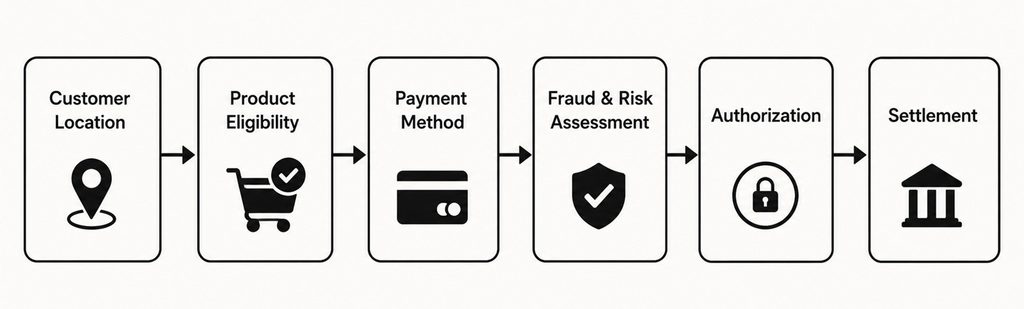
A sensible architecture could look like:
Customer Location → Product Eligibility → Payment Method → Fraud & Risk Assessment → Authorization → Settlement
This is particularly useful for companies expanding from the US into international markets.
The same payment method, transaction limit or customer-verification procedure may not be appropriate everywhere.
Payment Methods Can Influence Conversion
A gaming business should not evaluate payment processing purely from the merchant’s perspective.
Customers have preferences too.
Depending on the business model, the payment environment may include:
- Credit cards
- Debit cards
- Bank-based payments
- Digital wallets
- Alternative payment methods
- Account-based payment options
The right payment mix depends on the target audience.
For example, a game subscription company may prioritize recurring card payments, while a regulated iGaming operator may need a broader deposit and withdrawal ecosystem.
Payment choice can influence abandonment.
If customers reach checkout and discover that their preferred method is unavailable, the payment gateway has technically worked perfectly.
The customer still leaves.
That is not exactly the definition of a successful payment.
Where WebPays, PayCly, inquid, BoxChrge and Amald Fit Into Provider Research
Businesses researching payment infrastructure may come across WebPays, PayCly, inquid, BoxChrge and Amald.
These providers should be evaluated individually rather than placed into a generic “best gaming payment gateway” ranking without evidence.
For a US gaming merchant, the more useful questions are:
- Does the provider support the specific gaming category?
- Can it support the relevant US states?
- Does it support regulated iGaming where applicable?
- What underwriting documents are required?
- Which payment methods are available?
- What currencies can be settled?
- How are chargebacks handled?
- Are rolling reserves required?
- What fraud controls are available?
- Does the provider support international expansion?
The answers matter much more than a marketing badge on a homepage.
Building a Payment Strategy for a US Gaming Business
Before integrating a payment gateway, a merchant should map its payment ecosystem.
First: Define the product
Is it a game, subscription, esports platform, sportsbook, casino or another type of gaming service?
Second: Identify customers
Where are customers physically located?
Third: Determine legal eligibility
Which jurisdictions permit the specific activity?
Fourth: Select payment methods
Which methods are suitable for the audience and business model?
Fifth: Build risk controls
Set rules for suspicious transactions, account activity and unusual payment behaviour.
Sixth: Plan settlement
Understand currencies, timing, reserves and reconciliation.
Seventh: Prepare for disputes
Create a documented chargeback process before the first major dispute arrives.
This process may sound slower than simply installing a payment plugin.
It is also much less painful than discovering a regulatory or processing problem after launch.
A Practical Example
Consider a fictional online gaming company called NorthStar Games.
It sells digital games and subscriptions to customers in California, New York, Texas and Florida.
The company wants to add international customers later.
Its payment strategy might therefore separate:
Standard game purchases
from
Subscription payments
and, if it ever enters regulated gambling,
Gambling transactions
Each category can have different risk and compliance requirements.
Now imagine NorthStar Games later launches a gambling product.
The company should not simply activate a “casino” payment option inside the existing gateway.
It would need to reassess licensing, customer eligibility, payment flows, risk controls and regulatory obligations.
That is the kind of change that can turn a simple payment project into a compliance project very quickly.
What Merchants Should Look for in a Gaming Payment Gateway
A useful evaluation checklist includes:
| Area | What to Investigate |
| Business model | Is your exact gaming category supported? |
| Geography | Which US states and international markets are supported? |
| Payment methods | Are the methods your customers actually use available? |
| Risk | What fraud and transaction-monitoring tools exist? |
| Chargebacks | What evidence and dispute support are available? |
| Settlement | What currencies, timing and fees apply? |
| Reserves | Is a rolling reserve required? |
| Compliance | What documents and licences are required? |
| Reporting | Can finance teams reconcile transactions efficiently? |
| Scalability | Can the infrastructure support future expansion? |
The best payment decision is rarely the one with the shortest sales pitch.
It is the one that continues making sense after the merchant has processed its first million dollars.
The Future of Gaming Payment Processing in the US
Gaming payments are becoming increasingly connected to fraud technology, customer identity, account security and real-time risk analysis.
The checkout itself is becoming only one component of the payment ecosystem.
Future-focused gaming businesses will increasingly need to think about:
- Real-time fraud detection
- Account takeover prevention
- Smarter transaction routing
- Alternative payment methods
- Automated reconciliation
- Customer authentication
- Geographic controls
- Cross-border settlement
The interesting part is that customers may never notice most of this technology.
And that is probably a good thing.
A great payment experience feels simple to the customer while being extremely sophisticated behind the scenes.
Frequently Asked Questions
1. What is a gaming payment gateway in the United States?
A gaming payment gateway connects a gaming business with payment processing infrastructure, allowing eligible transactions to be securely submitted, authorized, recorded and settled. The exact requirements depend on the merchant’s business model and jurisdiction.
2. Is a gambling payment gateway the same as a normal gaming payment gateway?
No. A conventional video game business may primarily need ecommerce-style payment processing, while a gambling operator can face additional licensing, AML, customer-verification, responsible-gaming and transaction-monitoring requirements.
3. Why can gaming merchants be considered high risk?
Some gaming businesses have elevated exposure to fraud, chargebacks, digital-goods disputes, high transaction volumes or regulatory risk. However, not every gaming business automatically receives a high-risk classification.
4. Can one international payment gateway handle every US gaming transaction?
Not necessarily. Payment support depends on the business model, payment method, customer location, state requirements and processor underwriting. International capability does not eliminate state-level obligations.
5. What should a US gaming merchant check before selecting a payment gateway?
The merchant should verify business-category support, state coverage, payment methods, fraud controls, chargeback procedures, settlement terms, reserves, compliance requirements and the provider’s ability to support future expansion.
Final Thoughts
A gaming payment gateway in the United States is not simply a piece of checkout technology.
For ordinary gaming businesses, it can be the foundation for reliable digital commerce.
For regulated iGaming and gambling businesses, it can become part of a much larger ecosystem involving licensing, customer verification, fraud prevention, transaction monitoring and financial controls.
And in a market as fragmented as the United States, that preparation can be the difference between a payment system that merely works and one that can actually support a gaming business as it grows.