Choosing a payment provider involves more than comparing transaction fees. A business also needs to understand who manages merchant onboarding, how payments move through the processing system, who handles disputes, and what happens when the business expands into new markets.
Two common options are a Payment Service Provider (PSP) and a Payment Facilitator (PayFac). Both help businesses accept electronic payments, but they can operate under different business models and take on different responsibilities.
For U.S. businesses, the distinction matters when selecting payment infrastructure, launching a marketplace, or adding payment acceptance to a software platform.
A traditional online retailer may need a straightforward way to accept card payments. A SaaS company serving hundreds of merchants may need a payment solution that allows customers to accept payments directly through its platform. These businesses have different requirements, so they should not assume that the same payment model will suit both.
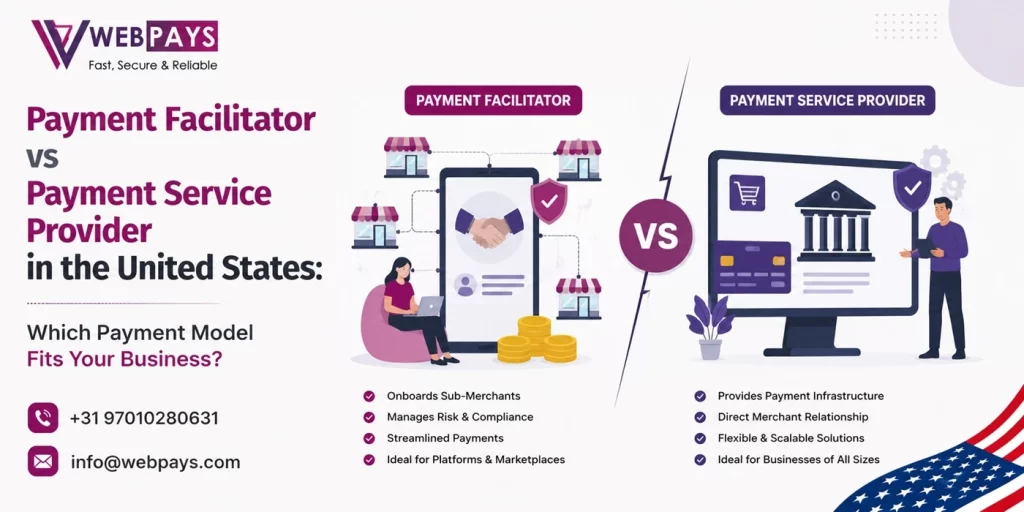
What Is a Payment Service Provider?
A Payment Service Provider (PSP) offers payment technology and services that allow businesses to accept electronic payments.
Depending on its business model, a PSP may provide access to card processing, payment gateways, alternative payment methods, transaction reporting, fraud screening, and other payment-related services.
A business can use a PSP to connect its checkout system with the payment infrastructure needed to process customer transactions.
Common PSP services include:
- Online card payment acceptance
- Payment gateway connectivity
- Alternative payment methods
- Transaction reporting and analytics
- Fraud screening and transaction monitoring
- Recurring billing support
- Payment integration APIs
- Currency conversion and settlement services
The exact services vary by provider. Some PSPs offer acquiring services directly, while others connect merchants with acquiring banks and processing partners.
PSP is a broad industry term rather than one specific legal or acquiring model. Businesses should review the provider’s actual services, contractual structure, and acquiring arrangements before signing an agreement.
For a conventional e-commerce business, a PSP may provide the payment infrastructure needed to accept customer payments without building a processing system internally.
What Is a Payment Facilitator?
A Payment Facilitator, commonly called a PayFac, enables other businesses to accept card payments through a structured relationship with an acquiring bank.
The businesses accepting payments through the PayFac are generally called sub-merchants.
Under this model, the PayFac operates within an acquiring arrangement that allows eligible sub-merchants to accept payments without each business necessarily establishing a separate traditional acquiring relationship.
This structure can be useful for platforms that regularly onboard businesses and want to include payment acceptance within their own products.
A PayFac may manage or coordinate responsibilities such as:
- Sub-merchant onboarding
- Merchant screening and underwriting
- Transaction monitoring
- Fraud controls
- Chargeback management
- Compliance oversight
- Merchant support
- Payment operations
- Settlement coordination
The allocation of these responsibilities depends on the PayFac’s agreements, acquiring relationship, and applicable requirements.
For example, a software platform serving independent fitness studios might want each studio to accept payments through the platform. A PayFac model may allow the platform to offer an integrated payment experience rather than requiring every studio to establish its own acquiring relationship from scratch.
However, faster onboarding does not mean that underwriting or compliance requirements disappear. Sub-merchants still need to meet the applicable requirements of the PayFac and its acquiring partners.
Payment Facilitator vs Payment Service Provider: Key Differences
The main difference between a PSP and a PayFac is the payment model they operate under and the responsibilities associated with that model.
A PSP generally provides payment services and infrastructure. A PayFac typically operates a structured acquiring arrangement that supports multiple sub-merchants.
The following table summarizes common differences.
| Comparison factor | Payment Facilitator | Payment Service Provider |
| Primary role | Enables sub-merchants to accept payments through a PayFac structure | Provides payment services and processing infrastructure |
| Merchant onboarding | Often manages or coordinates sub-merchant onboarding | Depends on the provider and acquiring arrangement |
| Acquiring relationship | Operates within a sponsored acquiring structure | May provide acquiring services or connect merchants with acquiring partners |
| Sub-merchant model | Central to the PayFac model | Not necessarily part of the service |
| Underwriting | Manages or coordinates sub-merchant screening | Responsibilities vary by provider |
| Fraud management | Often includes controls for its sub-merchant network | Depends on the services offered |
| Chargeback support | May provide centralized dispute management | Depends on the provider and merchant agreement |
| Platform integration | Often suited to embedded payments and marketplaces | May support platforms, retailers, and other business types |
| Merchant control | Can centralize payment operations within a platform | Depends on the provider’s payment model |
| Best suited for | Platforms that need to onboard and manage multiple merchants | Businesses seeking payment acceptance and processing services |
These are general characteristics, not universal rules. A PSP may offer many of the same services as a PayFac, and a PayFac may rely on third-party providers for certain functions.
The most useful question is not simply which model offers more services. It is which arrangement fits the business payment requirements, responsibilities, and growth plans.
How Does a Payment Facilitator Work?
Consider a U.S. software company that provides booking and billing tools to 500 independent businesses.
Each business needs to accept payments from its own customers. If every business had to establish a separate acquiring relationship, the software company could face a complicated onboarding process and a fragmented payment experience.
A PayFac model can help organize this process.
The platform establishes the appropriate acquiring arrangement and enables eligible businesses to accept payments as sub-merchants.
A simplified payment flow may look like this:
Customer → Sub-merchant → PayFac → Acquirer → Card network → Issuing bank
This diagram represents the broad acquiring relationship. The actual transaction flow may also involve a payment gateway, processor, or other service providers.
The PayFac may provide a centralized system for onboarding, monitoring, and managing sub-merchants.
Faster merchant onboarding
A platform can incorporate payment onboarding into its existing registration process.
This can reduce the administrative work required to establish payment acceptance for eligible businesses.
The PayFac still needs to complete the appropriate screening and underwriting procedures. The onboarding process depends on the merchant’s business model, risk profile, and applicable requirements.
Centralized payment operations
A PayFac can give a platform a more consistent way to manage payment-related activities across its sub-merchants.
Depending on the arrangement, these activities may include transaction monitoring, dispute handling, merchant support, and settlement coordination.
Payments built into the product
A marketplace or SaaS platform can make payments part of its own customer experience.
For example, a booking platform could allow businesses to accept payments directly through its software rather than sending users to a separate payment provider.
This can make the payment process easier to manage from the platform’s perspective.
How Does a Payment Service Provider Work?
A PSP gives a business access to the services and infrastructure needed to accept electronic payments.
A simplified transaction flow may look like this:
Customer → Merchant → Payment gateway or PSP → Processor or acquirer → Card network → Issuing bank
The exact arrangement depends on the PSP’s services and the merchant’s acquiring relationship.
For the business, the main benefit is access to payment capabilities without having to build the entire payment system internally.
A PSP may help a business:
- Accept online card payments
- Connect with acquiring partners
- Support different payment methods
- Manage recurring transactions
- Integrate payment services into its website or application
- Review transaction reports
- Apply fraud screening and security controls
A business can select the services it needs based on its payment volume, customer base, and technical requirements.
For a retailer that primarily needs to accept payments through an online checkout, a PSP may offer a suitable arrangement without requiring the business to operate a sub-merchant network.
Payment Facilitator vs PSP: Which Offers Faster Onboarding?
A PayFac can have an onboarding advantage when a platform needs to bring multiple sub-merchants into its payment system.
Instead of requiring every business to establish an independent traditional acquiring relationship, the platform can use its PayFac structure to onboard eligible sub-merchants.
This can reduce administrative work and help businesses begin accepting payments sooner.
However, there is no universal onboarding timeline for either model.
The time required depends on factors such as:
- The merchant’s industry
- The complexity of the business model
- Required underwriting documents
- The acquiring partner’s requirements
- The merchant’s transaction history
- Technical integration requirements
A PSP may also offer a streamlined onboarding process. Businesses should compare actual onboarding requirements and timelines rather than assuming that one model will always be faster.
PayFac vs PSP: What About Payment Processing Costs?
Neither model is automatically cheaper.
Payment processing costs depend on the provider, transaction volume, payment methods, business risk, geographic coverage, and commercial agreement.
A business should evaluate the full cost of accepting payments rather than comparing transaction rates alone.
Common payment-related expenses include:
| Cost | What to review |
| Processing fees | Percentage and fixed fees charged per transaction |
| Gateway fees | Charges for payment gateway access or usage |
| Monthly fees | Recurring platform or account charges |
| Chargeback fees | Fees associated with disputed transactions |
| Currency conversion | Costs when processing or settling in different currencies |
| Settlement fees | Charges associated with payouts or fund transfers |
| Integration expenses | Development and implementation costs |
| Fraud losses | Financial losses from fraudulent transactions |
| Operational costs | Staff time spent managing payments and disputes |
A provider with a lower advertised rate may not have the lowest total cost if its services require additional software, support, or operational work.
Likewise, a managed payment arrangement may have higher fees but reduce the amount of payment administration a platform needs to handle internally.
Before choosing a provider, request a complete fee schedule and clarify how the agreement handles reserves, settlement timing, refunds, chargebacks, and potential account holds.
Which Model Is Better for High-Risk Businesses?
Businesses operating in higher-risk industries often face additional underwriting, monitoring, and acquiring requirements.
Examples may include online gaming, adult businesses, forex, cryptocurrency-related services, nutraceuticals, digital subscriptions, and certain financial services.
For these merchants, choosing a payment provider requires more than finding a company that supports online card payments.
The business needs to understand whether the provider can support its particular industry, transaction profile, and operating markets.
When a PSP may be appropriate
A PSP may be suitable when a business needs payment acceptance, processing connectivity, and payment technology without operating a sub-merchant network.
This may apply to an online retailer, subscription business, or digital service provider that accepts payments directly from its customers.
When a PayFac may be appropriate
A PayFac may be suitable when a platform serves multiple businesses and wants to incorporate payment acceptance into its product.
For example, a software company serving merchants in a higher-risk industry may need a payment arrangement that supports sub-merchant onboarding and centralized payment management.
However, not every PayFac supports every industry. A platform must confirm that its business model and sub-merchants are eligible under the provider’s acquiring arrangements.
What high-risk merchants should verify
Before selecting a PSP or PayFac, businesses should ask:
- Does the provider support my specific industry?
- Which acquiring partners support the payment arrangement?
- What underwriting documents are required?
- How are fraud screening and chargebacks handled?
- What settlement currencies and schedules are available?
- Are reserves or rolling reserves required?
- Which countries and payment methods are supported?
No legitimate payment provider can guarantee approval without an appropriate assessment of the business.
WebPays provides payment processing solutions for businesses evaluating payment acceptance and operational requirements across different industries. Merchants should review the available services, underwriting requirements, and contractual terms to determine whether a particular arrangement suits their business.
When Should a U.S. Business Choose a PSP?
A PSP may be a good fit when a business:
- Sells products or services directly to customers.
- Needs online payment acceptance and processing connectivity.
- Wants payment technology without building its own processing infrastructure.
- Does not need to onboard multiple sub-merchants.
- Has the resources to manage its own merchant operations and contractual responsibilities.
For many e-commerce stores, subscription businesses, and service providers, a PSP can provide the payment services needed to operate an online checkout.
The right choice still depends on the provider’s services and the business’s acquiring arrangement.
When Should a Business Consider a Payment Facilitator?
A PayFac may be worth considering when a business:
- Operates a marketplace or software platform.
- Serves multiple businesses that need to accept payments.
- Wants to integrate payment acceptance into its product.
- Onboards merchants regularly.
- Needs centralized sub-merchant management.
- Wants to manage payment operations within its platform.
The model can be particularly useful when payment acceptance is part of the product being sold rather than a separate checkout function.
A platform should also consider the responsibilities involved in operating a PayFac structure, including underwriting, monitoring, compliance, and ongoing merchant management.
Can a Business Use Both a PSP and a PayFac?
Yes. The two models are not always mutually exclusive.
A business may use different payment providers, acquiring relationships, or payment technologies for different markets and business requirements.
For example, a marketplace may use a PayFac structure for its sub-merchants while using additional payment providers to support international transactions or alternative payment methods.
A larger business may also use payment orchestration technology to manage connections with multiple processors.
This approach can provide additional flexibility, but it also creates more integration and operational work.
Businesses should consider the cost, technical requirements, and risk implications before adding multiple payment providers.
Conclusion: Choosing Between a PSP and a PayFac
The difference between a Payment Facilitator and a Payment Service Provider comes down to the payment model, acquiring arrangement, and responsibilities involved.
A PSP may suit a business that needs payment technology and processing services to accept customer payments.
A PayFac may suit a platform that wants to embed payments into its product and manage multiple sub-merchants through a structured acquiring arrangement.
For U.S. businesses, the decision should account for transaction volume, industry, onboarding requirements, payment methods, settlement needs, and operational responsibilities.
The right payment partner is one whose services and contractual arrangements match the business’s actual requirements.
WebPays helps businesses evaluate payment processing options based on their industry, transaction profile, and payment needs. Businesses considering a new payment arrangement can review the available services and discuss their requirements before making a decision.
Final Takeaway
A PSP and a PayFac can both support payment acceptance, but they serve different business needs.
For a company accepting payments directly from customers, a PSP may provide the infrastructure it needs.
For a marketplace or software platform managing multiple merchants, a PayFac model may offer a more suitable structure.
The best choice depends on the business’s payment requirements, risk profile, and growth plans. A careful review of the acquiring relationship, fees, settlement terms, and operational responsibilities can help businesses select a payment arrangement that fits their needs.
Frequently Asked Questions
1. Who is the acquiring partner?
Understand which entity supports the acquiring relationship and how the payment arrangement is structured.
2. How does underwriting work?
Ask what documents are required, how the business is assessed, and what happens if its products, services, or transaction profile change.
3. How are chargebacks handled?
Find out who manages disputes, what evidence is required, and which party is responsible for chargeback-related costs.
4. What fraud tools are available?
Review the provider’s fraud screening, authentication, transaction monitoring, and risk management capabilities.
5. How are settlements handled?
Confirm settlement timing, currencies, payout procedures, reserve requirements, and the circumstances under which funds may be held.
6. Can the solution support business growth?
Consider whether the payment arrangement can support higher transaction volumes, additional markets, and new payment methods.
7. What support is included?
Ask which technical and merchant support channels are available, what response times apply, and how urgent payment issues are handled.
These questions can help businesses understand the commercial and operational implications of a payment arrangement before committing to a provider.
8. What is the difference between a Payment Facilitator and a Payment Service Provider?
A Payment Service Provider generally offers payment technology and services that allow businesses to accept electronic payments. A Payment Facilitator operates a structured acquiring arrangement that enables eligible sub-merchants to accept payments.
A PayFac commonly has additional responsibilities involving sub-merchant onboarding, underwriting, monitoring, and merchant management. The exact responsibilities depend on the provider’s agreements and operating model.
9. Is a Payment Facilitator the same as a Merchant of Record?
No. A Payment Facilitator and a Merchant of Record describe different aspects of a payment arrangement.
A PayFac operates a payment facilitation model involving an acquiring relationship and sub-merchants. A Merchant of Record generally refers to the entity that acts as the seller in a transaction and assumes specified contractual and legal responsibilities.
A business should review its actual contractual arrangements rather than assuming that every PayFac is also its Merchant of Record.
10. Is a PSP or PayFac better for a U.S. business?
Neither is automatically better.
A PSP may suit a business that needs payment acceptance and processing services. A PayFac may suit a platform that needs to onboard and manage multiple sub-merchants through an integrated payment arrangement.
The appropriate model depends on the business structure, transaction volume, risk profile, and operational requirements.
11. Can high-risk businesses use a PSP or PayFac?
Yes, some PSPs and PayFacs support businesses in higher-risk industries.
However, availability depends on the provider’s underwriting policies, acquiring relationships, business model, transaction history, and risk profile.
Businesses should disclose their activities accurately and confirm that the provider supports their specific industry before entering into an agreement.
12. What is the difference between a PSP and a payment gateway?
A payment gateway is technology that securely transmits payment information between a merchant’s checkout and the payment-processing infrastructure.
A PSP may provide a payment gateway as part of a broader set of payment services.
A PayFac, on the other hand, operates a payment facilitation model that enables eligible sub-merchants to accept payments through a structured acquiring relationship.
13. Why should a business consider WebPays for payment processing?
WebPays provides payment processing solutions for businesses evaluating online payment acceptance and payment infrastructure.
Businesses considering WebPays should review its supported industries, payment methods, integration capabilities, underwriting requirements, settlement arrangements, and pricing to determine whether its services fit their requirements.