
Selling to customers in different countries can create payment challenges. Customers may use different currencies, banks, cards, and local payment methods, while merchants have to manage conversion, settlement, fraud, and payment security.
Crypto wallets offer another way to handle international payments. Instead of relying entirely on card networks or traditional bank transfers, a merchant can add a crypto payment option to its checkout and allow eligible customers to pay from a supported wallet.
The basic process is straightforward:
Customer selects crypto payment → connects or uses a wallet → chooses the supported cryptocurrency → approves the transaction → blockchain confirms the payment → merchant receives crypto or converted fiat.
The exact experience depends on the payment provider, supported blockchain networks, currencies, compliance requirements, and settlement options.
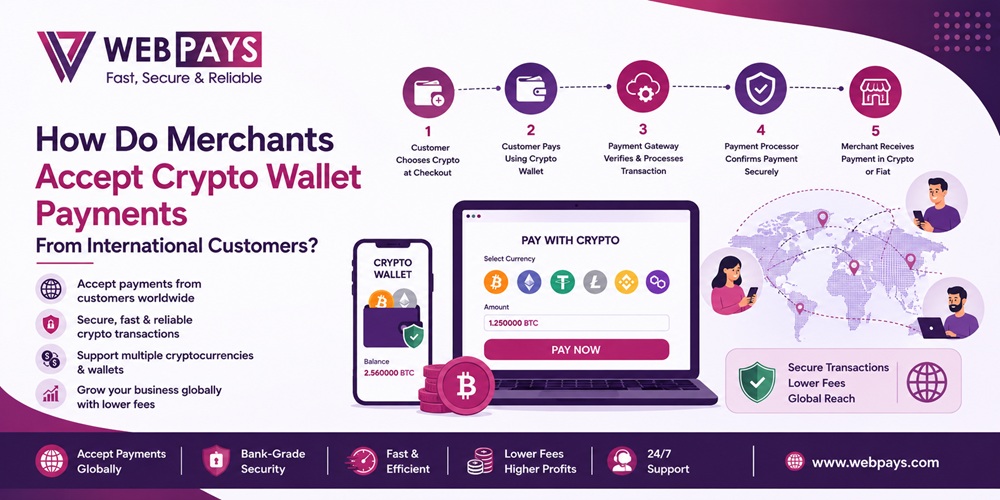
What Is a Crypto Wallet Payment?
A crypto wallet payment is a digital payment made using cryptocurrency stored in a blockchain wallet.
A wallet does not work exactly like a traditional bank account. It holds or provides access to blockchain-based assets and allows users to authorize transactions. Depending on the wallet and payment setup, a customer might pay by:
- Connecting a wallet to the checkout
- Scanning a QR code
- Approving a payment request
- Sending cryptocurrency to a payment address
- Using an exchange account connected to the payment service
For merchants, the important part is that a payment gateway or crypto processor can handle the technical connection between the checkout, wallet, blockchain network, transaction confirmation, and settlement.
Modern payment infrastructure can also support stablecoins such as USDC, USDT, and other digital assets. Stablecoins can be particularly useful for international commerce because their value is generally designed to remain tied to a reference currency such as the U.S. dollar.
How Does a Merchant Accept Crypto Wallet Payments?
There are several steps involved.
1. Choose a Crypto-Friendly Payment Provider
The first step is selecting a payment gateway or processor that supports cryptocurrency payments.
The provider should match the merchant business model, target countries, transaction volume, preferred cryptocurrencies, settlement currency, and compliance requirements.
Providers such as PAYCLY promote cryptocurrency alongside cards, digital wallets and other alternative payment methods. PAYCLY says its platform supports cryptocurrency and more than 100 payment methods, as well as multi-currency processing.
For businesses operating in digital assets, Inquid offers crypto payment and wallet infrastructure designed around multi-chain processing, stablecoins, fiat conversion and business-level wallet operations.
Other payment infrastructure providers, including Webpays, Boxchrge and Amald, can also be evaluated based on the merchant required payment methods, international coverage and business profile. Boxchrge, for example, describes support for cards, wallets, APMs and crypto, including USDT on TRC-20 and ERC-20 networks. Amald describes its payment infrastructure as supporting international payments and multiple alternative payment methods.
2. Integrate the Crypto Payment Option Into Checkout
Once the merchant account is approved, the crypto payment option can be added to the website or application.
Depending on the provider, integration may use:
- Hosted checkout
- Payment buttons
- Payment links
- APIs
- SDKs
- Plugins
- Invoicing systems
- QR-based payment flows
A well-designed checkout should make it clear which cryptocurrencies and networks are supported.
For example, a customer should not simply see “Pay with Crypto.” The checkout can show options such as:
Pay with BTC | Pay with ETH | Pay with USDT | Pay with USDC
The available choices depend on the payment provider and merchant configuration.
3. The International Customer Chooses Crypto at Checkout
Suppose a customer in Germany purchases a product from a merchant based in another country.
At checkout, the customer sees cryptocurrency as one of the available payment methods.
They select it and are presented with the supported cryptocurrency and network options.
The payment system may then display:
- Purchase amount
- Cryptocurrency amount
- Exchange rate, where applicable
- Network
- Estimated network fee
- Payment address or QR code
- Payment expiry time
This gives the customer enough information to verify the transaction before approving it.
4. The Customer Pays From a Crypto Wallet
The customer then authorizes the payment from their wallet.
Depending on the checkout design, this can involve connecting a wallet or scanning a QR code.
The customer checks the transaction details and approves the payment.
The wallet broadcasts the transaction to the relevant blockchain network.
Once the network confirms the transaction according to the payment provider requirements, the merchant receives a payment confirmation.
Stablecoin payment systems can provide a similar experience. Stripe current stablecoin documentation, for example, describes a flow where customers connect their crypto wallet, select the currency and network, and complete the payment before the merchant receives confirmation.
5. The Payment Processor Confirms the Transaction
This is where the payment gateway becomes important.
The processor can monitor the blockchain transaction and determine whether the payment meets the required conditions.
It may check:
- Transaction amount
- Blockchain network
- Wallet address
- Transaction status
- Required confirmations
- Compliance and risk signals
- Payment expiration
- Currency and token
The merchant website can then receive a payment confirmation through a webhook or API response.
This allows the order status to change automatically from:
Pending Payment → Payment Confirmed → Order Processing
Without this automation, merchants would have to manually monitor blockchain transactions.
6. The Merchant Chooses Crypto or Fiat Settlement
One of the biggest decisions is what happens after the customer pays.
A merchant may have several options depending on the provider:
Hold cryptocurrency
The merchant keeps the received crypto and manages it through a business wallet.
Convert crypto to fiat
The processor converts the cryptocurrency into a supported fiat currency such as USD, EUR or GBP.
Use a hybrid settlement strategy
A merchant can potentially retain part of the crypto and convert the rest, depending on the provider capabilities.
This can help businesses separate payment acceptance from cryptocurrency price exposure.
For example, Paypal current Pay with Crypto system converts eligible crypto payments into USD for the merchant, meaning the merchant does not need to hold the customer cryptocurrency directly.
Why Are Crypto Wallet Payments Useful for International Customers?
Crypto wallet payments can solve several problems associated with cross-border commerce.
1. Access to Global Customers
A merchant can offer an additional payment method to customers who prefer cryptocurrency over cards or bank transfers.
This can be especially relevant for digital businesses, Web3 companies, software businesses and merchants with an international customer base.
2. Fewer Traditional Banking Restrictions
International bank transfers can involve intermediary banks, banking hours, currency conversions and additional processing requirements.
Blockchain transactions operate through decentralized networks instead of traditional card or correspondent banking rails.
That does not remove regulatory requirements, but it can provide another route for moving value internationally.
3. Faster Settlement
Blockchain confirmation can occur much faster than some traditional international payment methods.
The actual timing depends on the network, congestion, asset and payment processor.
4. Reduced Chargeback Exposure
Blockchain transactions are generally irreversible once confirmed.
That is different from card payments, where customers can initiate disputes and chargebacks.
PayPal explicitly states that its Pay with Crypto payments are irrevocable and are not subject to traditional chargebacks or disputes.
However, merchants should not interpret this as “no payment risk.” Fraud, compromised wallets, sanctions exposure, stolen assets and incorrect transfers remain important considerations.
5. Stablecoins Can Reduce Volatility
Accepting Bitcoin or other volatile assets exposes merchants to price movements.
Stablecoins can provide an alternative because their value is designed to track a reference asset.
For businesses primarily interested in international settlement rather than cryptocurrency speculation, stablecoin payments can therefore be attractive.
Crypto Wallet Payments vs Traditional International Payments
| Feature | Crypto Wallet Payment | Card Payment | International Bank Transfer |
| Customer payment source | Crypto wallet | Card | Bank account |
| Cross-border availability | Depends on network/provider | Depends on card acceptance | Depends on banking rails |
| Currency conversion | Crypto/fiat conversion may apply | Usually automatic | Often required |
| Chargebacks | Blockchain payments generally irreversible | Possible | Depends on payment method |
| Settlement speed | Often fast, network dependent | Usually fast authorization | Can take longer |
| Wallet required | Yes | No | No |
| Volatility risk | Possible with volatile assets | Low for merchant | Low |
| Stablecoin option | Often available through specialist providers | Not normally native | No |
| Compliance requirements | Still required | Required | Required |
The right option is not necessarily to replace cards or bank transfers. Many international merchants use multiple payment methods so customers can choose the method they already trust.
What Should Merchants Look for in a Crypto Payment Gateway?
Choosing a provider only because it supports Bitcoin is not enough.
A serious international payment setup should be evaluated across several areas.
Multi-Currency Support
Customers should have access to relevant cryptocurrencies and stablecoins.
Support for BTC alone may not be enough for an international customer base.
Multi-Chain Support
USDT, for example, can exist on multiple blockchain networks.
A merchant needs to understand which networks the provider supports and make the network choice obvious at checkout.
Automatic Conversion
Automatic crypto-to-fiat conversion can protect merchants that do not want to carry cryptocurrency price risk.
Wallet Compatibility
The provider should support the wallets and payment methods commonly used by the merchant target customers.
Compliance and Risk Management
KYC, AML, sanctions screening and transaction monitoring remain important.
A crypto payment is not automatically outside financial regulation simply because it occurs on a blockchain.
API and Webhook Support
For eCommerce stores, SaaS businesses and marketplaces, automated payment notifications are important.
The system should be able to tell the website when a payment has been initiated, confirmed, failed or refunded.
Transparent Settlement
Before signing up, merchants should understand:
- Processing fees
- Conversion fees
- Network fees
- Settlement fees
- Minimum withdrawal amounts
- Settlement currencies
- Settlement schedules
- Refund procedures
How PayPal Handles International Crypto Payments
PayPal has introduced a specific Pay with Crypto option for eligible merchants.
According to Paypal current documentation, eligible U.S. merchants can accept cryptocurrency from global buyers using supported third-party and self-hosted wallets. The customer approves the transaction, while PayPal manages the crypto payment flow and converts the cryptocurrency into the merchant local settlement currency.
Paypal current developer documentation says the service supports around 100 cryptocurrencies, including Bitcoin, Ethereum and PYUSD, with customers able to pay using wallets such as MetaMask or supported exchange accounts.
There are important eligibility limitations. The current PayPal documentation says Pay with Crypto is available only to U.S. merchants, while global buyers can use the service if eligible.
This is an important reminder for merchants: always check the provider current geographic, industry and compliance requirements before choosing a crypto payment solution.
High Risk Crypto Wallet Payment Infrastructure Providers
Different merchants have different requirements, so providers should be compared according to their actual capabilities rather than simply being placed into a universal “best” ranking.
PAYCLY
Paycly positions itself as an international payment provider offering cards, digital wallets, cryptocurrency, alternative payment methods and multi-currency processing. Its published features include cryptocurrency acceptance and more than 100 payment methods.
WebPays
Webpays can be considered by merchants looking for international payment infrastructure and alternative payment options. Merchants should review its current supported cryptocurrencies, jurisdictions, settlement methods and onboarding requirements directly before integration.
Inquid
Inquid focuses heavily on crypto-related payment infrastructure, including wallet infrastructure, stablecoin settlement, multi-chain processing and fiat on/off-ramp capabilities. Its published crypto infrastructure covers networks including Bitcoin, Ethereum, Tron, BNB Chain, Solana, Polygon and Arbitrum.
Boxchrge
Boxchrge provides global payment infrastructure covering cards, wallets, APMs, bank rails and crypto. Its website specifically lists USDT on TRC-20 and ERC-20 for crypto pay-ins and payouts.
Amald
Amald describes its services around online acquiring and alternative payment methods. Its published information includes international payments and multiple payment wallets, making it another provider merchants can investigate when building a broader international payment strategy.
The important point is that merchants should compare providers based on their own business model, countries, transaction volume, cryptocurrency requirements, settlement preferences and compliance obligations.
Security Considerations for Crypto Wallet Payments
Crypto payments remove some traditional payment problems, but they introduce their own risks.
Use the Correct Network
Sending USDT to an incompatible network can result in funds becoming inaccessible.
The checkout should clearly identify the required network.
Verify Wallet Addresses
Businesses should use secure payment infrastructure rather than copying wallet addresses manually between systems.
Monitor Blockchain Transactions
Transaction monitoring helps identify unusual payment activity and potential compliance issues.
Protect Private Keys
If a merchant holds crypto directly, private-key security becomes critical.
Business wallets should use appropriate access controls, authorization procedures and institutional-grade custody where required.
Keep Records
Merchants should retain transaction records for accounting, tax and compliance purposes.
Have a Refund Policy
Crypto transactions generally cannot simply be reversed like a card authorization.
A refund may require sending a new blockchain transaction to the customer wallet.
What Happens When a Customer Wants a Refund?
A cryptocurrency payment and a refund are two different blockchain transactions.
For example:
Customer → Merchant: 100 USDC
If the merchant approves a refund:
Merchant → Customer: 100 USDC
The exact refund amount and currency can depend on the provider and its terms.
Paypal current pay with crypto documentation says refunds are issued in PYUSD or another supported stablecoin where applicable.
Merchants should therefore establish a clear refund policy before accepting crypto payments.
A Practical Example
Imagine an online software company based in Europe selling subscriptions worldwide.
A customer in Canada reaches checkout.
The customer sees:
- Credit card
- Bank transfer
- Digital wallet
- Crypto
The customer selects crypto.
The checkout displays:
Amount: $250
Payment option: USDC
Network: Supported blockchain
Wallet: Connect or scan QR
The customer approves the payment.
The blockchain processes the transaction.
The payment provider verifies the transaction.
The merchant receives a webhook confirming payment.
The provider then either:
Option A: keeps the USDC in the merchant crypto balance
or
Option B: converts the USDC into the merchant selected fiat currency.
The order is automatically marked as paid.
This is the basic model behind modern crypto wallet payment acceptance.
Best Practices for Merchants Accepting International Crypto Payments
Before launching crypto payments, merchants should:
- Choose supported cryptocurrencies carefully.
- Prefer stablecoins when reducing volatility is a priority.
- Confirm the blockchain network before accepting a payment.
- Use automated payment confirmation instead of manually checking wallets.
- Understand conversion and settlement fees.
- Review KYC, AML and sanctions requirements.
- Create a clear refund policy.
- Secure business wallets and private keys.
- Keep accounting and transaction records.
- Maintain cards, bank transfers and local APMs alongside crypto where appropriate.
The strongest international checkout is usually not the one with the most payment logos. It is the one that gives customers the payment methods they actually use while giving the merchant reliable authorization, risk controls, settlement and reconciliation.
Final Thoughts
Crypto wallets have become a practical payment option for merchants serving international customers. The technology allows customers to pay directly from compatible wallets while payment providers can handle blockchain connectivity, transaction monitoring, conversion and settlement.
For merchants, the real decision is not simply whether to accept Bitcoin or another cryptocurrency. It is how to build a payment flow that combines wallet compatibility, stablecoins, multi-chain support, compliance, security, automated confirmation and predictable settlement.
Providers such as PAYCLY, WebPays, inquid, BoxChrge, Amald and PayPal offer different approaches to digital and international payment acceptance. The best fit depends on the merchant location, industry, target markets, transaction volume and settlement requirements.
As international commerce continues to evolve, crypto wallet payments can work alongside cards, bank transfers and alternative payment methods rather than replacing them entirely.
Frequently Asked Questions
1. Can merchants accept crypto payments from customers in other countries?
Yes. Merchants can accept international crypto payments when their payment provider supports the customer country, cryptocurrency, wallet and blockchain network. Availability varies by provider and jurisdiction.
2. Do merchants need their own crypto wallet to accept cryptocurrency?
Not always. Some payment processors allow merchants to accept crypto and automatically convert it into fiat. Others provide business wallets where merchants can hold digital assets. The settlement model depends on the provider.
3. What cryptocurrencies can merchants accept?
It depends on the payment gateway. Common options include Bitcoin, Ethereum, USDT, USDC and other supported digital assets. Some providers also support multiple blockchain networks.
4. Are crypto wallet payments reversible?
Blockchain transactions are generally irreversible once confirmed. If a merchant wants to refund a customer, a separate transaction normally has to be sent back to the customer wallet. PayPal also states that its Pay with Crypto transactions are not subject to traditional chargebacks.
5. Is accepting crypto payments safe for international businesses?
It can be, provided the merchant uses appropriate security, wallet controls, transaction monitoring and compliance procedures. Merchants should also verify wallet addresses, supported networks, settlement terms and the provider regulatory requirements before going live.