
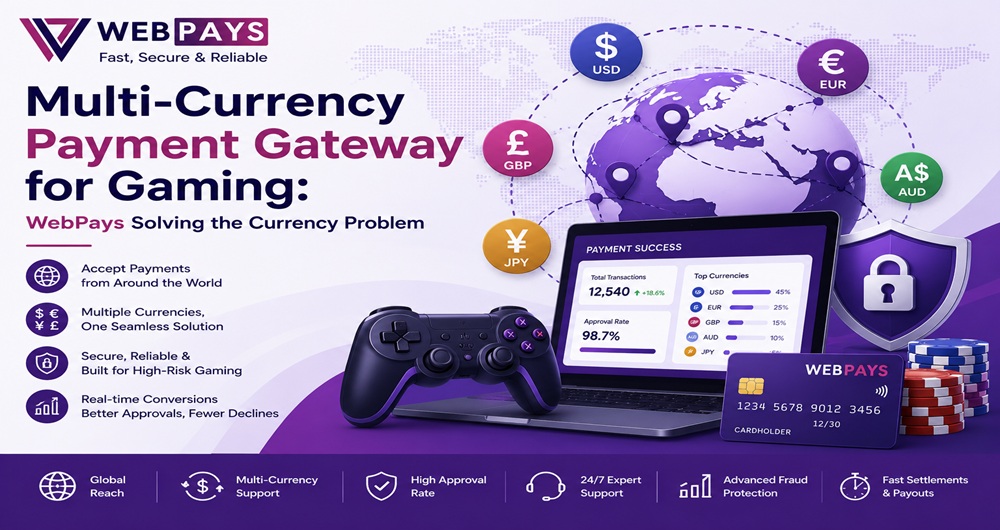
A multi-currency payment gateway lets a gaming platform accept and settle their deposits in a player’s home currency instead of forcing every transaction through a single currency, which reduces foreign exchange losses, lowers decline rates, and cuts down on currency-related disputes. For gaming operators serving Singapore and the wider Southeast Asian market, this typically needs to be paired with forex-specific merchant infrastructure where currency conversion is part of the core business model.
Most Online gaming operators discover the currency problem the hard way — either through complaints about unfavourable exchange rates, or through a finance team that can’t reconcile settlement figures because everything is being converted at inconsistent rates across different transactions.
Why Single-Currency Processing Quietly Costs You Players
If your gaming platform only settles in one currency — say, US dollars — every international player pays a conversion fee somewhere in the transaction chain, whether it’s charged by their card issuer, absorbed into a worse exchange rate, or passed along as an explicit surcharge. Players notice this, and in a competitive gaming market, an unfavourable foreign exchange experience at deposit is a quiet but real driver of abandoned transactions.
It also creates a second, less visible problem: currency mismatch tends to correlate with higher dispute rates, because players are more likely to contest a transaction when the amount charged doesn’t match their expectation due to conversion timing or rate differences.
What a Genuine Multi-Currency Payment Gateway Provides
Not every gateway that advertises “multi-currency” actually settles in multiple currencies — some simply accept the payment in a foreign currency and convert it immediately to a single settlement currency, which still leaves the foreign exchange cost problem intact just moved earlier in the process. A gateway built properly for multi-currency gaming should offer:
- Local currency acceptance at the point of deposit, so players see prices and charges in their own currency.
- Multi-currency settlement, allowing the operator to hold and reconcile balances across several currencies rather than forcing immediate conversion.
- Transparent FX rates, disclosed rather than buried in a spread that only shows up in the settlement report.
- Consistent rate application, so reconciliation between deposits, payouts, and platform ledgers doesn’t require manual adjustment for rate drift.
Where Forex Infrastructure Comes In
For gaming operators whose model includes elements closer to currency trading — spread-based products, forex-linked gaming mechanics, or simply very high currency exposure due to a broad international player base — a standard multi-currency gateway alone may not be sufficient. This is where dedicated forex merchant infrastructure becomes relevant: a Forex Merchant Account provides underwriting specifically calibrated to currency-exposure risk, while a Forex Payment Gateway adds the transaction routing and settlement mechanics built for that exposure.
The distinction matters because forex and gaming, while both classified as high-risk, carry different regulatory and fraud profiles. A provider treating them identically is likely missing risk controls relevant to one or the other.
Singapore as a Multi-Currency Hub
Singapore position as a regional financial hub makes it a natural settlement point for gaming operators serving Southeast Asia, but that role comes with regulatory weight. Any payment institution handling multi-currency settlement connected to Singapore operates under the Monetary Authority of Singapore Payment Services Act, which governs licensing for payment institutions handling cross-border and multi-currency flows.
For gaming operators specifically, this means your multi-currency gateway provider needs licensing that covers cross-border settlement, not just domestic Singapore dollar processing. It’s worth confirming this directly rather than assuming a providers general payment license extends to multi-currency, cross-border gaming settlement.
Practical Signs a Multi-Currency Setup Is Working
A well-implemented multi-currency payment gateway for gaming should show up in a few measurable ways:
- Decline rates on international transactions dropping compared to single-currency processing.
- Fewer disputes related to unexpected charge amounts or unfavourable conversion.
- Cleaner reconciliation reports, where settled amounts in each currency match expected figures without manual adjustment.
- Players from key regional markets depositing through locally preferred methods rather than defaulting to card-only options.
If none of these improve after implementing a “multi-currency” gateway, it’s worth checking whether the provider is actually settling in multiple currencies or simply converting everything at the point of entry.
Questions Worth Asking a Provider
- Do you settle in multiple currencies, or convert everything to one settlement currency internally?
- What FX rate source do you use, and how often is it updated?
- Can you provide reconciliation reports broken down by currency?
- Does your licensing explicitly cover cross-border, multi-currency settlement connected to Singapore?
- Is forex-specific merchant infrastructure available if our model needs it?
Choosing Which Currencies to Prioritise First
Not every gaming operator needs full global currency coverage on day one, and trying to support every currency at once often slows down implementation without adding proportional value. A more practical approach is to prioritise currencies based on where your actual or targeted player volume sits — for operators focused on Southeast Asia, that typically means Singapore dollars, Malaysian ringgit, and a small set of other regional currencies alongside US dollars as a common settlement baseline. Expanding currency coverage in phases, tied to actual regional growth rather than speculative expansion, keeps reconciliation manageable and lets the finance team validate that foreign exchange handling is working correctly before adding complexity. Providers that insist on an all-or-nothing currency rollout are often less flexible operationally than they appear during the sales process.
How Webpays Approaches Multi-Currency Gaming Payments
Webpays Multi-Currency Payment Gateway is built to settle across currencies rather than simply accepting them and converting immediately, giving gaming operators cleaner reconciliation and better foreign exchange
outcomes for international players. Where currency exposure is a core part of the business model, dedicated Forex Merchant Account and Forex Payment Gateway services provide underwriting and routing calibrated specifically for that risk. These sit alongside the broader Secure Payment Gateway and High Risk Merchant Account infrastructure that gaming operators need for fraud control and compliant settlement, with Global Payment Solutions supporting expansion across additional currencies and markets as the platform grows.
Frequently Asked Questions
What is the difference between a multi-currency gateway and simply accepting foreign cards?
Accepting a foreign card usually still converts the transaction to a single settlement currency immediately, leaving FX costs in place. A true multi-currency gateway allows settlement in multiple currencies, reducing conversion costs and improving reconciliation.
Do I need a separate forex merchant account if I already have a gaming merchant account?
Only if your model involves significant currency-exposure elements beyond standard multi-currency acceptance — for example, forex-linked products or very high-volume cross-currency settlement. A standard multi-currency gateway is sufficient for most gaming operators.
How does multi-currency processing affect player experience?
Players generally see clearer pricing in their own currency and fewer unexpected charges, which tends to reduce both cart abandonment at deposit and disputes related to unfavourable conversion.
Does Singapore regulatory framework affect multi-currency settlement specifically?
Yes — any payment institution handling cross-border, multi-currency settlement connected to Singapore needs licensing under the Monetary Authority of Singapore’s Payment Services Act that explicitly covers that scope, not just domestic processing.
Should a gaming operator support every currency at launch?
Not necessarily. Prioritising currencies based on actual or targeted player volume, then expanding in phases, is generally easier to reconcile and validate than an all-at-once rollout.